Meaning at a glance
Tower jewelry meaning is best understood as a motif that has appeared in European decorative and revivalist jewelry to evoke architecture, fortification, or family identity; the documented record shows changing social contexts rather than a single universal symbolism, and modern wearers layer personal meanings on top of those historical associations.
What the historical evidence shows
The museum record and scholarly summaries point to the tower as an architectural motif that appears at different times in European jewelry rather than a single, unchanging symbol. The Victoria and Albert Museum frames jewellery as an object type whose style and motifs shift with social tastes and architectural influence, and it documents how decorative references to architecture—spires, arches, and tower-like forms—appear in different historical moments of European jewellery design.
In practice, that means towers or tower-like elements appear in medieval and later European decorative arts where architecture was a strong visual reference, and they re-emerge more explicitly in nineteenth-century Gothic Revival jewellery when architects and designers borrowed medieval forms for new fashions. The V&A discussion of jewellery history stresses these changing social contexts and revival movements rather than a single, continuous meaning attached to any specific motif.
Which cultures and periods are represented in the evidence
The clearest documentary trace for tower and architectural motifs in the V&A material is within European contexts: medieval and post-medieval decorative work that referenced buildings and fortifications, and especially the nineteenth-century Gothic Revival when medieval forms were consciously reused in jewelry and other applied arts. The V&A account is careful to distinguish periods and tastes, so references to towers in a Gothic Revival pendant are not the same kind of object as a medieval reliquary or a later sentimental piece.
There is less solid museum documentation in the provided evidence for tower motifs as central symbols in non-European cultural jewelry within the approved sources. That absence does not mean such motifs never appear elsewhere, but it does mean the statements below confine documented claims to those periods and styles for which the V&A provides contextual evidence.
Documented historical meanings versus modern interpretations
When the historical record describes towers in jewellery motifs, it does so in the language of architecture, patronage, and style: towers evoke fortification, skyline, domestic seat, or the visual vocabulary of a particular architectural period. The V&A frames these meanings as context-dependent features of taste and social signaling rather than fixed symbolic content that applies across all cultures and eras.
Modern interpretations of tower jewellery are often personal, associative, and varied. Contemporary wearers or designers commonly read the tower as a sign of strength, solitude, protection, aspiration, or rootedness. These are modern, subjective layers of meaning created by individuals and communities and should not be presented as historically documented certainties. Distinguishing the two is important: museum evidence shows where and how the motif was used; modern users decide what it means to them today.
How the tower motif, gemstones, and traditions appear in jewellery
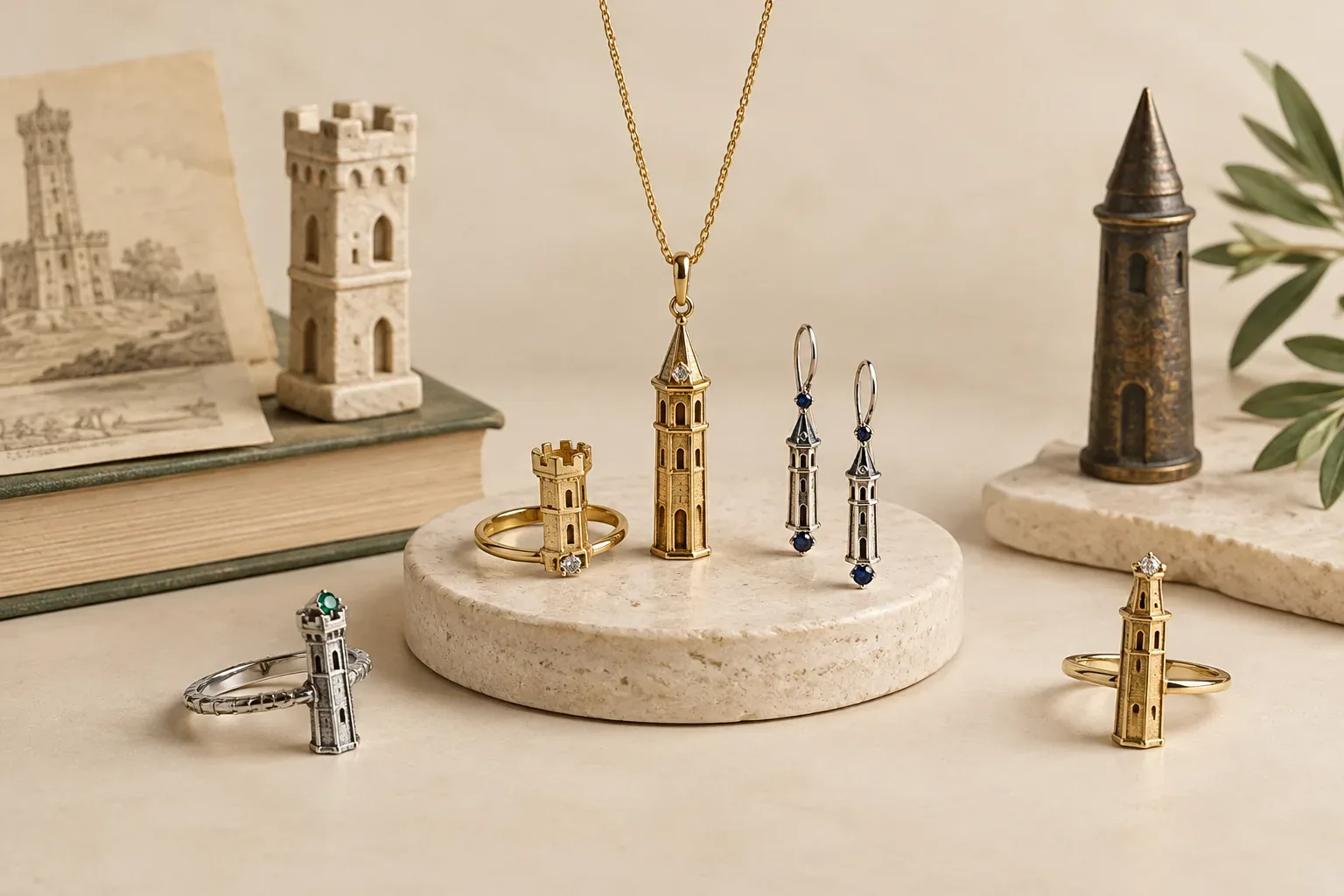
Practically, the tower motif shows up in jewelry in several recognizable ways. Designers may create figurative miniature pendants and charms shaped like towers or spires, use vertical architectural profiles for brooches and rings, or incorporate stylized crenellations and arches as decorative borders. In revivalist or historically inspired pieces, an overall Gothic or medieval silhouette—pointed arches, buttresses, and spires—signals the architectural source of the design.
Gemstones are used in conjunction with architectural motifs in the same ways they are used elsewhere in jewellery: as focal points, as coloured 'windows' in a miniature tower, or as accent stones in the setting. For practical identification and historic context on gemstones used in jewellery, the Victoria and Albert Museum’s A–Z of Gemstones is a helpful reference for the types of stones commonly employed and their historic associations. For modern buying and material disclosure—how treatments, synthetics, and imitations should be presented to buyers—the Federal Trade Commission provides guidance that sellers must follow in consumer transactions.
Choosing or gifting tower jewelry: practical, respectful guidance
Start with the recipient’s known tastes and the intended meaning. If you intend the piece to signal resilience, protection, or a milestone, consider a design that clearly communicates that idea to the recipient—either by style, accompanying note, or a conversation—because the motif’s historical meanings are not universally understood.
Choose materials and disclosures carefully. If the piece features gemstones, ask the seller for written information on stone type, treatments, and any synthetic substitutes. The FTC’s consumer guidance on buying gemstones and pearls stresses that sellers should disclose treatments and imitations, so request those details before purchase.
Respect cultural or religious sensitivities by asking when in doubt. Because museum evidence for tower motifs in the approved sources is strongest within specific European contexts, avoid making broad cross-cultural claims about spiritual or religious symbolism. If the recipient connects towers to family heritage or faith, acknowledge that personal and community meaning as primary.
Consider scale, wearability, and care. Architectural motifs can be sculptural and therefore heavier or more angular than plain shapes. Think about where the recipient will wear the jewelry—everyday versus occasional—and choose a size and metal that fit those habits. For care, standard precautions apply: avoid harsh chemicals, store pieces in dry places, and follow any gemstone-specific recommendations found in reputable references such as the V&A’s gemstone overviews.
When gifting, add context. A short card that explains whether the piece is a historical revival design, a contemporary interpretation, or chosen for a personal meaning helps the recipient understand both the documented background and your intent.
How to research a specific piece’s origins and authenticity
Begin with seller documentation and marks. Provenance, maker’s marks, and any hallmarking on metal provide primary clues. Museums like the V&A emphasize contextual evidence—style, construction, and materials—to situate a piece historically.
Verify gemstone claims. Use specialist reports or ask for lab documentation on high-value stones. The FTC recommends that sellers disclose treatments and imitations; if a seller cannot answer whether a stone is natural, heat-treated, or synthetic, treat the claim with caution.
Consult reputable specialists. For a historically significant or high-value item, a qualified appraiser or a museum department with a documented collection can provide connoisseurship and objective assessment. If a piece is described as 'Gothic Revival' or 'medieval-inspired,' compare its forms and construction to museum descriptions and catalogues to see if the label is accurate.
Concluding note
Tower jewelry meaning is not a single fixed statement found in a single culture, but a motif with documented uses in specific European historical and revivalist contexts and with many valid modern interpretations. Use the museum record to understand original contexts and the FTC guidance to protect yourself when buying gem-set pieces, and choose or gift tower motifs in ways that respect both documented history and the personal meanings they carry today.
Frequently asked questions
What does tower jewelry symbolize?
Historically, museum evidence indicates towers were used as architectural references in decorative jewellery, especially within European contexts and revival movements; modern wearers often ascribe personal meanings such as strength or protection, but those contemporary readings are personal rather than universally documented.
Is tower jewelry linked to a particular religion or culture?
The approved museum evidence ties the motif most clearly to European architectural and revivalist contexts; that does not establish a single religious meaning and you should not assume universal spiritual significance without specific local or family context.
How can I verify gemstone claims in a tower pendant?
Ask the seller for written disclosure on stone type and treatments. The FTC recommends sellers disclose treatments and imitations, and the Victoria and Albert Museum’s A–Z of Gemstones can help you understand commonly used stones and their historical use.
What should I consider when gifting tower-themed jewelry?
Consider the recipient’s aesthetic and the intended meaning; request full material and gemstone disclosures from the seller; provide a short note explaining whether the design is historically inspired or a personal symbol; and be mindful of cultural sensitivities.
How do I care for architectural or sculptural jewellery?
Because such pieces can be three-dimensional and ornate, avoid rough wear, keep them away from harsh chemicals, store them in dry, padded containers, and follow any gemstone-specific care recommendations found in reputable references.
Sources and further reading
- Bedazzled: A History of Jewellery — Victoria and Albert Museum
- An A-Z of Gemstones — Victoria and Albert Museum
- Buying Gemstones, Diamonds, and Pearls — Federal Trade Commission