Meaning at a glance
Explain the documented history and changing contexts of the axe motif, separate cultural or religious evidence from later popular interpretations, and give practical guidance for choosing and wearing the motif in modern jewelry.
What the historical evidence shows
Surveys of jewelry history collected and interpreted by institutions such as the Victoria and Albert Museum indicate that motifs drawn from tools and weapons—including axe forms—appear repeatedly across time because makers borrowed recognisable shapes from daily life, ritual objects, and heraldry (Victoria and Albert Museum). The V&A’s broad account of jewellery history describes how craftsmen adapted familiar forms into small-scale, wearable objects for social display and symbolic use rather than documenting a single, unchanging meaning for any one motif.
In prehistoric and Bronze Age contexts, archaeologists and curators commonly find stylized representations of utilitarian items incorporated into personal ornament and votive objects; museum summaries interpret these as signals of role, technology, or ritual, but attributions differ by site and culture (Victoria and Albert Museum).
In classical and Iron Age material traditions, weapon-shaped amulets and miniature tools occur among grave goods and personal items. The V&A’s historical overview emphasizes that such objects can serve multiple functions—identifying status, indicating a profession, or acting as an apotropaic (protective) emblem—depending on the culture and archaeological context (Victoria and Albert Museum).
Medieval and early modern jewellery often borrowed heraldic and occupational imagery. Axe-like forms could appear on seals, badges, or as part of a carved crest; in these contexts museums note a tendency to encode civic roles or familial emblems rather than a single universal symbolism (Victoria and Albert Museum).
Across these periods, the key point in the museum evidence is methodological: a motif’s presence is documented, but its meaning must be inferred from context—archaeological findspot, associated objects, inscriptions, and contemporaneous texts—so museums present range of plausible functions rather than one definitive interpretation (Victoria and Albert Museum).
Documented historical meanings vs modern interpretations
Documented historical meanings for axe imagery are context-dependent and typically reconstructed by curators and historians from material evidence. Museum accounts stress that an axe motif might signify a tool tied to a trade, a badge of office, a ritual implement, or a decorative echo of daily life. These are contextual conclusions drawn from archaeological and historical evidence, not blanket meanings applied everywhere (Victoria and Albert Museum).
Modern personal interpretations are varied and often private. Contemporary wearers commonly ascribe meanings such as strength, self-reliance, readiness for change, protection, or ancestral connection to an axe pendant or ring. These modern readings are valid personal or cultural choices, but they should be distinguished from claims that an axe motif carried the same symbolic content in a particular historic culture without supporting evidence.
Separating the two is important when choosing or gifting: you can adopt a modern symbolic reading intentionally, but if you claim historical continuity you should be specific about the evidence and cautious about universal statements. The Victoria and Albert Museum’s approach to jewellery history is useful here: they document forms and contexts and avoid overstating symbolic continuity across time and place (Victoria and Albert Museum).
How the axe motif and related traditions appear in jewelry
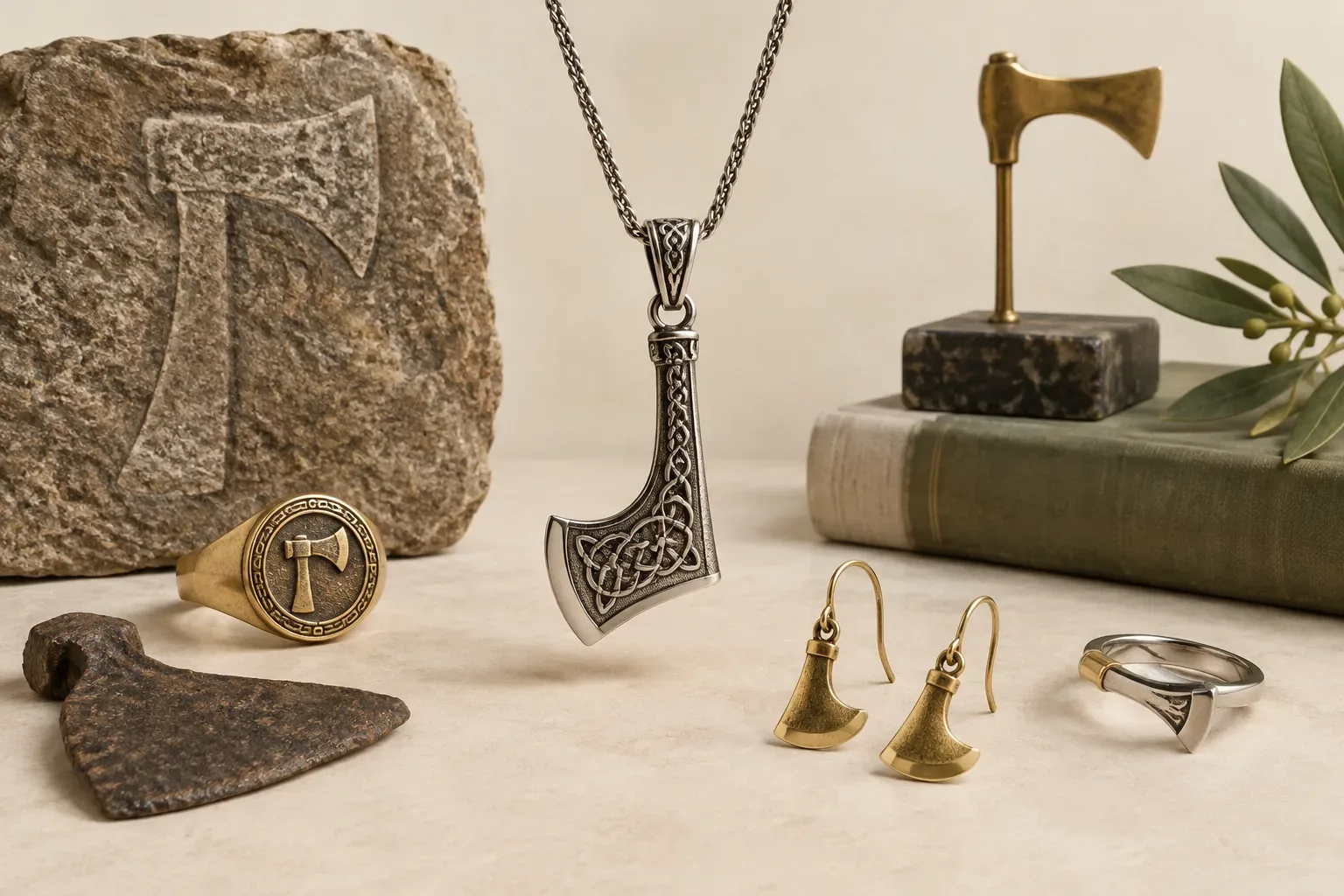
The axe motif appears in jewellery in several consistent ways. Artisans render axe heads or stylised silhouettes as pendants, charms, signet motifs, ring shoulders, cufflink faces, or engraved details on bracelets and lockets. The motif may be literal, as a miniaturised tool, or highly stylised to fit decorative conventions of a period. Museum collections and exhibitions show a wide variety of scale and finish for such motifs (Victoria and Albert Museum).
Stone and metal choices contribute to meaning and visual effect. Historically, a maker might use bronze, iron, silver, or gold depending on resources and status; in museums’ descriptions of gemstones and materials, curators note that the same gemstone types—such as garnet, agate, and glass paste—appear across periods as decorative inlays or to convey wealth (Victoria and Albert Museum, An A-Z of Gemstones). Modern axe jewellery commonly pairs metalwork with stones for contrast: a burnished bronze or oxidised silver axe head set with a small cabochon, or a polished steel blade motif paired with onyx or garnet, for example.
Surface techniques matter: engraving, enamelling, granulation, and modern surface treatments are all ways to render texture and detail on a small axe motif. Contemporary makers may also combine mixed metals, laser engraving, or cast reproduction of historical forms for a stylised or historically inspired look.
Finally, traditions of gifting or wearing tools-as-symbols vary. In some historical contexts museum labels interpret tool-forms as vocational badges; in the modern market axe jewellery is often offered as a statement or commemorative piece, sometimes marketed for its association with resilience or protection rather than an occupational identity (Victoria and Albert Museum).
Practical guidance for selecting or gifting axe jewellery
Decide whether you are choosing a historically inspired piece, a modern symbolic piece, or an heirloom with provenance. If historical accuracy matters, look for reliable provenance or museum-style references and ask sellers for documentation. The Victoria and Albert Museum’s material surveys are a helpful frame: look for pieces that clearly present themselves as reproductions or inspired-by items rather than presenting speculative historical claims as fact (Victoria and Albert Museum).
Check materials, hallmarks, and gemstone disclosures. For gemstones and treatments, consult consumer guidance: reputable sellers should disclose treatments, imitation stones, and any enhancements; the Federal Trade Commission provides advice on buying gemstones, diamonds, and pearls and notes obligations for disclosure of treatments and imitations (Federal Trade Commission).
Match scale and style to the recipient. A small, subtle axe charm may suit someone who prefers understated symbolism; a bold, sculptural pendant communicates a different intent. Consider metal allergies and comfort: choose gold vermeil, sterling silver, or stainless steel where appropriate and verify karat or plating information.
Be respectful with cultural or religious associations. If a piece references a specific cultural design or sacred object, research its background before gifting. If you are unsure, choose a design described by the maker as inspired-by rather than claiming authentic ritual significance.
Ask questions about manufacture and care. Enquire whether a piece is cast or hand-forged, whether stones are natural or synthetic, and how to care for the metal and any inlay gemstones. The V&A’s gemstone resources can help you ask better questions about stone identification and historical use (Victoria and Albert Museum, An A-Z of Gemstones).
If you seek an example for a modern gift, consider a well-made pendant that balances craftsmanship and symbolic intent. A contemporary sterling-silver axe pendant with clear disclosure of materials and origin is a practical, wearable choice for many occasions. For a curated, ornate option with medieval inspiration, see the Divine Axe pendant as an illustrative design choice.
Care, authenticity, and ethical considerations
Take routine steps for jewellery care: store pieces separately to avoid abrasion, avoid exposing plated finishes to harsh chemicals, and follow maker instructions for polishing. Ask the seller about plating thickness, sterling silver content, or gold karat to understand long-term wear expectations.
For authenticity and ethical sourcing, request clear information on metal fineness, hallmarking, and whether gemstones are treated or synthetic. The Federal Trade Commission outlines buyer protections and the need for transparent disclosure of gemstone treatments and imitations (Federal Trade Commission).
Finally, respect that a modern wearer’s meaning may differ from historic interpretations. Whether the axe is chosen for its working-class resonance, mythic associations, or purely aesthetic qualities, the responsible buyer balances personal intent with accurate statements about provenance and symbolism.
Frequently asked questions
Does an axe motif always mean strength or protection?
No. While modern wearers often interpret an axe as a sign of strength or protection, museum evidence shows that historical meanings depended on context and could include occupational identity, ritual function, or purely decorative use (Victoria and Albert Museum).
How can I tell if an axe-themed piece is historically authentic?
Look for clear provenance, museum or dealer documentation, and conservative seller language that describes an object as an original rather than 'inspired by' a period. If accuracy matters, ask for research references and condition reports (Victoria and Albert Museum).
What materials are best for everyday axe jewelry?
For daily wear choose durable metals such as solid sterling silver, stainless steel, or solid gold with appropriate karat marking. Confirm plating thickness if a plated finish is used and ask about artisan construction for long-term durability.
Should I worry about gemstone treatments in axe jewellery?
Yes. Reputable sellers disclose treatments, enhancements, and imitations. Consult consumer guidance on gemstones and request written disclosure of any treatments or synthetic stones before purchase (Federal Trade Commission; Victoria and Albert Museum, An A-Z of Gemstones).
Is it respectful to gift axe jewellery tied to a specific culture?
Exercise care. If a design references a living culture’s sacred objects or specific ritual forms, research its background and prefer pieces sold by makers from that culture or clearly labeled as contemporary, respectful designs rather than claiming historical or sacred authenticity.
How should I care for an axe pendant with mixed metal or gemstones?
Follow the maker’s care instructions. Generally avoid harsh chemicals, store pieces separately to avoid abrasion, and use appropriate polishes for the metals involved. For gemstone settings, ask the seller about ultrasonic or steam cleaning safety.
Sources and further reading
- Bedazzled: A History of Jewellery — Victoria and Albert Museum
- An A-Z of Gemstones — Victoria and Albert Museum
- Buying Gemstones, Diamonds, and Pearls — Federal Trade Commission