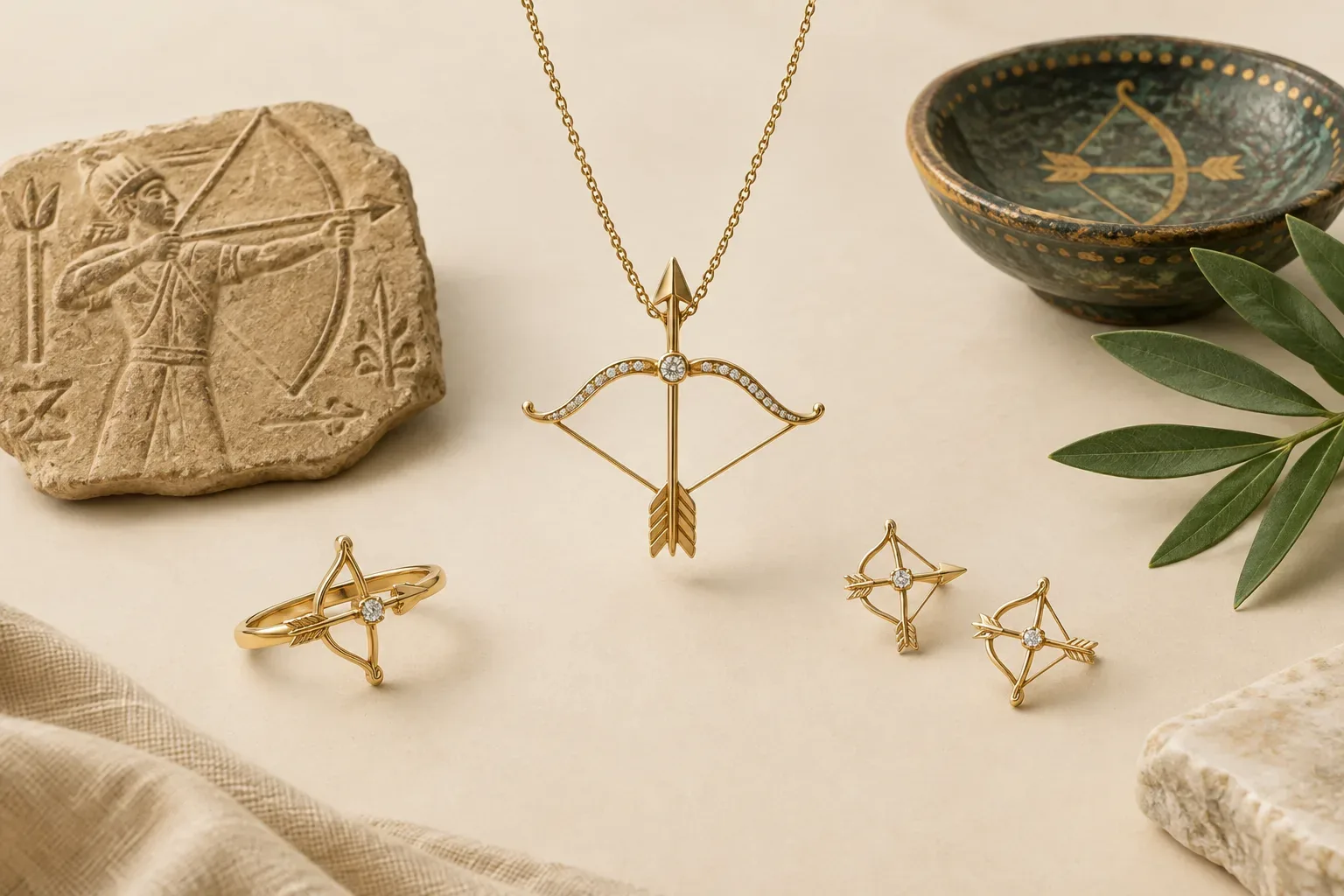
Meaning at a glance
Bow-and-arrow jewelry meaning combines documented historical roles—hunting, warfare, and association with mythological figures—with a wide range of modern personal and fashion interpretations; museums record the motif across periods, and practical buying guidance centers on materials, provenance, and respectful use.
Quick answer
In short: historically the bow and arrow motif in jewelry has been used to reference hunting, combat, and mythological archers or love figures; this is the documented context recorded by museum collections and curators. Modern wearers often layer personal meanings—romance, protection, aim, or athletic identity—on top of that history. When choosing or gifting a bow-and-arrow piece, consider the documented provenance and materials, the cultural context of the motif, and standard gemstone disclosure and treatment issues.
What the historical evidence shows (culture and period by period)
Museum surveys and collections draw a line of continuity for the bow-and-arrow image across many periods and regions, where the motif most commonly connects to practical uses like hunting and warfare and to figurative uses tied to myth and allegory. The Victoria and Albert Museum presents jewelry history as a record of social function and changing tastes, showing how motifs migrate between utility, status display, and symbolic ornamentation.
In the classical Mediterranean and related European traditions the image of an archer appears in decorative arts and as attributes of mythological figures; museum scholarship documents the use of archery images in personal adornment to suggest skill, military prowess, or the identity of a deity or mythic character. In medieval and early modern European contexts, bows and arrows also appear on rings and brooches with associations to hunting as a noble pastime and to allegorical imagery popular in devotional and courtly ornament, as described in museum surveys.
The V&A's work on later eighteenth- and nineteenth-century jewelry traces how classical and pastoral themes returned in fashionable ornament: bows and arrows could be stylized as delicate romantic motifs during the Georgian and Victorian periods, and they were reinterpreted in the decorative arts of the late nineteenth and early twentieth centuries. Museums emphasize that such motifs shift meaning as they move between class, gendered fashion, and artistic trends.
Modern and contemporary jewelry continues to reuse bow-and-arrow imagery in diverse ways, sometimes referencing historical fashions and sometimes drawing on popular culture associations. The V&A frames these changes as part of broader patterns in jewelry history: a symbol’s visual persistence does not guarantee a single meaning across times and communities.
Documented historical meanings versus modern interpretations
Documented historical meanings are those that appear in primary objects, inventories, and museum interpretation: bows and arrows in jewelry often reflected hunting or military status, or identified a wearer with a particular mythological figure or allegory. When museum catalogs and exhibitions explain a piece as referencing a hunt, a patron’s rank, or a classical myth, that interpretation is grounded in how that item was used, positioned, or described in its original context, as emphasized by the Victoria and Albert Museum’s approach to jewelry history.
Modern personal interpretations are often layered, varied, and subjective. Contemporary wearers may choose a bow-and-arrow pendant to express romantic love (drawing on Cupid iconography), personal ambition and focus, sporting identity (archery as a hobby or profession), or simply a fondness for the aesthetic. These are valid personal meanings but should be distinguished from the documented functions recorded by museum scholarship. No single symbolic meaning is universal.
How the motif and gemstones appear in jewelry
The bow-and-arrow motif appears in jewelry in several technical and stylistic forms: as tiny charms or pendants shaped like a bow and an arrow; as combined motifs where an arrow pierces a heart or accompanies a bow-shaped ribbon; as brooches or stickpins with arrow forms; as engraved or enameled decoration on rings; and as decorative clasps or fastenings. Museum collections show both literal, anatomically suggestive forms and stylized, decorative renditions depending on period taste.
Gemstones and materials commonly used with these motifs depend on the period and the intended social message. The Victoria and Albert Museum’s resources on gemstones outline historical preferences—diamonds and rock crystal for brilliance, garnets and colored stones for saturated color, and pearls for soft luminosity—and note that gem choice was part of the overall symbolic language of jewelry. For example, a bow-and-arrow brooch set with a garnet could read differently in a nineteenth-century context than a minimalist arrow pendant in contemporary silver.
Techniques vary from delicate gem-setting and enameling in fine periods to modern casting and mixed metals. Contemporary designers might use laser-cut shapes, openwork silhouettes, or minimalist metal lines to evoke the bow-and-arrow without literal representation. Museums document this technical evolution as part of broader changes in jewelry making and fashion.
Practical and respectful selection or gifting guidance
Start with intention: ask whether you or the recipient value historical reference, aesthetic minimalism, or symbolic meaning. If your intent is to honor a specific culture’s tradition, learn which communities or periods use the motif and whether the design has particular spiritual or ceremonial significance; museum resources can help establish a research baseline.
Consider authenticity and provenance. For historical pieces or antiques, provenance, condition reports, and museum documentation practices are useful models. When buying gemstones or vintage jewelry, follow the Federal Trade Commission’s guidance on disclosure: ask sellers about treatments, synthetics, and whether gems are natural, lab-grown, or imitations, and request written confirmation when possible. Reputable dealers will provide clear information about treatments and origin.
Match material and design to the occasion. For an intimate romantic gift one might choose a stylized Cupid-inspired pendant set with a small diamond or garnet; for a sports-minded recipient an arrow-shaped pendant in durable metal might be more appropriate. Keep scale and wearability in mind: long, dangling representations read differently than small lapel pins or signet-style rings.
Be sensitive to cultural appropriation. Avoid adopting motifs from living communities as novel fashion statements if they are sacred or tied to active cultural identity unless you have permission or clear guidance. When in doubt, prioritize designs that reference general historical styles rather than directly copying contemporary ritual objects.
Practical care and communication complete the gift. Include a note about your chosen meaning if you intend the piece as a symbolic present, and provide care or valuation documents for valuable gemstones. For inexpensive fashion jewelry, consider sourcing from designers who credit their inspirations and avoid passing off culturally specific work as generic.
Authenticity, care, and buying notes
When assessing a piece, examine construction and materials: secure settings, hallmarks on precious metals, and consistent patina can indicate quality or age. The Victoria and Albert Museum’s summaries of jewelry history and gemstones are useful starting points for identifying period techniques and typical materials. For gemstones specifically, the Federal Trade Commission advises buyers to confirm disclosures about treatments, enhancements, and whether stones are natural or lab-grown, and to be wary of ambiguous claims.
Care instructions depend on materials. Fine metal and gemstone pieces benefit from periodic professional cleaning and inspection; plated fashion jewelry requires gentler handling to avoid wear. For valuable antiques, seek conservation advice rather than attempting aggressive cleaning that could remove patina or damage mounts.
Final considerations
Bow-and-arrow jewelry carries a layered history recorded in museum collections and scholarship; its past uses—tied to hunting, martial identity, and myth—coexist with a broad field of modern personal meanings. Distinguishing documented cultural contexts from personal symbolism will help you choose or give a piece that is both thoughtful and respectful.
If you want to learn more about related symbols, material identification, or how to research a piece’s meaning, consult museum resources and jewelry research guides and consider reading a practical gift-selection guide from trusted sites to combine historical awareness with contemporary taste.
Frequently asked questions
Does bow-and-arrow jewelry always mean love or Cupid?
No. While modern wearers sometimes associate bow-and-arrow motifs with romantic love via Cupid imagery, museum documentation shows the motif historically referenced hunting, martial identity, or mythological persons; meanings vary by context and period.
Is it respectful to wear a bow-and-arrow design from another culture?
It depends. If the motif is a general or historical decorative form, wearing it is usually uncontroversial. If it derives from a living community’s sacred or ceremonial object, seek guidance and avoid appropriation. Research provenance and intent before adopting culturally specific designs.
What gemstones work well with bow-and-arrow motifs?
Gem choice depends on the historical reference and the wearer’s taste. Museums note traditional uses of diamonds for brilliance, garnets and colored stones for saturation, and pearls for softness. Ask sellers about historical precedents and aesthetic fit.
How can I verify a vintage arrow-themed piece is authentic?
Look for hallmarks, consistent construction, and documented provenance. Consult reputable dealers or a qualified appraiser and compare the piece to museum-documented examples for stylistic and technical matches.
Are there buying cautions for gemstone arrow jewelry?
Yes. Follow Federal Trade Commission guidance: request disclosure of treatments, learn whether stones are natural, lab-grown, or imitations, and get written confirmation when buying valuable gemstones.
How should I care for bow-and-arrow jewelry?
Care depends on materials: precious metals and gemstones generally tolerate professional cleaning, while plated or delicate pieces require gentle handling. For antiques, consult a conservator before any cleaning to avoid damaging patina or settings.
Sources and further reading
- Bedazzled: A History of Jewellery — Victoria and Albert Museum
- An A-Z of Gemstones — Victoria and Albert Museum
- Buying Gemstones, Diamonds, and Pearls — Federal Trade Commission