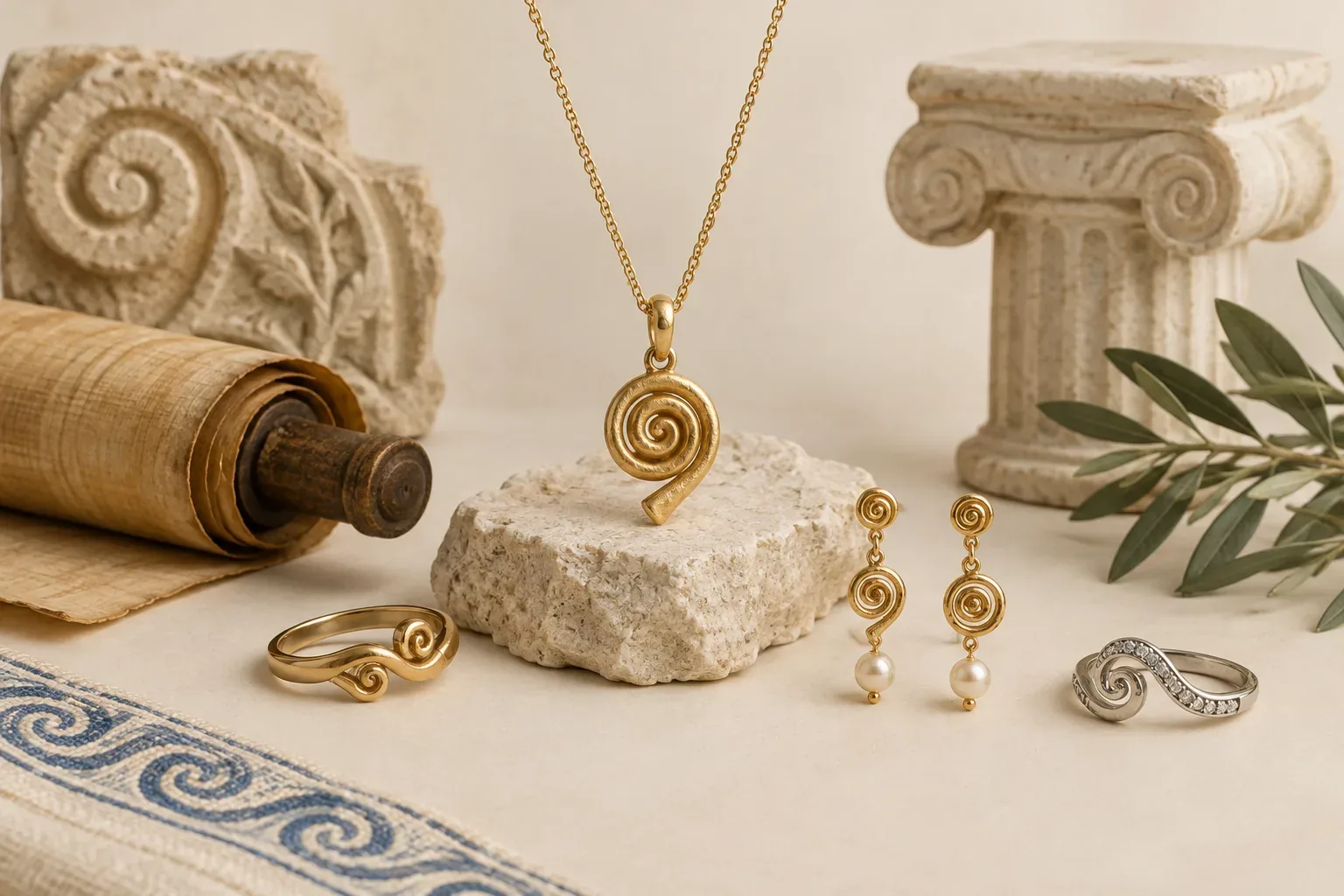
Meaning at a glance
This article explains the documented history and shifting contexts of the scroll motif in jewelry, separates museum-supported cultural and stylistic evidence from modern personal interpretations, and offers practical guidance for selecting, authenticating, gifting, and caring for scroll-motif pieces.
Quick answer
The scroll jewelry meaning is best described as a historically decorative motif with varied stylistic uses across periods and cultures; museum evidence shows it served ornamental and framing functions rather than a single universal symbolic message, while modern wearers often add personal meanings such as continuity or memory.
What the scroll motif is and where it comes from
The term "scroll" in ornament refers to a curving, often spiraling line that can be botanical, architectural, or abstract. In applied arts and jewelry, scrolls derive from broader decorative vocabularies used in architecture, metalwork, textiles, and manuscript illumination. The Victoria and Albert Museum describes how ornamental motifs migrate across media and eras, with scroll-like forms recurring in many styles as part of designers' visual vocabulary.
Historical evidence by culture and period
Museum scholarship treats scroll ornament as a recurring decorative element rather than a single cultural symbol. The Victoria and Albert Museum documents scroll forms appearing in classical-inspired ornament (for example volutes and acanthus-derived curves), in Renaissance metalwork where gem settings and intricate surround became more elaborate, and in later Baroque and Rococo periods when abundant curved ornament dominated fashionable objects and jewelry. These notes describe changes in taste and technique rather than a fixed symbolic meaning.
In the 18th and 19th centuries, collections and exhibition records show jewellery designers used scrollwork alongside other motifs to display metalworking skill, to frame gemstones, and to fit the overall silhouette of fashionable accessories. The V&A's historical overview links such changes in surface decoration and construction to social and technological shifts in jewellery production and patronage.
In the modern era, designers have reinterpreted scroll shapes in revivalist and contemporary jewellery. Museums and curators at institutions like the V&A treat these as part of an evolving design language, tracing influences between historical styles and modern makers rather than asserting a single continuity of meaning.
Documented historical meanings versus modern personal interpretations
Documented historical evidence, as presented by museum catalogues and curatorial essays, emphasizes function and style: scrollwork was used to ornament, to frame stones and cameos, and to demonstrate technique. The V&A frames such uses in the broader history of jewellery—highlighting social context, materials, and craftsmanship—rather than attributing an intrinsic allegorical meaning to the motif itself.
By contrast, many contemporary interpretations are personal or cultural readings layered onto the motif. Today people commonly ascribe meanings such as continuity, movement, protection, or familial bonds to scroll motifs. These modern associations are valid as personal or cultural symbolism but should not be presented as the motif's documented historical meaning. Distinguishing scholarly evidence from later sentiment preserves the historical record while acknowledging how meanings evolve with wearers.
How the scroll motif appears in jewelry: techniques and materials
Across periods, the scroll motif appears in multiple techniques: engraved and chased metal surfaces, openwork filigree where sinuous wires form scrolls, repoussé where scrolls rise in relief, and as part of enamelled surfaces or pierced settings. Scrolls frequently function as frames or arabesques around gemstones, cameos, or miniature portraits, and they are integrated into clasps, links, and earring mounts to carry a consistent decorative line through a piece.
Gemstone choices historically depended on fashion, availability, and the optical and symbolic qualities given to particular stones. The Victoria and Albert Museum's resources on gemstones outline how gem use and cutting techniques evolved and how designers selected stones to suit a piece's proportion and aesthetic. Scroll motifs have often been paired with cabochons, cameos, pearls, and early table-cut stones because the curved metalwork naturally complements rounded or oval gem shapes.
In contemporary jewellery the scroll form can be stylized or literal. Some makers cut scrolls from sheet metal for a graphic silhouette, while others hand-form delicate wires into filigree. Modern production may mix traditional techniques with cast components, machine engraving, or laser-cut elements, all of which update the scroll vocabulary for new tastes while retaining its historic lineage.
Respect, provenance, and cultural sensitivity
Because scrolls appear in many cultures and decorative traditions, select and wear scroll jewelry with awareness of provenance. Museum documentation differentiates between Western stylistic families—classical, Renaissance, Baroque, Rococo, Victorian—and later revivals. If a particular piece is presented as coming from a specific culture or religious tradition, look for maker marks, provenance records, or collection references to confirm that attribution rather than relying on visual similarity alone.
When a scroll design clearly references an identifiable regional or religious decorative system, consider the meaning and context in that culture before assuming it is a neutral ornament. Researching comparable examples in museum collections and consulting authoritative resources helps avoid casual appropriation and deepens appreciation for the piece's history.
Practical guidance for choosing, gifting, and authenticating scroll jewelry
Decide whether you want a piece for historical interest, aesthetic preference, or personal symbolism. For historical interest, seek provenance: museum-style descriptions, maker's marks, or reputable dealer documentation. For aesthetic preference prioritize scale, metal color, and how a scroll pattern complements the wearer's wardrobe and daily habits.
If your budget includes gemstones, be aware of treatment and imitation disclosures. The U.S. Federal Trade Commission provides clear guidance that sellers should disclose treatments, enhancements, and imitations when selling gemstones and pearls. Ask sellers for written details about gem treatments, mounting materials, and any certificates or laboratory reports when the value merits it.
For gifting, consider the recipient's relationship to symbolism. Some recipients appreciate a literal traditional meaning; others prefer a private or newly assigned significance. If you intend a sentiment—memory, continuity, or protection—make that intention explicit in a note, since the historical record does not guarantee those meanings. Personal engraving or pairing the piece with a short explanation makes the gift both thoughtful and transparent about its modern symbolism.
When authenticity matters, consult independent appraisers and consider checking auction or museum references for stylistic matches. For vintage or antique pieces, condition reports and treatment histories clarify restorations or replaced stones. For contemporary pieces, ask about fabrication technique and whether components are handmade or cast, as this affects value and care.
Care and maintenance
Care depends on metal and gemstones. Fine filigree and openwork scrolls are delicate and benefit from storage that prevents snagging and crushing. Pearls and some early-cut stones are soft or porous and require gentle cleaning and protection from chemicals. Periodic professional inspection is advisable to secure prongs and check soldered joins.
When cleaning at home, use methods suitable to the materials and follow manufacturer or seller guidance. For higher-value gemstones or historic pieces, leave significant cleaning and conservation to professionals to avoid loss of original material or damage from inappropriate techniques.
Conclusion: an evolving motif with layered meanings
Museum sources show the scroll in jewellery is a durable decorative language used across many historical styles to ornament, frame, and express craftsmanship rather than to convey a single fixed message. Contemporary wearers and designers freely attach personal and cultural meaning to the motif, a legitimate development reflecting how symbols evolve with use.
If you are selecting, giving, or researching a scroll piece, balance appreciation for documented history—consult museum resources and provenance information—with thoughtful modern interpretation. Use the practical guidance above when authenticating, buying, or caring for scroll jewellery, and follow resources on this site to learn more about related symbols and how to choose meaningful jewelry.
Frequently asked questions
Does a scroll motif have a single historical meaning?
No. Museum documentation shows scroll ornament served primarily decorative and framing functions across different styles; a single universal historical meaning is not supported by the evidence.
Can scroll jewelry have personal or sentimental meanings?
Yes. Modern wearers and givers frequently ascribe personal meanings such as continuity, memory, or connection, but these are contemporary interpretations rather than documented historical meanings.
How can I tell if a scroll piece is antique or a later revival?
Look for provenance details, maker's marks, construction techniques, and condition reports. Compare the piece to museum-documented examples and consult qualified appraisers for a reliable assessment.
What should I ask a seller about gemstones in scroll jewellery?
Ask for disclosure of any treatments or imitations, written details about the gems and metals, and laboratory reports when relevant. The Federal Trade Commission advises sellers to disclose enhancements and imitations.
Is it culturally insensitive to wear scroll motifs from other cultures?
Not necessarily, but be mindful of the piece's provenance and whether the motif holds particular cultural or religious significance. Research and respect for the origin are recommended to avoid casual appropriation.
How do I care for delicate filigree scrollwork?
Store filigree pieces to avoid crushing and snagging, clean gently according to the materials, and have a jeweller inspect delicate joins periodically. For high-value or historic pieces, leave significant conservation to professionals.
Are certain gemstones traditionally paired with scroll designs?
Historically, designers paired scrollwork with rounded stones like cabochons, cameos, and pearls because the curves complement oval and circular forms; the V&A's resources explain how gemstone choices evolved with fashion and technique.
Should I personalize a scroll piece when gifting?
Personalization such as engraving or a written note clarifying your intended meaning can make a gift more meaningful, since modern symbolic readings are personal rather than historically fixed.
Sources and further reading
- Bedazzled: A History of Jewellery — Victoria and Albert Museum
- An A-Z of Gemstones — Victoria and Albert Museum
- Buying Gemstones, Diamonds, and Pearls — Federal Trade Commission