Meaning at a glance
Quill jewelry meaning combines historically shifting visual motifs with modern personal symbolism; museums like the Victoria and Albert Museum show that motifs evolve with social context, while contemporary wearers most often use quill imagery to suggest writing, communication, creativity, or remembrance.
What the historical evidence shows
Museum scholarship demonstrates that jewelry motifs shift with social context, patronage, and technology rather than carrying a single fixed meaning. The Victoria and Albert Museum frames the history of jewelry as a series of changing uses and meanings tied to fashion, commemoration, trade, and material innovations, so any claim about a single universal meaning for a motif must be treated cautiously.
When researchers and curators catalogue motifs, they place them in specific periods and settings. For example, naturalistic motifs—leaves, feathers, birds—are well documented in Renaissance and later European decorative arts, while the Victorians used sentimental symbolism in lockets and hair jewelry to signify remembrance and domestic attachment. The V&A’s work on gemstones and jewellery history explains these shifting visual languages and the ways motifs are reinterpreted across centuries.
There is less direct museum documentation that a single, distinct ‘quill’ symbol consistently represented the same idea across many cultures and eras. Instead, what is well documented is that feather-like and tool-like shapes (including pen nibs or stylized feathers) appear in different contexts and carry meanings that depend on the period, the wearer’s social position, and the specific object type. Where precise provenance exists, curators assign meaning cautiously and in context rather than asserting universal symbolism.
Separating documented historical meanings from modern interpretations
Documented meanings: Historical attributions recorded by museums and curators tend to be specific and contextual. For example, in sentimental or mourning jewellery from the 18th and 19th centuries, as described in museum collections and exhibitions, objects often incorporated natural motifs and personal keepsakes to signal mourning, family ties, or status. Curatorial records typically identify the period and object function rather than attributing a single, universal symbolic value to a motif.
Modern personal interpretations: Today, jewelers, designers, and wearers commonly adopt the quill motif to represent writing, literature, creativity, education, speech, or intellectual work, and sometimes to suggest freedom or spiritual lightness when read as a feather. These contemporary meanings are personal and cultural choices rather than single, longstanding historical facts. Such uses are part of a broader trend in which historic visual elements are repurposed to serve contemporary identity and storytelling.
How the quill motif and related traditions appear in jewelry
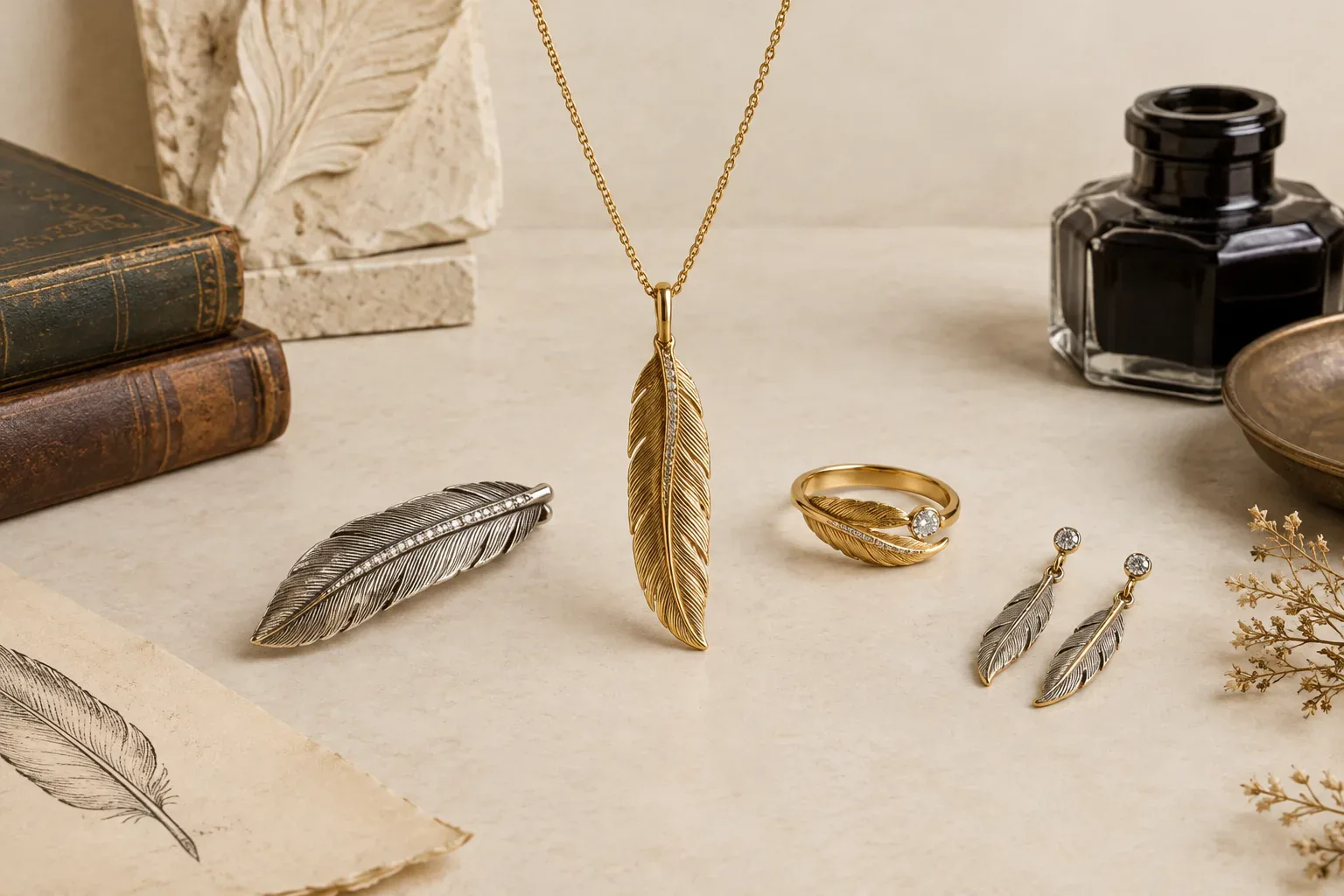
As a visual motif, the quill tends to appear in two overlapping stylistic veins: feather-like designs and pen-or-nib-inspired forms. Designers may render the quill as a delicate feather pendant, a stylized pen nib charm, an engraved motif on a signet or locket, or as decorative filigree mimicking a plume. These treatments let the same basic idea read in different keys—natural, literary, or ornamental—depending on the piece.
Materials and techniques vary. Simple everyday quill-themed pieces may be cast in base metals or silver, while more formal examples are worked in gold, set with gemstones, or combined with enamel. Where gemstones are present, museum guidance on gemstones is useful for identifying materials, historical associations, and workmanship: gemstones and their settings have their own histories and can change how a motif is perceived in a jewellery object, for example lending a sense of luxury or commemorative importance to a quill pendant.
Beyond standalone motifs, quill imagery can be integrated into established jewellery traditions. Sentimental lockets and memorial jewellery historically used hairwork or miniature portraits; a contemporary locket may instead feature an engraved quill to indicate the wearer’s relationship to writing or reading. Jewelry that references tools of a trade—such as a writer’s quill—follows a long pattern of occupational or hobbyist emblems in wearable form, but the contemporary meanings reflect personal identity choices rather than consistent historical symbolism.
Practical guidance for selecting or gifting quill jewelry
Think about the recipient’s relationship to the motif. If you are choosing a quill piece as a gift, consider whether the recipient identifies with writing, communication, teaching, or literary pursuits. A quill pendant may be especially meaningful for authors, editors, teachers, or graduates in the humanities, but it can also be a broader signifier of creativity or remembrance. When in doubt, ask about what images matter to the person rather than assuming a single interpretation.
Consider cultural and religious sensitivities. Because meaning is not universal, avoid assigning a definitive spiritual or cultural message unless you know the recipient’s background. If the wearer belongs to a community where feather imagery has distinct sacred significance, check that a stylized quill piece is appropriate and respectfully used.
Check materials and disclosure. For gemstone settings or metalwork, follow consumer-protection guidance: the Federal Trade Commission requires accurate disclosure of material treatments, imitations, and significant enhancements. Ask sellers about metal karatage, gemstone treatments, and whether gems are natural, lab-grown, or simulated. Reputable dealers will provide this information and, for higher-value purchases, certification or a receipts trail.
Match scale and style to everyday use. Select a size and construction suited to the wearer’s lifestyle: small, low-profile pendants and studs work for everyday wear, while larger, intricately set pieces suit dress or commemorative occasions. Consider the durability of the setting and the wearer’s tolerance for cleaning and maintenance.
Keep provenance in mind for historically styled or antique pieces. If buying a vintage quill motif item, ask for provenance or documentation and consult museum resources on style and manufacture when possible. Museum catalogs and exhibitions can help place an object in time and identify characteristic techniques and materials.
Care, authentication, and where to learn more
Basic care follows standard jewellery practice: avoid harsh chemicals, store pieces separately to prevent abrasion, and have precious-metal settings checked periodically for loose stones or worn mounts. For gemstone identification and the historical context of materials, museum resources provide valuable introductory information on how stones were used and valued in jewellery history.
For buyers and gifters, rely on transparent sellers who disclose treatments and provide receipts. The FTC’s consumer guidance on buying gemstones, diamonds, and pearls outlines the importance of disclosure about enhancements and imitations; consult that guidance when assessing value and authenticity.
If you want deeper historical context, look to museum collections and publications for object-specific analyses. The Victoria and Albert Museum’s work on jewellery history and gemstones is a reliable place to start for understanding how motifs have changed across periods and what evidence is used to interpret them.
Conclusion
The quill jewelry meaning is not a single historical constant but a set of related visual ideas that have been repurposed over time. Museums caution against broad claims about universal symbolism and instead document motifs in their specific social and material contexts. In contemporary use, the quill most commonly signals writing, creativity, or memory, but personal and cultural interpretation determines its meaning for any wearer. Choose and gift quill-themed jewellery thoughtfully, verify materials and disclosures, and respect the recipient’s cultural background when attributing symbolic intent.
Frequently asked questions
What does quill jewelry traditionally symbolize?
There is no single traditional meaning documented across all cultures; museums like the Victoria and Albert Museum show that motifs shift by period and context. In contemporary use the quill often stands for writing, creativity, communication, or remembrance, but these are modern, personal interpretations rather than universal historical facts.
Was the quill commonly used as a formal symbol in a specific historical culture?
Museum scholarship does not support a single longstanding, cross-cultural role for the quill as a formal symbol. Curators document feather-like and tool-like motifs in specific periods—such as Renaissance naturalism or Victorian sentimentalism—and interpret them in context rather than ascribing a single universal meaning.
How should I choose a quill piece as a gift?
Choose with the recipient’s relationship to writing or creativity in mind, check materials and disclosures, consider cultural sensitivities around feather imagery, and match the piece’s size and durability to the wearer’s lifestyle; for additional gift selection advice, see our practical guide on choosing meaningful jewelry.
Are gemstone treatments and imitations important when buying quill jewelry?
Yes. The Federal Trade Commission advises that sellers must disclose treatments, enhancements, and imitations for gemstones and pearls. Ask for clear information about materials and any certifications or receipts when purchasing.
How can I learn whether an antique quill motif piece is authentic or historically significant?
Seek provenance documentation and consult museum resources or a qualified appraiser. Museum catalogs and exhibitions, such as those from the Victoria and Albert Museum, provide context for dating and understanding motifs in their historical settings.
Sources and further reading
- Bedazzled: A History of Jewellery — Victoria and Albert Museum
- An A-Z of Gemstones — Victoria and Albert Museum
- Buying Gemstones, Diamonds, and Pearls — Federal Trade Commission