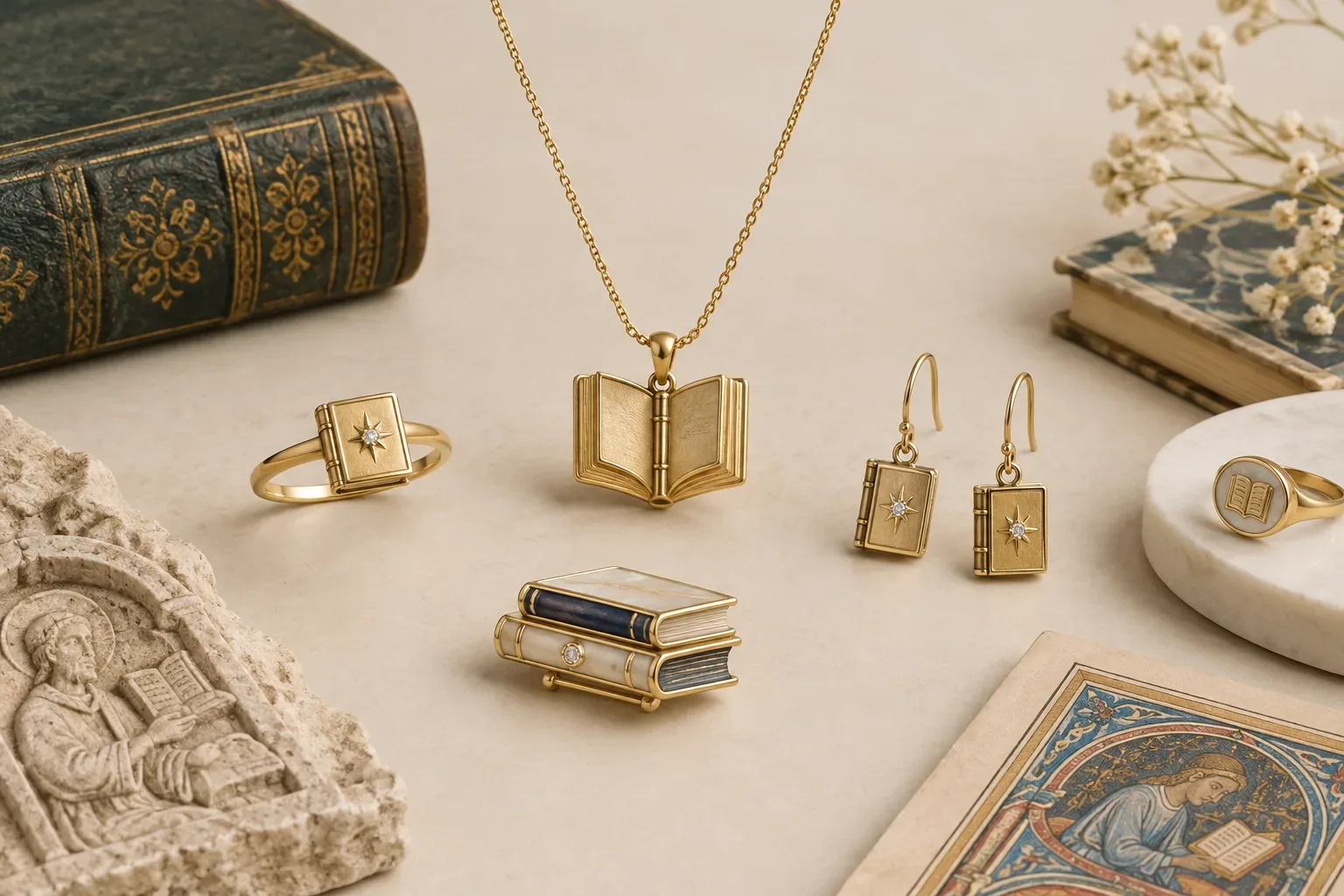
Meaning at a glance
Explain the documented history and changing contexts of the book motif, separate cultural or religious evidence from later popular interpretations, and give practical guidance for choosing and wearing the motif in modern jewelry.
What the historical evidence shows
Museum collections and scholarship demonstrate that the book form has been used as a jewelry motif for centuries in different cultural and religious contexts. The Victoria and Albert Museum (V&A) presents the long social history of jewellery and documents examples where small book-shaped objects served devotional or commemorative purposes on personal chains and in reliquary-style lockets. These items are often linked to Christian devotional practice in Europe and to the material culture of remembrance and status in periods that include the medieval, Renaissance, and Victorian eras, as represented in V&A holdings and interpretation.
Specific documented uses in the V&A record include miniature books or book-shaped pendants that held tiny devotional texts, prayer reminders, or images, and lockets with covers shaped like books that enclosed portraits or inscriptions. The V&A's broader history of jewellery emphasizes that motifs which appear as functional or religious objects frequently became visual shorthand for related qualities—piety, learning, or lineage—over time while their meanings shifted with changing social contexts.
Separating documented meanings from modern interpretations
Documented historical meanings are those supported by material evidence, provenance, or contemporary records catalogued by museums and archives. For book-shaped jewelry, documented meanings from such collections include devotional use, keepsakes for memory, and markers of social rank or education in particular societies and periods. These documented meanings should be presented tied to the specific culture or era in which the object was made or used; the V&A’s exhibitions and catalogue notes are a primary reference for those attributions.
Modern personal and commercial interpretations are not the same as historical function. Contemporary makers, retailers, and wearers frequently treat an open-book pendant as a general symbol for reading, teaching, learning, creativity, or a love of literature. These modern readings reflect current values and identities rather than direct, continuous meanings inherited unchanged from past centuries. They are valid as personal symbolism but should not be presented as universally historical facts.
How the book motif, gemstones, and techniques appear in jewellery
Design: The book motif appears in many forms—solid book-shaped charms and pendants, open-book silhouettes, miniature hinged lockets that mimic bindings, and engraved or enameled covers that reproduce printed pages or titles. Craft techniques historically used to create these objects include metalworking, engraving, enamel, miniature painting, and inlaid gemstones; museum examples noted by the V&A show a range of finishes and levels of ornamentation depending on period and purpose.
Gemstones and materials: Gemstones have been used in jewelry to decorate book motifs or to serve as the central stone in a pendant or brooch. The V&A’s A–Z of Gemstones describes how different stones carried varying levels of value and visual effect across time and that gem choices often reflected availability, fashion, and symbolic associations. In modern pieces, gem accents or birthstones are commonly paired with the book form to personalize meaning, but wearers should be aware of treatments, synthetics, and imitations. The U.S. Federal Trade Commission (FTC) requires disclosure of material treatments and imitations in gemstone sales, so sellers should be able to explain whether a stone is natural, treated, lab-grown, or simulated.
Scale and function: Historically documented book-jewelry objects could be substantial enough to open and contain small items or texts, while many modern designs are purely decorative and small. The presence of a hinge, cavity, or inscription in a historical piece is part of the evidence for a functional, devotional, or memorial purpose; the absence of such features in modern designs usually indicates symbolic rather than functional intent.
Reading context: culture, religion, and period
When interpreting book jewelry, contextualize each piece by asking where and when it was made and how it was used. The V&A’s catalogue and exhibits demonstrate that an object’s form, materials, inscriptions, and documented provenance are the secure basis for identifying its historical meaning. For example, objects made in Christian contexts that clearly contain prayers or images are best understood within that religious use. Similarly, Victorian sentimental jewellery is often documented as part of mourning and remembrance practices in British society of that period; such attributions come from museum documentation and contemporary records rather than from later commercial narratives.
Do not assume continuity: a motif that once had a specific devotional or social function may be repurposed centuries later for very different reasons. Modern makers frequently borrow historic visual language—book spines, gilt edges, clasps—without reproducing the original social or religious intent.
Practical guidance for choosing and gifting book jewelry
Match meaning to recipient: If you gift a book pendant to mark achievement—graduation, passing an exam, or a new teaching role—choose a design that reflects that intention: an open-book silhouette for learning, a locket for a personal message, or an engraved cover with a meaningful quote. If the recipient has a known religious practice, be mindful that historically devotional book-jewelry could carry sacred meaning; choose a neutral, secular design if you wish to avoid religious connotations.
Materials and durability: Decide whether you want precious metals and natural gemstones or affordable alternatives. The V&A’s A–Z of Gemstones is a helpful reference for how various gems have been used historically and how their properties affect wear. Check with sellers about gemstone treatments, synthetics, and imitations; the FTC’s guidance requires clear disclosure of these facts. For everyday wear, consider durable stones and solid metal settings, and prefer hallmarked metals or reputable maker marks for longevity.
Personalization and inscription: A small inscription, an engraved title or date, or an inner message in a locket-style book pendant can make the symbolism explicit and respectful. When engraving a text with cultural or religious connotations, verify the recipient’s preferences and sensitivities.
Respectful selection: If a piece resembles an object with known devotional purpose (for example, a miniature prayer book-style locket), consider whether wearing it as a casual fashion item might be inappropriate in certain settings or could be misconstrued. When in doubt, choose a clearly secular design for casual gifting.
Wearing and caring for book jewelry
Care follows materials: Clean and store according to the metal and stones used. The V&A’s references on gemstones and the museum’s broader conservation guidance indicate that different materials require different approaches; for example, soft stones need more protection, and enamel or miniature paintings should not be exposed to harsh chemicals. Ask the seller for care instructions.
Layering and styling: Open-book pendants are commonly worn at the throat as a single pendant or layered with delicate chains. Heavier, hinged book lockets may work better on sturdier chains and are often treated as statement or heirloom pieces.
Documentation: For antique or high-value pieces, obtain provenance, condition reports, and any available conservation history. For modern pieces with gemstones, ask for treatment disclosure and any certification. These documents preserve meaning and value for future owners.
Final note on meaning
Book jewelry offers a versatile symbol because it connects to reading, faith, memory, education, and personal narrative in different ways across cultures and time. Use museum-documented contexts, such as those provided by the Victoria and Albert Museum, as the basis for historical claims, and treat commercial or personal readings as contemporary reinterpretations. That approach keeps cultural histories clear while allowing modern wearers to imbue pieces with individual meaning.
Frequently asked questions
What does book jewelry traditionally symbolize?
Historically, book-shaped jewelry is documented in museum collections as serving devotional, memorial, or status-related functions in specific cultures and periods; the Victoria and Albert Museum provides examples of miniature book pendants and lockets used in those contexts. Modern symbolic uses—such as representing learning or a love of reading—are contemporary interpretations rather than universal historical meanings.
Is book jewelry a religious symbol?
It can be, depending on the object and its provenance. Some historical book-jewelry items clearly held devotional texts or images and should be understood as religious artifacts in their original context, as noted by the V&A. Many modern book motifs are secular and intended to celebrate education or literature; consider the design and any inscriptions to determine likely intent.
How do I know if the gemstones in a book pendant are real?
Ask the seller for full disclosure about whether a stone is natural, treated, lab-grown, or simulated. The U.S. Federal Trade Commission requires sellers to disclose treatments and imitations. For higher-value stones, request certification or an independent appraisal.
What should I consider when gifting book jewelry?
Match the piece to the recipient’s interests and beliefs. Choose secular designs for general gifting and consider a locket or engraved title for a personal keepsake. Verify materials, durability, and any cultural or religious connotations before gifting, and include a note explaining your intended meaning to avoid misinterpretation.
How should I care for an antique book-shaped locket?
Care depends on materials; avoid harsh chemicals, excessive moisture, and rough handling, particularly if the piece contains miniature paintings, enamel, or delicate hinges. For valuable antiques, consult a conservator or ask the seller for documented conservation history, as recommended by museum conservation practice.
Sources and further reading
- Bedazzled: A History of Jewellery — Victoria and Albert Museum
- An A-Z of Gemstones — Victoria and Albert Museum
- Buying Gemstones, Diamonds, and Pearls — Federal Trade Commission