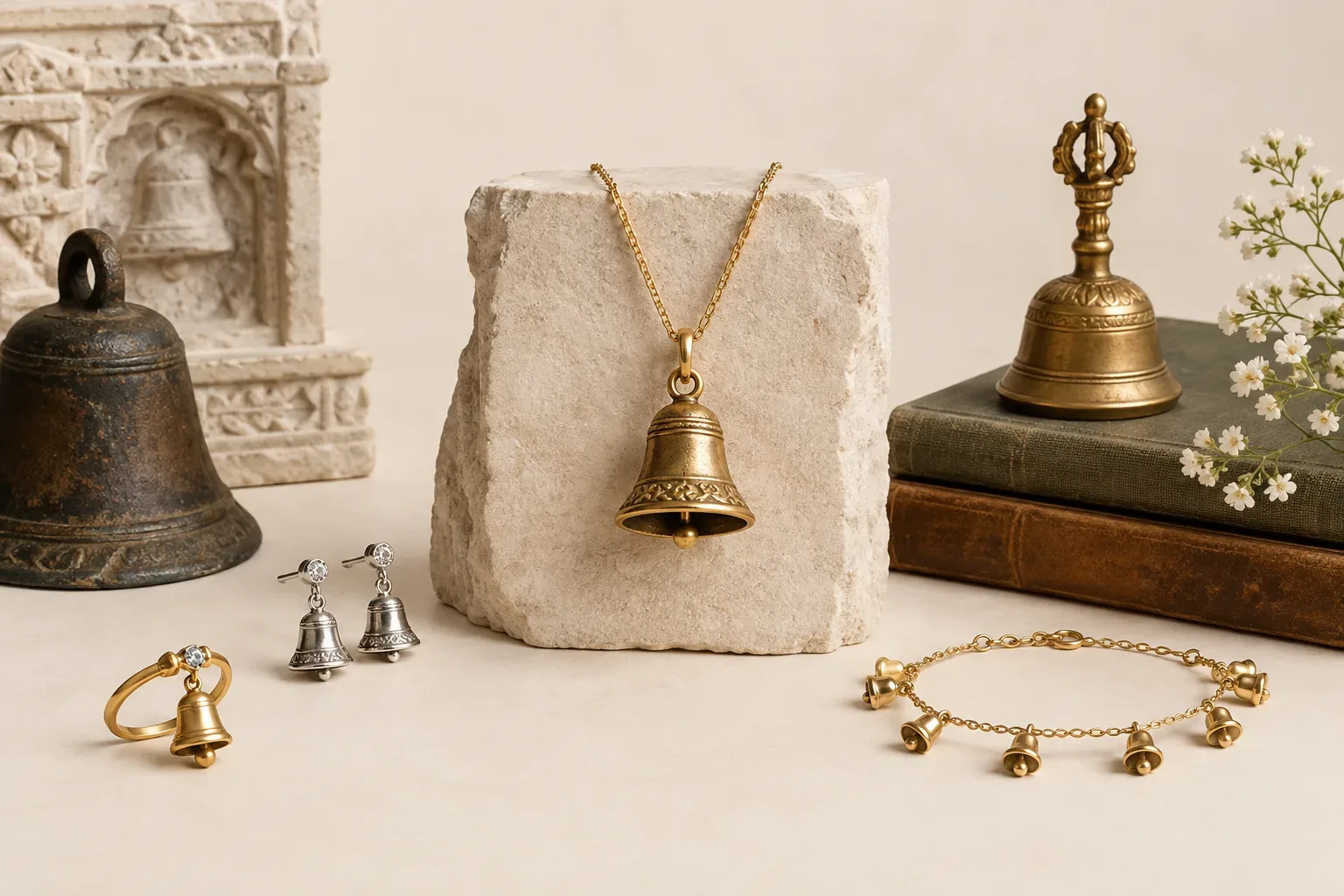
Meaning at a glance
Bell jewelry meaning: document the motif's historical uses and contexts as recorded in museum scholarship, separate those documented functions from later personal or popular interpretations, describe how bell forms and related gemstones appear in jewelry, and offer respectful, practical guidance for selecting and gifting bell-themed pieces today.
Direct answer — the thesis
Historically, bells and bell-like forms appear in jewelry and dress as sound-producing ornaments, status markers, and ritual objects in diverse cultures; museum scholarship documents those changing functions and contexts. Modern wearers layer new meanings onto the motif — celebration, protection, attention, memory or fashion — and those are personal or cultural choices rather than universal truths. Use documented history to inform respectful selection, check materials and disclosures, and choose style, scale and provenance that suit the recipient and occasion.
What the historical evidence shows
The Victoria and Albert Museum's surveys of jewellery history emphasise that ornamentation has shifted in purpose and meaning across time and place, and that sound-producing elements have long been part of personal dress and accessories. Museum collections and catalogues cited by the Victoria and Albert Museum show bell forms and small bells used on garments, horse tack, and jewelry in a wide range of regions, where they functioned variously as practical sound-makers, decorative movement, and markers of social role.
Because the archaeological and museum records are diverse, the documented functions are best described by region or context rather than as a single global meaning. For example, V&A scholarship situates bells and jangling ornaments within the material culture of South Asian, East Asian, and European collections, among others, noting that the same object type could have different meanings in each setting.
Museum evidence supports three broad, historically documented uses: bells as practical signals or identifiers (for example, to make presence known in movement or processions); bells and bell-shaped mounts as decorative or status-bearing elements in costume and accoutrement; and bells used within ritual contexts where sound played a role in liturgy, ceremony, or household practice. The detailed social or religious meanings attached to particular examples are specific to each culture and period and should be read in that context, as V&A’s historical overview emphasises.
Distinguishing documented historical meanings from modern interpretations
Documented historical meanings come from object records, contemporaneous descriptions, and curatorial interpretation. Those sources can tell us how an item was used, where it was worn, and sometimes who wore it or why. The Victoria and Albert Museum’s work on jewellery history stresses that social context and changing fashions shape those documented meanings, so a bell-shaped pendant worn by one community for ritual reasons might appear elsewhere as merely decorative.
Modern interpretations are often personal, commercial, or folkloric additions layered onto older motifs. In contemporary Western fashion, for instance, bell jewelry may be marketed as a symbol of joy, awakening, protection, or good luck. These modern readings are valid as personal symbolism but are not the same as the historically documented uses recorded in museum collections. When discussing bell jewelry meaning, it is important to label statements as historically documented or as contemporary interpretation, and to avoid implying that any meaning is universal.
How the bell motif and related traditions appear in jewelry
As a motif, bells appear in jewelry in several recognizable ways: as literal miniature bells that jingle, as bell-shaped pendants or mounts that echo the silhouette of a bell, and as stylised representations incorporated into engraved, filigree, or cast work. Museum collections show examples ranging from small suspended bells on anklets and belts to bell-shaped amulets and ornamental finials on necklaces and hair accessories.
Gemstones and materials are used in combination with the bell motif in multiple ways. Bell-shaped metalwork may be set with gemstones, or tiny bell charms may be strung on chains alongside beads or stones. The Victoria and Albert Museum’s guide to gemstones provides context for how particular stones have been used in jewellery over time and highlights that the choice of gem or metal affects a piece’s appearance, social reading, and durability. Designers also exploit the bell silhouette in settings — for example, a domed gem setting that echoes a bell’s curve or a cabochon mounted to resemble a clappered interior.
Gemstones, materials, and authenticity
If a bell-themed piece includes gemstones, the Victoria and Albert Museum’s resources on gemstones explain the historical associations and technical properties of commonly used stones, and why particular gems were chosen in different eras or cultural contexts. Those choices contribute to a piece’s look and historical feel but do not by themselves determine meaning.
From a practical and legal standpoint, the Federal Trade Commission advises buyers to ask sellers for clear disclosures about material treatments, synthetic stones, and imitations. The FTC recommends that consumers confirm whether a gem has been heat-treated, dyed, filled, or is laboratory-grown and to insist on written or catalogue disclosures. That guidance applies equally to bell jewelry whether antique or new: ask about metal content, hallmarking, gemstone origin and treatment, and any restoration work on historical pieces.
Practical and respectful guidance for choosing or gifting bell jewelry
Consider the recipient’s background and beliefs. Because bells can have religious or ritual significance in some cultures, ask whether the motif is appropriate for the wearer. If you are unsure, choose a more clearly secular or stylised bell design, or discuss the piece with the recipient to avoid unintended offence.
Match scale and sound to context. Miniature bells that jingle are lively and informal and suit playful designs, festival wear, or garments intended to make sound with movement. Solid bell-shaped pendants or settings that do not produce sound read as elegant and wearable in professional or formal contexts. Think about where the receiver will wear the piece—on a daily basis, at events, or as part of a costume—and select accordingly.
Verify materials and disclosures. For antique or high-value bell jewelry with gems, ask for condition reports, provenance information, and any treatment disclosures. For new pieces, request details on metal fineness and gemstone treatment in writing, following the FTC’s advice. If authenticity or ethical sourcing is a priority, request gem reports or supplier statements.
Respect cultural origin. If the design is taken from an identifiable cultural or religious tradition, consider buying from makers within that tradition or from craftspeople who explain their relationship to the motif. This supports cultural continuity and avoids careless appropriation.
Care and maintenance. Tiny bells and dangling components can be fragile; check soldered joins and clappers on moving parts. Routine cleaning should follow the materials involved—gently clean metals and stones with appropriate, non-abrasive methods, and consult a professional for repairs to antique items.
Putting meaning on a modern piece
If you choose bell jewelry for symbolic reasons, make those meanings explicit for the recipient if it feels appropriate. A small card explaining why you selected the motif—because it marks a joyful life change, commemorates a sound associated with a memory, or simply suits the wearer’s personality—helps the piece carry intentional meaning in a contemporary context.
When buying as an heirloom or collecting historically important pieces, rely on museum and dealer documentation to understand the object’s original function. Use contemporary reinterpretations thoughtfully: they are part of the life of a motif, but they do not replace or erase the specific historical meanings recorded in museum collections.
Frequently asked questions
Does bell jewelry always have a religious meaning?
No. Museum records show that bells have been used for ritual purposes in some contexts, but they have also been purely decorative, practical, or status-related in others. Modern meanings vary by wearer and culture.
Are miniature bells on jewelry meant to make noise?
Some are designed to jingle as part of their function and aesthetic, while others are solid bell-shaped pendants that do not produce sound. Choose sound-producing pieces deliberately depending on where the recipient will wear them.
What gemstones are commonly used with bell motifs?
Gemstones are used to accent or set bell-shaped mounts; historically a wide range of stones have been used depending on period and region. The Victoria and Albert Museum’s gemstones guide explains typical historical choices.
How do I verify the authenticity of gemstone bell jewelry?
Ask sellers for written disclosures about metal fineness and any gemstone treatments or imitations, and request gem reports for high-value stones, following Federal Trade Commission guidance on material disclosure.
Is it offensive to wear bell designs from another culture?
It can be, depending on the design’s religious or ritual significance. If a motif is clearly sacred, consider choosing a secular or locally made alternative, or buy from craftspeople within the tradition to support cultural continuity.
How should I care for bell jewelry with moving parts?
Check joins and clappers for weakness, avoid harsh chemicals, clean gently according to the metal and stone involved, and consult a professional jeweller for repairs, especially for antiques.
Sources and further reading
- Bedazzled: A History of Jewellery — Victoria and Albert Museum
- An A-Z of Gemstones — Victoria and Albert Museum
- Buying Gemstones, Diamonds, and Pearls — Federal Trade Commission