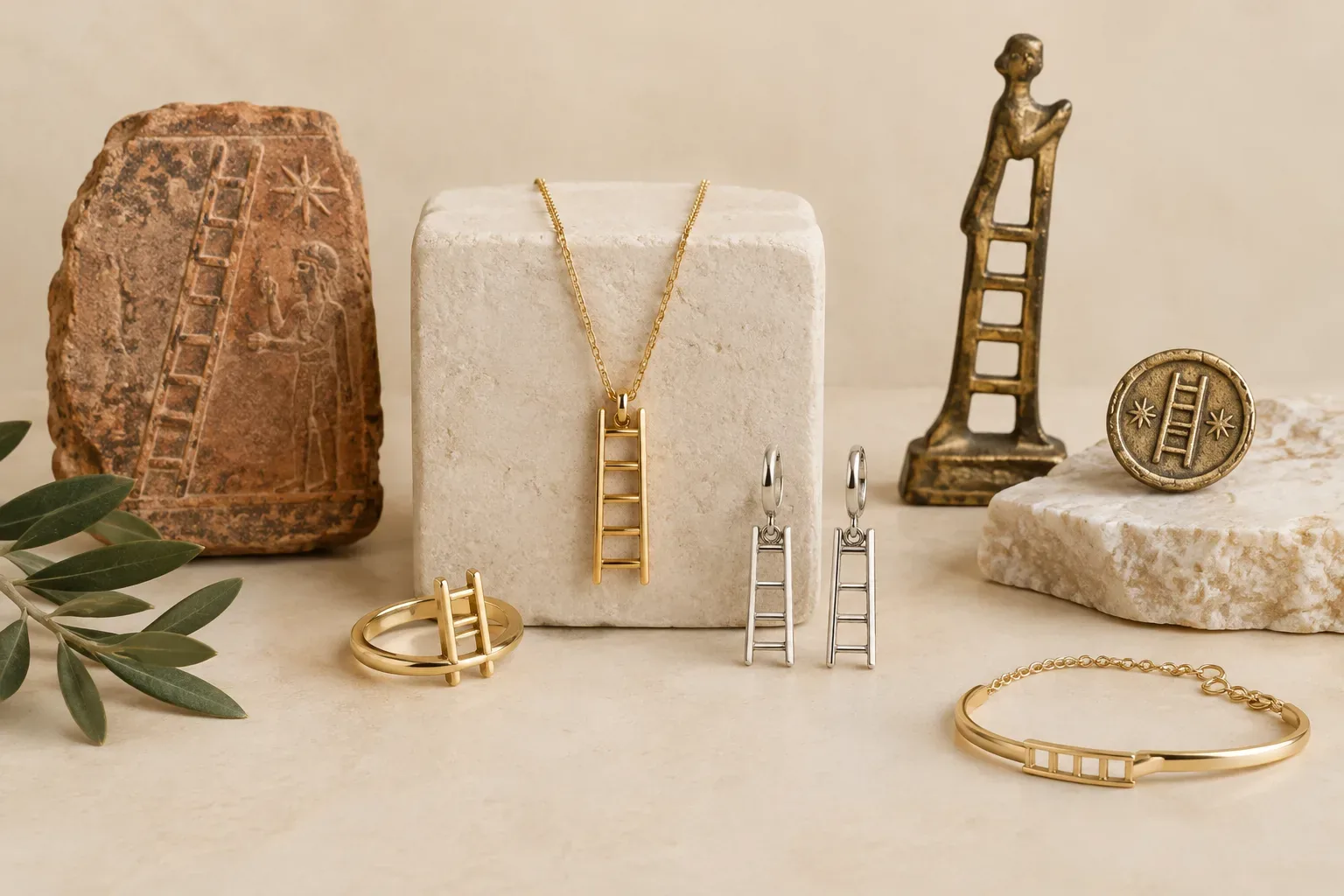
Meaning at a glance
Documented historical evidence for a distinct 'ladder' symbol in jewelry is limited; museums that study jewelry history, including the Victoria and Albert Museum, show that motifs shift with time and context, and the ladder has become a popular modern motif interpreted variously as ascent, connection, or recovery—meanings that are personal rather than universal.
Quick answer
Historical evidence for a specific, consistent ladder symbol in jewelry is sparse; museum scholarship on jewelry shows a wide array of recurring motifs and changing meanings over time but does not establish a single, universal ladder meaning. In contemporary jewelry the ladder motif is commonly used as a visual shorthand for ideas such as progress, steps in a relationship, recovery, or spiritual ascent, but these are modern, personal or marketing interpretations rather than documented historical facts.
What the historical record shows (and what it does not)
Institutions that catalogue and interpret historic jewellery collections, including the Victoria and Albert Museum, emphasise how motifs reflect their social, technological and cultural contexts. The V&A's overview of jewellery history explains how forms and motifs are adopted, adapted and reinterpreted as tastes, meanings and manufacturing techniques change, but it does not present the ladder as a pervasive, clearly defined symbol with a single historical meaning across cultures.
That absence matters. Where a motif like a heart, anchor or cross shows predictable, well-documented meanings in particular periods and places, the ladder does not enjoy the same level of consistent documentation in major museum narratives. Instead, where ladder-like imagery appears in historical objects it tends to be incidental, decorative or part of a larger iconographic program rather than an independently recorded jewellery symbol with a single agreed interpretation.
Cultural and period-specific examples and limits of the evidence
Because comprehensive cataloguing of every motif across all collections is beyond the scope of a short article, the safest historical claim is that there are limited documented instances of ladder-like designs in decorative arts and jewellery, and no single, broadly attested meaning tied to a particular religion or culture in the major reference collections summarised by museums such as the V&A. In other words, the historical record preserved in museum overviews highlights the changing social contexts of motifs but does not support a universal, ancient ladder symbolism in jewellery.
Where ladder imagery has clearer meanings—for example in certain forms of religious or allegorical art outside jewellery—those meanings should be attributed to the specific cultural or religious tradition and not automatically extended to jewellery without direct evidence. The V&A's work on jewellery history is useful precisely because it encourages reading each motif in its documented social and historical context rather than assuming timeless meanings.
Documented history versus modern personal interpretations
Documented history: museums and jewellery historians record motifs and their contexts when there is evidence tying a symbol to a belief, social practice or moment in time. For the ladder motif, such documentary connections in jewellery are not widely established in the major surveys and museum narratives summarised by the Victoria and Albert Museum. That means there is no single historically documented ladder meaning that applies across periods and cultures.
Modern interpretations: in contemporary jewellery the ladder is often used as a versatile metaphor. Designers and wearers commonly interpret it as representing progress, steps toward a goal, spiritual or emotional ascent, recovery after struggle, career advancement, or the idea of building connection between states. These are valid personal or contemporary meanings, but they should be presented as modern interpretations rather than as historical facts.
How the ladder motif appears in jewellery today
Design language: the ladder motif may be literal—a pendant shaped like a miniature ladder with distinct rungs—or abstracted, using parallel bars and connecting elements that evoke steps. Designers also translate the idea into repeated horizontal bars, graduated links, or stacked plain or gem-set bars that suggest progression. The motif works at many scales, from subtle ear studs to statement necklaces and bracelet links.
Use with gemstones and materials: a ladder motif can be combined with accent stones set along the rungs or posts, or with graduated gems that mark each step. Museum resources such as the Victoria and Albert Museum’s A–Z of Gemstones help identify historical uses of particular stones, while consumer guidance from the Federal Trade Commission reminds buyers that gemstone treatments, synthetics and imitations should be disclosed. When purchasing ladder jewellery with gems, ask about stone origin, treatment and any guarantees to ensure you are getting what the seller advertises.
Techniques and finishes: ladder designs may be formed by casting, hand-fabrication, laser-cut metalwork or link construction. Finishes such as polished bars, brushed textures, pavé-set rungs, or enamel inlay change the visual weight and emotional tone of the motif—polished metal reads contemporary and minimal, while mixed metals or hammered bars can feel artisanal or rustic.
Choosing or gifting ladder jewellery: practical and respectful guidance
Be clear about meaning: because ladder symbolism is primarily a contemporary and personal reading, decide whether you want the piece to carry an explicit message. If you intend a symbolic gift—for example to mark recovery, promotion, or a milestone—explain the intended meaning to the recipient in a note so the design is understood as you mean it.
Respect cultural and religious contexts: avoid assuming the ladder has an established sacred meaning for people from different faiths or cultures. If you believe a recipient may attach religious significance to symbols, ask them or someone close to them first. Presenting the motif as an uplifting or practical metaphor rather than a religious emblem reduces the risk of misunderstanding.
Materials and wearability: consider metal allergies and lifestyle. Solid metals like gold or sterling silver are durable for daily wear, while plated or mixed-metal pieces may show wear sooner. When the design includes gemstones, use the FTC’s buying guidance to ask about treatments, synthetic stones, or simulants; reputable sellers will provide disclosure and documentation when applicable.
Quality and construction: check how rungs and connecting bars are attached and whether small links or stones are secure. Ladder motifs with fine links can tangle or snag if worn in active situations, so match the piece to the recipient’s typical activities. For a long-lasting gift, prioritise secure settings and a construction style suited to daily wear if that’s the intended use.
Personalise thoughtfully: a simple personalisation—engraving a date on a bar or choosing a birthstone for a particular rung—can make a ladder motif more specifically meaningful without imposing a broader symbolic narrative. If the meaning you attach is private or sensitive (for example linked to recovery), consider a discrete placement or a private explanation rather than public labelling.
Care and longevity
Routine care for ladder jewellery follows standard jewellery practice: avoid harsh chemicals, store pieces to minimise tangling, and have settings checked periodically. If the ladder incorporates delicate links or many small stones, plan professional inspection and occasional cleaning to maintain structural integrity and appearance.
When buying secondhand or vintage ladder pieces, rely on documentation where possible and ask about repairs or alterations. Museums’ narratives about jewellery history show that styles and techniques change; an older piece may carry charm but also need restoration to be wearable safely.
Frequently asked questions
Is the ladder a traditional symbol in jewellery?
No single traditional or universal ladder meaning in jewellery is well documented in major museum surveys. Institutions such as the Victoria and Albert Museum record how motifs evolve and are reinterpreted; the ladder does appear in some decorative contexts, but it lacks a broadly attested historical meaning across cultures.
What does ladder jewellery commonly represent today?
Contemporary interpretations include progress, steps toward a goal, recovery, spiritual ascent, career advancement, or stages in a relationship. These are modern, personal or marketing meanings rather than proven historical symbolism.
How should I choose a ladder piece as a gift?
Decide whether you want the design to carry an explicit message, consider the recipient’s cultural or religious background, choose durable materials and secure construction for everyday wear, and ask the seller about gemstone treatments or synthetic stones following consumer guidance such as the FTC’s recommendations.
Are gemstones in ladder jewellery different to other pieces?
Not inherently, but when gemstones are used to mark 'steps' or rungs you should ask about stone origin, treatments and certification. The Victoria and Albert Museum’s guides on gemstones explain historical uses, while the FTC advises shoppers to seek full disclosure about treatments, synthetics and imitations.
Can ladder jewellery have religious meaning?
It can for some individuals or communities, but there is no single documented religious meaning for ladder jewellery across cultures. If the recipient might interpret the motif religiously, discuss it with them or choose a design that clearly aligns with the intended context.
Sources and further reading
- Bedazzled: A History of Jewellery — Victoria and Albert Museum
- An A-Z of Gemstones — Victoria and Albert Museum
- Buying Gemstones, Diamonds, and Pearls — Federal Trade Commission