Meaning at a glance
Bridge jewelry meaning combines modest historical evidence for architectural and passage imagery in decorative jewelry with a larger body of modern personal and romantic interpretation; museums document changing social contexts for motifs, while contemporary wearers often choose the bridge for ideas of connection, transition, or support.
Short answer — direct thesis
Bridge jewelry meaning: historically there is limited museum documentation of a single, continuous symbolic meaning for a "bridge" motif in jewelry; institutions that study jewelry trace architectural and passage-related motifs across periods, but most specific meanings—connection, transition, safe passage, reunion—are modern or personal interpretations rather than consistently documented historical beliefs. The Victoria and Albert Museum treats motifs and gemstones as changing with social context and fashion, so the most reliable framing is to separate what museums record about motifs from later sentiment attached to them.
What the historical record actually shows
Museum scholarship treats jewelry as material culture that changes meaning over time. The Victoria and Albert Museum presents jewelry history as a series of shifting forms, materials, and social uses, and it documents how motifs are adopted, adapted, and reinterpreted across eras. This means specific ornamental elements that look like bridges—arches, gates, arbors, or architectural flourishes—appear in objects from different times and regions, but they do not always carry a single, consistent symbolic message.
Where V&A and similar collections identify a clear historic meaning for a motif, that meaning is usually tied to a particular culture, style, or use-case. For example, religious imagery, heraldry, and mourning symbols are well documented in specific periods and places. For architectural or landscape motifs the museum record typically describes decorative use and changing taste rather than a single universal symbolic glossary for a "bridge" image. In short, museum evidence supports that bridge-like elements occur in jewelry designs, but it does not establish a uniform historic meaning across cultures and centuries.
Identifying cultures and periods precisely
When exploring motif history it is important to name the culture or period where scholars have actually documented something meaningful. The Victoria and Albert Museum's surveys cover ancient, medieval, Renaissance, Georgian, Victorian, and modern periods and describe how forms and motifs shift within those contexts. In practice, decorative architectural motifs appear in multiple periods: in classical and Hellenistic metalwork, in medieval reliquary and architectural ornament, and again in the revival styles of the 18th and 19th centuries where designers borrowed arches and gateways as decorative ideas.
Therefore, if you seek a historically grounded meaning for a bridge-like motif, you should look for evidence tied to a specific object, maker, or cultural context noted in museum records. The V&A's approach shows that a motif in a Victorian sentimental locket can have a different social and emotional resonance than an architectural ornament borrowed by an Art Deco jeweller, even if both objects include an arch or span in their design.
Documented historical meanings versus modern personal interpretations
Documented historical meanings: where museums and archives have clear evidence, motifs are interpreted within the context of the object. V&A publications stress that meaning is historically contingent: religious icons have liturgical meanings, mourning jewelry has established conventions, and heraldic devices follow genealogical rules. For the bridge motif specifically, V&A records show decorative and architectural use but do not offer a single, long-standing symbolic definition across cultures.
Modern personal interpretations: in contemporary usage many people adopt the bridge as a metaphor. Today the bridge motif is commonly read as representing connection between people, a transition (for example between life stages), a crossing of difficulties, or reunion after separation. These are contemporary symbolic assignments that reflect present-day language and sentiment rather than consistent historical documentation. They are legitimate personal meanings, but they should be described as modern interpretation rather than proven historical fact.
How the bridge motif and related motifs appear in jewelry
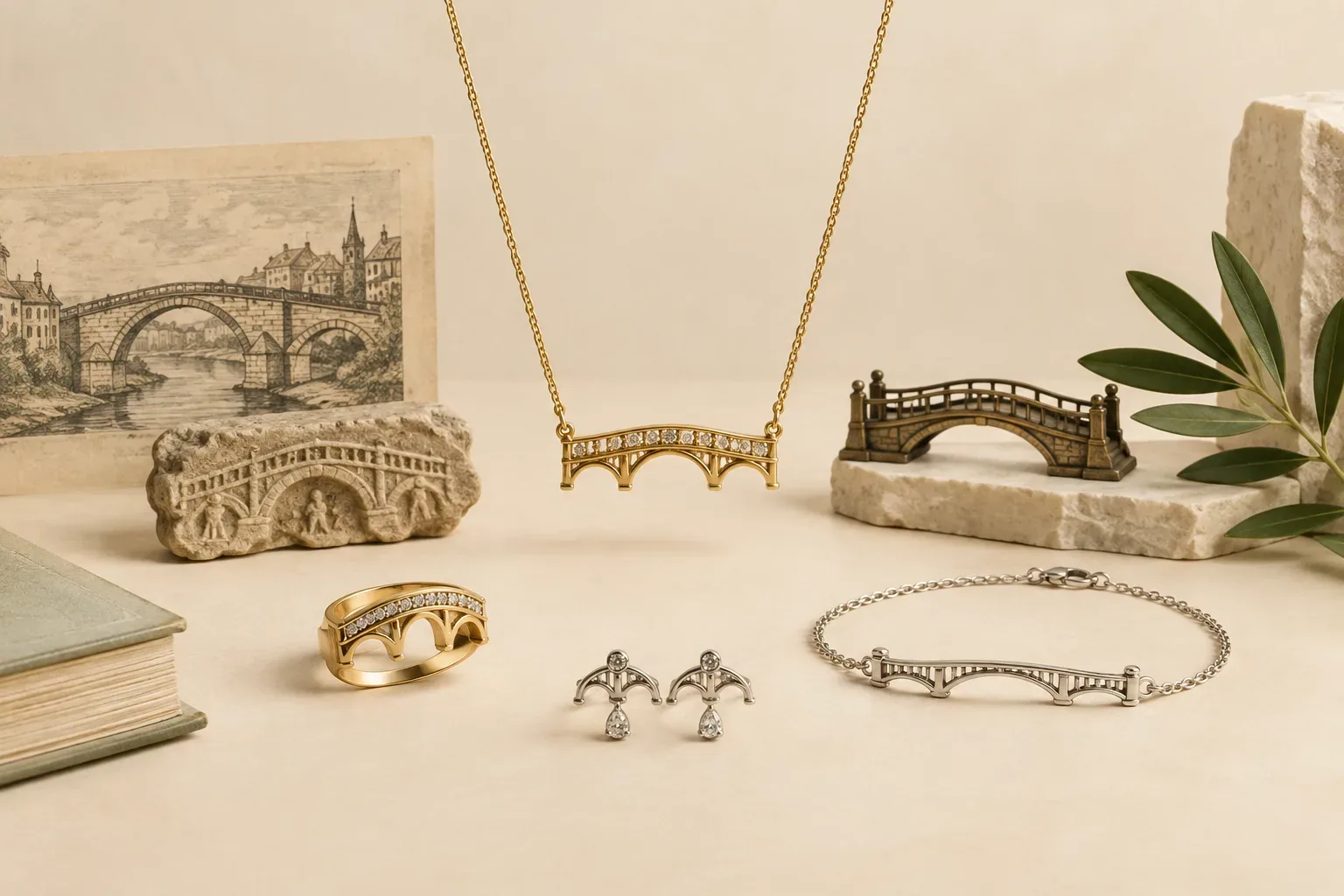
Design vocabulary: jewelers employ the visual language of arches and spans in many ways. The motif can appear as openwork arches in ring galleries, as engraved or pierced arches on pendants and lockets, as repoussé or cast architectural details on brooches, and as illustrative scenes on cameos, enamel, or miniature paintings that include bridges as landscape elements. Museum collections include objects in which architectural motifs are used for framing, structure, or ornament rather than explicit symbolism.
Gemstone and setting choices: gemstones and settings can support bridge imagery. For instance, rows of small stones can form a visual "span," an arch of accent stones can suggest a curve, and cabochons or enamel scenes can portray an actual bridge. The Victoria and Albert Museum's A–Z of gemstones explains historical associations and material uses for particular stones, and it is a useful reference for understanding how gem choice contributes to style and perceived meaning.
Necklaces and lockets: because necklaces and lockets are commonly used to express sentiment, lockets that depict or contain scenes of landscapes including bridges may be read as metaphors for passage or reunion. Museum descriptions emphasize the social function of lockets and portrait jewelry in particular periods, so where a bridge appears in a locket's imagery its meaning should be evaluated in relation to the object’s date and provenance.
Practical and respectful selection or gifting guidance
Respect cultural and personal context. If you intend to give bridge-themed jewelry, consider whether the recipient prefers historically grounded meanings or contemporary metaphors. Because museums attribute different meanings to motifs depending on period and provenance, ask whether the wearer values design history or personal symbolism and explain the distinction when you gift the piece.
Explain documented versus personal meaning. When you give a bridge motif piece, you can include a short note that separates documented history from your personal message. For example: "Historically, museum records show architectural motifs in many periods; I chose this piece to symbolize the connection I feel to you." That approach is respectful and honest about what is historically recorded and what is your sentiment.
Choose materials thoughtfully and check disclosures. The Federal Trade Commission reminds buyers to ask about treatments, imitations, and material disclosure when purchasing gemstones and pearls. If the piece contains colored stones, pearls, or treated gems, verify how those materials were altered and whether that information has been clearly disclosed. Treat the recipient’s preferences and any cultural sensitivities about materials as you would any other stylistic decision.
Match scale and occasion. A small arch motif on a ring or pendant reads differently from a large sculptural brooch or statement necklace. Choose a scale appropriate to the wearer’s usual jewelry habits and the context in which they will wear the piece. If the motif is intended as a memorial or life-transition gift, consider a durable setting and timeless design that can be worn often.
Care, sourcing, and additional buying tips
Sourcing: buy from reputable dealers who provide provenance or clear material information. The Victoria and Albert Museum and responsible dealers both emphasize the importance of provenance for understanding an object’s context. For modern pieces, provenance may mean designer, date, and country of origin rather than centuries-old ownership records.
Material care: consider the construction when selecting a bridge motif item. Openwork arches and pierced galleries can trap dirt and require occasional professional cleaning. Gemstone hardness will affect daily wear. The V&A’s materials overviews are a helpful starting point to understand how different gemstones and metals behave.
Ask about treatments and imitations: follow the FTC’s guidance to request disclosure about heat treatments, dyeing, filling, or synthetic substitutes. Clear information protects both buyer and recipient and allows you to make an informed selection that aligns with budget and expectations.
Conclusion
If you are researching bridge jewelry meaning, start with the distinction between documented museum evidence and modern metaphor. The Victoria and Albert Museum demonstrates that motifs evolve across periods and cultures, and that the same visual device can carry different meanings depending on object, maker, and context. Contemporary wearers and gift-givers commonly adopt bridge imagery to express connection, passage, and reunion—valid personal interpretations but not universal historical facts. Choose and present bridge-themed jewelry with clarity about both the object’s provenance and the personal message you intend to convey.
Frequently asked questions
Is the bridge motif an established historical symbol in jewelry?
No single, continuous historical meaning for a bridge motif is established across cultures. Museum records, as summarized by the Victoria and Albert Museum, show that architectural and landscape motifs appear in many periods but meanings vary by object, culture, and era. Contemporary symbolic uses—such as connection or transition—are modern interpretations unless tied to a documented cultural context.
What does a bridge motif usually mean today?
Today people commonly interpret a bridge motif as symbolizing connection, transition, reunion, or support. These are personal or cultural metaphors rather than universally documented historical meanings, so treat them as contemporary symbolism when gifting or wearing the motif.
How can I tell if a piece with a bridge motif is historically significant?
Look for provenance, maker’s marks, documented date, and museum or dealer cataloguing. The Victoria and Albert Museum’s work on jewelry history shows that meaning and value are tied to context. If an object lacks documented provenance, its historical significance is harder to verify.
Are some gemstones better for bridge-themed jewelry?
Choice of gemstone depends on wearability and the intended message. The V&A’s A–Z of gemstones provides context for historical uses and properties. For everyday wear choose harder gems or protective settings; for symbolic pieces prioritize stones that carry personal meaning to the wearer.
What should I ask a seller before buying bridge jewelry?
Ask about provenance, materials, gemstone treatments, and disclosure of synthetics or imitations. The Federal Trade Commission recommends clear disclosure of treatments, so request written information on any enhancements or substitutes before purchase.
How should I present a bridge jewelry gift respectfully?
Clearly separate documented history from your personal intention. Include a note that explains the gift’s personal meaning and, if relevant, any historical context. Respect the recipient’s cultural or religious background and ask about material or stylistic preferences ahead of time when possible.
Sources and further reading
- Bedazzled: A History of Jewellery — Victoria and Albert Museum
- An A-Z of Gemstones — Victoria and Albert Museum
- Buying Gemstones, Diamonds, and Pearls — Federal Trade Commission