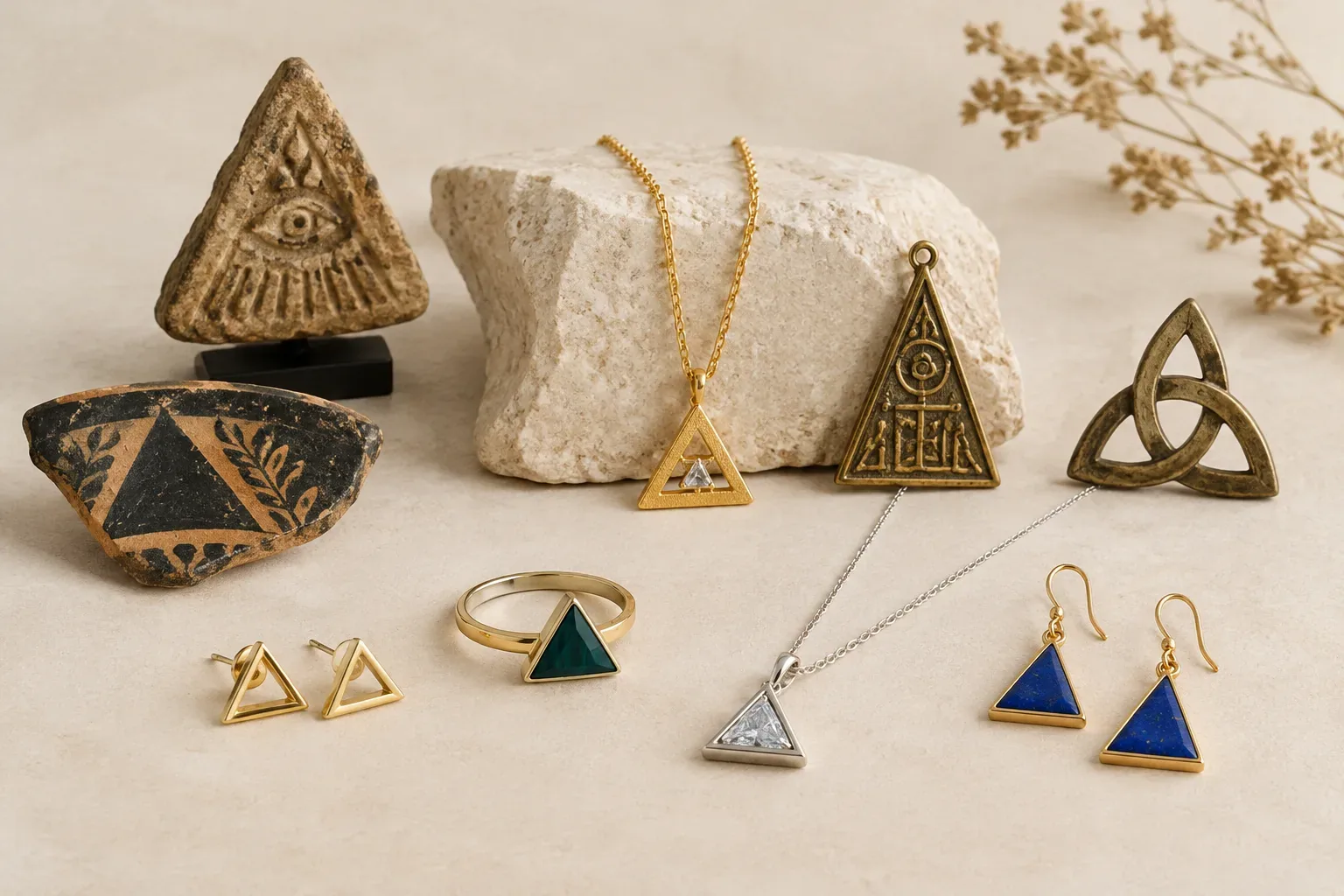
Meaning at a glance
Triangle jewelry meaning is rooted in a long visual history—used in architecture, ornament, and religious art across distinct cultures—while modern wearers attach personal, spiritual, or aesthetic interpretations; this article distinguishes documented uses (as recorded by museums and gem references) from later popular meanings and gives practical buying and gifting advice.
Historical evidence: where the triangle appears and who recorded it
Surviving objects and museum scholarship show that triangles have been used repeatedly as a deliberate motif rather than as a single, consistent symbol. The Victoria and Albert Museum presents the triangle and other geometric forms within a broad history of jewellery and ornament, highlighting how shapes recur in different decorative systems and reflect changing tastes and technologies. The V&A places jewellery within social and material histories, which helps identify when triangle forms were structural, decorative, or loaded with specific meanings in a particular context.
In ancient and early historical contexts the triangle appears as a component of larger decorative schemes—on metalwork, beads, and architectural detailing—where its importance often comes from pattern, balance, or the technical possibilities of the material rather than an explicit, single symbolic message. The V&A collection and interpretation emphasize that such geometric uses were part of wider decorative vocabularies that shifted by place and period.
During later historical periods, triangles were sometimes incorporated into religious architecture and symbolism, but the presence of a triangular motif alone does not prove a uniform theological meaning across cultures. The V&A’s curatorial approach shows that to claim a specific religious interpretation requires contextual evidence from inscriptions, documented rituals, or contemporaneous explanatory texts rather than motif shape alone.
In short, the best-documented claims for the triangle motif come from material and decorative history: museums such as the V&A catalogue and interpret object forms, production methods, and changing social contexts rather than assigning a single cross-cultural meaning to the shape.
Documented historical meanings versus modern interpretations
Documented historical meanings are those that can be tied to specific objects, contexts, or texts. For example, when a triangular motif appears as part of a religious object and is described by contemporary sources as representing a theological idea, the link is documented. The V&A’s work on jewellery history stresses this evidence-based approach: context matters and each culture or period must be considered on its own terms.
Modern interpretations often arise from later readings, revival aesthetics, or contemporary spiritual movements that adopt the triangle as a concise visual shorthand. Today many people interpret triangles as symbols of balance, strength, the threefold (past/present/future, mind/body/spirit, or parent/child/partner), or direction and change. Those meanings are contemporary and personal; they are valid for individual wearers but are not universal historical facts.
Separating the two is important when assigning significance to a piece. If you own or receive an antique triangle pendant, its original maker may have used the motif for decorative rhythm or technical reasons rather than to communicate a modern symbolic message. Conversely, modern designers frequently intend symbolic readings when they use triangles, and those intentions are meaningful for contemporary recipients.
How the triangle motif, gemstones, and traditions appear in jewelry
As a motif, the triangle appears in jewellery in multiple forms: open-frame triangular pendants, solid triangular bezels, repeating triangular patterns in filigree and granulation, and triangular insets in clasp or setting design. Designers use the triangle because its strong lines read clearly at small scale, it stacks well for layered designs, and it can be oriented to suggest motion or stability.
Gemstones are sometimes cut or set to echo triangular geometry. Traditional gem cuts are dominated by rounds, ovals and step cuts, but triangular or trilliant cuts are used in modern and nineteenth–twentieth century jewelry to produce a directional sparkle or to nestle against other stones. The Victoria and Albert Museum’s A–Z of Gemstones provides context on how gem choice, cut, and setting techniques have changed over time, showing that gem shapes and settings both reflect available technology and changing fashion.
Materials and workmanship also influence how triangular motifs are realized. Metalworking techniques recorded in museum collections—such as chasing, piercing, granulation and openwork—allow for delicate triangular patterns. In contemporary pieces the triangle may be combined with mixed metals, enamel, or pavé gemstone settings to create contrast and emphasize the form.
Material, treatment, and disclosure considerations
When evaluating triangle jewelry that includes gemstones, be aware of treatments, imitations, and disclosure practices. The Federal Trade Commission provides guidance on buying gemstones, diamonds, and pearls and emphasizes the importance of seller disclosure about treatments, enhancements, and whether stones are natural, lab-grown, or simulants. That guidance helps protect buyers from surprises and ensures informed choices, particularly when a stone’s origin or treatment affects value or care.
Documentation or a reputable seller’s certificate can confirm whether a triangular-cut stone is natural or treated and whether metal hallmarks match claimed karat or alloy. For historically important pieces, museum catalogues and provenance records contribute evidence; for recent purchases, ask for treatment disclosure, return policies, and any hallmarks or certification that accompany the piece.
Practical and respectful selection and gifting guidance
Choose triangle jewelry by separating three questions: what the wearer values, the cultural context of the motif on the piece, and the practicalities of materials and care. If you are buying for someone who values symbolism, ask whether they prefer an explicit meaning (for example, a triangle representing a personal trinity) or a more aesthetic geometric piece. If the recipient has a specific cultural or religious background, take care to learn whether a triangular motif has particular contemporary resonance for them before gifting.
If the piece is an antique or from another culture, treat its origins respectfully. Learn what the maker or culture documented about the object rather than projecting a modern interpretation onto it. Museum resources such as those at the V&A can help you find historically grounded descriptions and context for older pieces.
For practical matters, follow FTC guidance on buying gemstones: request disclosure on treatments and whether a stone is lab-grown or a simulant, check metal hallmarks, and ask about return policies. Consider the recipient’s daily life when choosing size, weight, and fastening: small open-frame pendants are lightweight and suitable for everyday wear, while thicker or heavier triangular pendants might be better for occasional use.
If gifting a symbolic triangle intentionally, explain your intended meaning in a card or conversation so the recipient understands whether it is meant as personal, spiritual, or purely aesthetic. When in doubt, choose neutral phrasing about balance, direction, or design, and avoid asserting a universal spiritual meaning.
Wearing styles and care
Triangle pieces are versatile in modern wardrobes. A small, simple triangle pendant suits layering with chains of different lengths, while a bold geometric collar or statement earrings make the triangle the visual focus. Orientation matters: a triangle pointing upward reads differently from one pointing downward, and contemporary designers use that orientation deliberately to suggest stability or openness.
Care depends on materials. For metal forms, store pieces away from moisture and chemicals and polish with a soft cloth. For gemstone-set triangles, follow the seller’s care instructions and be aware that some treatments require gentler cleaning. If you are unsure about a stone’s treatment or stability, request documentation from the seller as recommended by the FTC.
Final note
Triangle jewelry meaning is best understood as a layered conversation between documented historical uses and contemporary personal or design-led interpretations. Museums like the Victoria and Albert Museum record how shapes functioned in specific times and places, and consumer guidance from the Federal Trade Commission helps buyers navigate material facts about gems and treatments. Respect context, ask questions when provenance or cultural significance matters, and choose or gift triangle pieces with an awareness of both their visual power and the wearer’s values.
Frequently asked questions
Does a triangle always mean the same thing in jewelry?
No. The triangle’s role depends on period, culture, maker intention, and wearer interpretation. Museums such as the Victoria and Albert Museum show that in many historical objects the triangle was a decorative or structural form; modern symbolic meanings are often personal or design-driven rather than universally historical.
Can a triangle motif be a religious symbol?
Sometimes—if contextual evidence ties it to religious practice or texts. A triangle appearing on a documented religious object with contemporary explanation can carry religious meaning, but the motif alone does not prove a religious interpretation across cultures.
Are triangular gemstones less valuable or more fragile?
Value and durability depend on the gem species, cut, and any treatments. The Federal Trade Commission recommends asking sellers about treatments, origins, and care. Trilliant or triangular cuts may show different wear patterns but are not inherently less valuable than other cuts.
How should I gift a triangle pendant respectfully?
Consider the recipient’s cultural and spiritual background, explain your intended meaning if you ascribe one, and choose appropriate materials and size for their lifestyle. If the piece is antique or from another culture, learn about its provenance before presenting it as a symbolic gift.
What orientation should a triangle pendant have when worn?
Orientation is a stylistic choice. An upward-pointing triangle commonly reads as stable or ascending in contemporary design, while a downward-pointing triangle can read as receptive or feminine in some modern usages. Neither orientation has a universal meaning; choose what suits the wearer’s aesthetic and comfort.
How can I verify a gemstone or metal claim for a triangle piece?
Request documentation, certificates, and treatment disclosure from the seller. Check for metal hallmarks and ask for independent appraisal if the piece is expensive or claimed to be historically important, following FTC guidance on gemstone purchases.
Sources and further reading
- Bedazzled: A History of Jewellery — Victoria and Albert Museum
- An A-Z of Gemstones — Victoria and Albert Museum
- Buying Gemstones, Diamonds, and Pearls — Federal Trade Commission