Meaning at a glance
Hourglass jewelry meaning lies in its historic association with time and transience—documented most clearly in Western memento mori and mourning contexts—and in a range of modern personal interpretations; choose pieces with attention to materials, provenance, and the recipient's values.
Historical evidence and cultural contexts
Museums and curators warn against assuming a single, universal meaning for any symbol, and the Victoria and Albert Museum (V&A) is explicit that jewellery acquires and changes meanings as social contexts shift. V&A resources on the history of jewellery show how objects that mark time and life—such as lockets, watches, and other time-related motifs—became important in different social practices, including mourning and commemoration.
In Western visual culture, the hourglass appears alongside other time-related symbols in memento mori imagery. The use of such symbols in personal adornment is best documented in European contexts where jewellery functioned as a public and private sign of grief, memory, and moral reflection. The V&A's surveys of jewellery history describe how these motifs were incorporated into mourning jewellery and sentimental pieces, particularly in the social climates that emphasized visible signs of remembrance.
Beyond European mourning contexts, the hourglass as a functional instrument for measuring time existed in many cultures as a practical device. However, the specific symbolic use of the hourglass motif in jewellery—especially as an explicit emblem of mortality and the passage of time—is most thoroughly documented in Western collections and displays curated by museums such as the V&A.
Documented historical meanings versus modern interpretations
Documented historical meanings are those attested in museum collections and curatorial literature. The V&A's work on the history of jewellery shows that time-related symbols, including hourglasses when present, were often read within a memento mori or mourning framework: they could remind viewers of life's brevity or mark the memory of a lost person. Those are historical, evidence-based readings tied to specific social uses of jewellery.
Modern personal interpretations are diverse and not universal. Contemporary wearers may adopt an hourglass motif to mean patience, a reminder to live in the present, an emblem of productivity or deadlines, a symbol of personal transformation, or simply an appreciation for the form. Some people choose it as a fashion statement with no intended symbolic meaning. These modern readings are valid as personal expression but should not be conflated with the historical record.
How the hourglass motif, gemstones, and traditions appear in jewelry
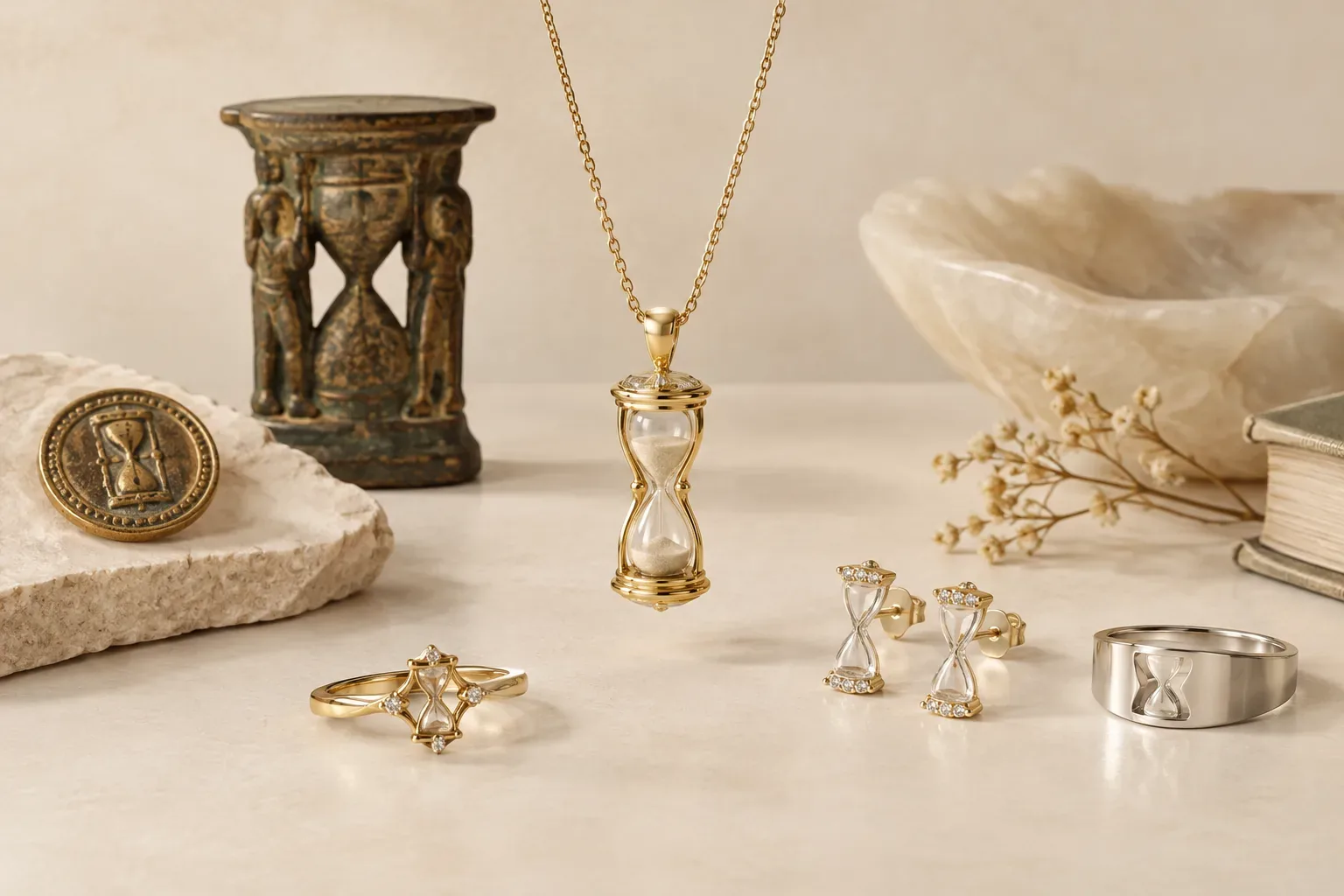
As a motif, the hourglass appears in jewellery in several ways: as a literal miniature hourglass set into a pendant or charm; as a stylized silhouette engraved or cast into metal; as part of a larger composition on brooches, lockets, and rings; or as an element paired with other memento mori motifs such as skulls, wilting flowers, or hour marks. Designers working in historical revival styles sometimes recreate Victorian or Georgian approaches to symbolism, while contemporary designers may simplify the shape into a modern geometric icon.
Gemstones are used in hourglass-themed pieces both as accents and as symbolic substitutions. Historical and museum guidance on gemstones, such as the V&A's A–Z of Gemstones, explains that particular stones have their own histories and associations and that gem choice affects appearance, durability, and cost. For example, deep-colored stones may be chosen for mourning-style pieces because of their visual tone, while bright stones can render the motif more celebratory or decorative.
Materials and construction vary: solid metal silhouettes are common for minimalist interpretations; enamel inlay and niello work appear in historically influenced pieces; and contemporary makers sometimes include tiny, working sand-filled hourglasses in pocket pendants or novelty objects. The presence of moving sand or glass elements creates a literal kinetic reference to passing time but also demands different care and adds fragility.
Practical guidance for choosing or gifting hourglass jewelry
Consider the recipient and the occasion. If the recipient has a known interest in history, memorial art, or symbolism, a historically informed piece—such as a Victorian-style locket with an hourglass motif—may be appreciated. If the piece is intended as a sympathy gift, be sensitive: some people find memento mori imagery comforting and meaningful, while others may find it too explicit. For celebratory occasions, opt for lighter, less funeral-associated treatments of the motif such as a simple silhouette pendant or a ring with an hourglass accent.
Choose materials with longevity and meaning in mind. If you want the piece to be wearable every day, select durable metals (for example, gold or platinum) and understand the properties of any gemstones. The V&A's gemstones guide explains that stones differ in hardness, colorfastness, and historical associations, and these factors affect suitability for daily wear.
Ask about treatments, imitations, and disclosure. The Federal Trade Commission (FTC) provides consumer guidance on buying gemstones, diamonds, and pearls and emphasizes that sellers must disclose treatments and the presence of lab-created or imitation materials. If provenance, untreated stones, or antique authenticity matter to you or your recipient, request documentation and clear labeling from the seller.
Think about personalization. Inscriptions, small attached charms, or pairing the hourglass motif with a birthstone or engraved date can shift the piece from a public symbol to a private memory. If gifting to someone who values subtle symbolism, choose a discreet placement (inside a locket or on the reverse of a band) rather than a prominent exterior depiction.
Budget and ethical considerations also matter. Discuss sourcing with the seller if ethical mining or recycled metals are priorities. Many contemporary jewelers will share whether materials are recycled, Fairmined, or conflict-free; this communicates care that often aligns with the symbolic intent of time and stewardship embodied by the hourglass.
Care, authenticity, and buying considerations
If a design includes moving parts or a tiny glass vial with sand, recognize the increased fragility and need for careful handling and occasional repair. Solid metal or engraved motifs are more robust for active wearers.
Ask the seller to explain gemstone treatments and whether gems are natural, treated, or lab-created. The FTC advises consumers to seek clear disclosure about treatments and imitation materials; reputable sellers provide that information and any relevant certificates. For antiques, provenance and documented restoration work affect both value and meaning.
For historically styled pieces purchased as antiques or reproductions, consult the seller and, when possible, museum or scholarly references to understand which attributes are original and which are modern additions. The V&A's approach to jewellery history underlines that many motifs are reused and repurposed across periods; accurate description helps preserve the distinction between original context and contemporary reuse.
Final thoughts
Hourglass jewelry meaning is best understood as layered: a documented historical layer in which the motif participated in Western practices of memento mori and mourning, and a living contemporary layer in which individuals assign personal significance or enjoy the motif aesthetically. Museums such as the V&A provide documentary context showing how motifs change with taste and social meaning, and consumer guidance from the FTC helps buyers navigate material and disclosure concerns.
If you are choosing or giving hourglass jewelry, be deliberate about what you want the piece to say. Consider context, materials, and transparency from the seller, and remember that the most lasting meanings are those that the wearer recognizes and values.
Frequently asked questions
Does an hourglass always symbolize death?
No. Historically in Western memento mori contexts the hourglass often signified the passage of life and the finitude of time, but modern wearers attribute a range of meanings—patience, transformation, deadlines, or aesthetic preference. The historical association with mortality is documented in museum literature, while contemporary meanings vary by individual.
Is hourglass jewelry appropriate as a sympathy gift?
It can be appropriate for some recipients, particularly if they appreciate symbolic memorial objects, but others may find the imagery too explicit. When in doubt, ask about the recipient’s preferences, consider a subtler design such as an inside-engraved locket, or choose a different symbol of remembrance.
Are tiny working hourglass pendants durable for daily wear?
Noisy, kinetic, or sand-filled micro-hourglasses are fragile compared with solid metal or engraved motifs. If the recipient needs a robust everyday piece, choose a design without moving parts or one made in durable materials and construction.
How should I check whether gemstones are real or treated?
Ask the seller for full disclosure. The Federal Trade Commission advises buyers to request information about treatments, lab-created stones, and any certificates. Reputable sellers will provide clear answers and documentation when available.
Can hourglass designs be combined with birthstones or initials?
Yes. Personalization such as adding a birthstone, engraving a date or initial, or pairing the motif with another charm can shift the piece from a public symbol to a private memento, often making it a more meaningful gift.
Where can I learn more about the historical use of time motifs in jewelry?
Museum publications and collections are a good starting point; for example, the Victoria and Albert Museum’s work on jewellery history discusses how motifs change with social context and how time-related symbols have been used in mourning and commemoration.
Sources and further reading
- Bedazzled: A History of Jewellery — Victoria and Albert Museum
- An A-Z of Gemstones — Victoria and Albert Museum
- Buying Gemstones, Diamonds, and Pearls — Federal Trade Commission