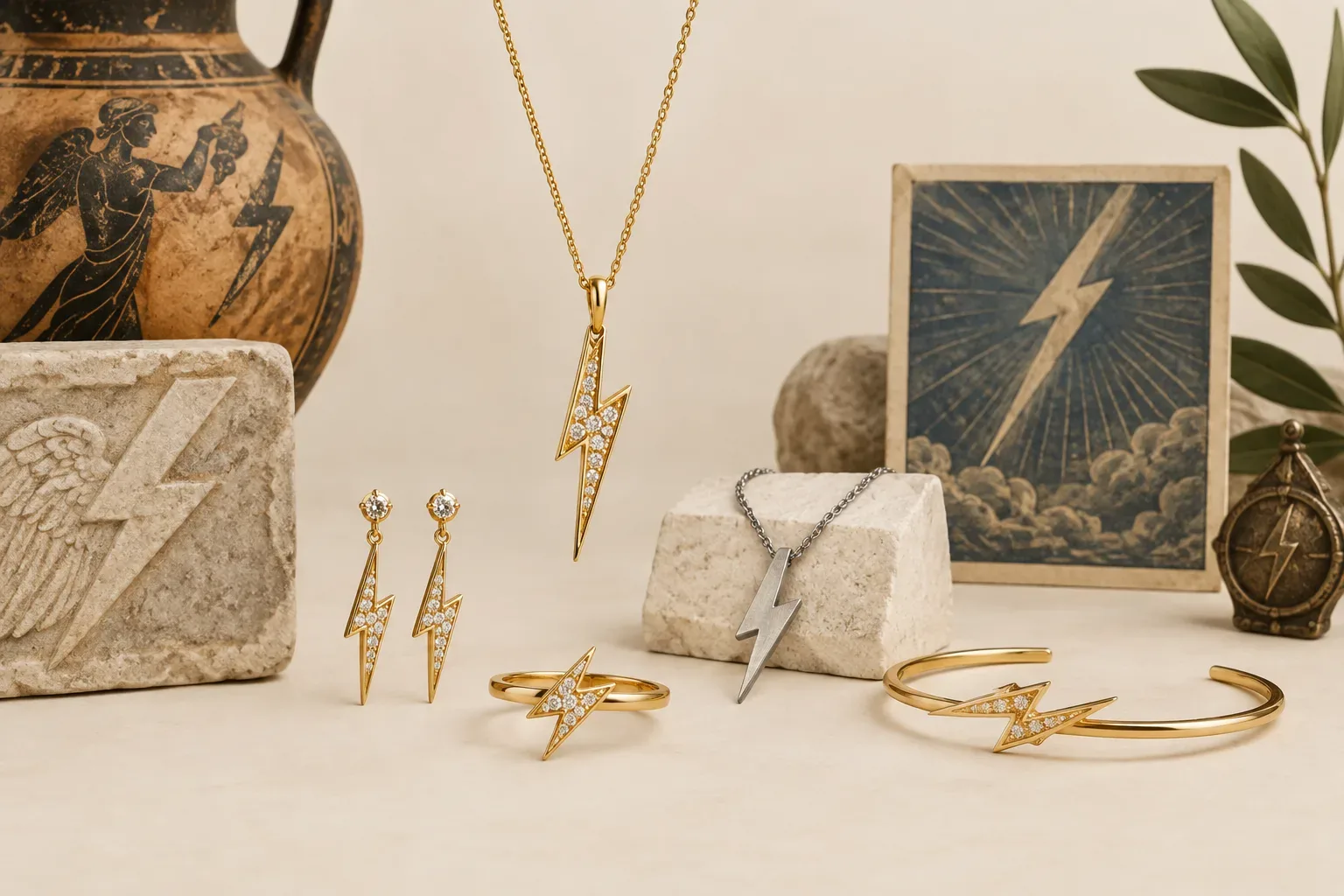
Meaning at a glance
This article explains the documented history and changing contexts of the lightning bolt motif, separates cultural and religious evidence from modern personal interpretations, and offers practical guidance for choosing and wearing the motif in modern jewelry.
Direct answer — quick thesis
Explain the documented history and changing contexts of the lightning bolt motif, separate cultural or religious evidence from later popular interpretations, and give practical guidance for choosing and wearing the motif in modern jewelry.
What the historical record shows (and how we know it)
Museum surveys of jewelry note that imagery drawn from nature and natural forces—lightning included—has been adapted into personal ornament across many times and places. The Victoria and Albert Museum frames this idea in its exhibitions and curatorial commentary: decorative motifs often reference the wider visual language of a period, including symbolic representations of weather and power, and are best understood in their original social contexts rather than as single, fixed meanings. The V&A's overview of jewelry history emphasizes changing social context and function as central to interpreting any repeated motif.
Because the lightning-bolt shape is visually distinct and easy to stylize, it recurs across periods—from decorative elements inspired by classical art, through stylized devices in later European decoration, to 20th-century graphic motifs used in costume jewelry and popular culture. The V&A's historical treatment of jewelry collections links examples like these to evolving fashion, technology, and symbolism. Those museum records and catalogues are the primary public documentation that ties the motif to specific periods in dress and display.
Which periods and traditions are documented (precise but generalizable)
Curatorial surveys break the motif’s appearances into broad periods rather than a single, global origin. In the classical and post-classical tradition visible in many Western collections, motifs borrowed from myth and nature can appear on signet rings, cameos, and engraved gems that circulated in the Mediterranean and later in European collections. During the Renaissance and subsequent centuries, jewelers working in Europe adapted classical and heraldic images into brooches and pendant ornamentation, reflecting their cultural and political contexts. Museums such as the V&A treat these categories—classical, medieval, Renaissance/early modern, and modern—as useful period labels for how motifs evolve.
In the 18th and 19th centuries jewelry catalogs and museum holdings show a continued interest in symbolic motifs as part of sentimental and fashionable ornament. In the 20th century the lightning bolt is clearly visible in commercial and costume jewelry as designers referenced industrial power, speed, or electrical progress, and later in pop culture styling. The V&A's
Documented historical meanings versus modern personal interpretations
Documented historical meanings are those attested in the surviving objects, inventories, inscriptions, or contemporary descriptions recorded by curators and historians. The V&A emphasizes that many motifs signaled status, allegiances, trade connections, or references to classical learning; museums derive interpreted meanings from object context and contemporary texts. For the lightning bolt specifically, museum interpretation tends to present it as one of several nature-derived or power-related motifs used decoratively or emblemically rather than as a single, universally fixed religious sign.
Modern personal interpretations—claims that a lightning bolt always means empowerment, rebellion, or spiritual awakening—are contemporary readings that may be meaningful to wearers but are not the same as historically documented uses. Popular culture, music, and branding have layered new connotations onto the motif, and many people adopt those modern meanings intentionally. Distinguishing the two is important: historical museum evidence supports that the motif circulated with varied meanings across time, while present-day wearers may choose the bolt for personal, aesthetic, or subcultural reasons.
How the lightning bolt motif appears in jewelry (forms, materials, gemstones)
Jewelry makers render the lightning bolt motif in many forms: small stamped or engraved devices on rings and signet stones, openwork or sculpted brooches and pendants, simple charms on chains, and as part of more graphic costume pieces. In fine jewelry the motif may be worked in metal as a stylized strike, sometimes set with accent stones to catch light at the edges of a zigzag. In costume jewelry the bolt can be oversized and enamelled or be used as a repeating pattern.
Gemstones and cuts are chosen for complementary effects rather than any single established symbolic rule. The Victoria and Albert Museum's A–Z of Gemstones explains that different stones and cuts were historically chosen for their visual properties, durability, and cultural associations. Designers often use bright, faceted stones to simulate the flashing quality of lightning or contrasting dark inlays to emphasize the bolt’s silhouette. Contemporary makers may mix metal finishes—polished, matte, or blackened—to enhance contrast. Where gemstones or treated materials are involved, the U.S. Federal Trade Commission’s guidance on buying gemstones, diamonds, and pearls applies: sellers should disclose treatments and imitations so buyers understand what they are purchasing.
Practical guidance for choosing or gifting lightning bolt jewelry
Decide whether your priority is historical resonance, aesthetic impact, or personal symbolism. If you want a piece rooted in historical craft or collector interest, look for makers and dealers who document provenance and technique; museum descriptions collected by institutions like the V&A show how important context is to understanding meaning. If the gift is meant to convey a modern sentiment—such as encouragement, boldness, or individuality—select a style and scale consistent with the recipient’s wardrobe and daily habits.
Confirm materials and disclosures on any gemstone or treated material. The U.S. Federal Trade Commission urges consumers to ask sellers about treatments, enhancements, and whether gems are synthetic or imitation. For budget-conscious gifting, quality of finish and secure settings often matter more than stone size for a motif-driven piece. For everyday wear choose durable metals and secure settings; for occasional wear, decorative finishes and enamel are acceptable but may require more careful handling.
Be respectful about cultural associations. If a maker explicitly links a bolt design to a particular religious or cultural tradition, read their explanation and consider whether the recipient would appreciate that association. When in doubt, opt for a neutral aesthetic description—such as “lightning motif” or “bolt pendant”—and pair the gift with a note explaining why you chose it, whether for its visual energy, technological symbolism, or personal meaning.
Styling, care, and long-term considerations
Styling choices depend on scale. Small bolt charms layer easily with other pendants; larger sculptural bolts work as statement pieces and suit simpler clothing so the motif stands alone. Consider metal colour and the recipient’s existing jewellery: warm gold tones alter the visual warmth of the motif while silver and white metals give a crisp, graphic look.
Care depends on materials. Solid precious metals are resilient but still benefit from regular cleaning and safe storage. Enamel and plated finishes need gentler handling to avoid chipping or wear. If gemstones are present, follow any seller care instructions and ask about treatment disclosures before purchase so you understand cleaning limits. The FTC recommends consumers keep records of any seller statements about treatments or warranties when buying gemstones.
Frequently asked questions
What does lightning bolt jewelry mean?
Historically the lightning bolt appears in jewellery as a visual motif drawn from nature and power imagery; museum interpretation shows it carried varied, context-dependent meanings rather than a single universal meaning. Today many people wear it for personal reasons—strength, speed, or aesthetic impact—but those modern meanings are distinct from documented historical uses.
Is the lightning bolt a religious or cultural symbol I should avoid?
The motif has been used in different contexts and may carry religious or cultural resonance in specific cases. If a piece claims a direct religious or cultural origin, ask the maker for documentation and consider whether the recipient would appreciate that link. When uncertain, choose a neutral description and be open about your intentions when gifting.
Which gemstones suit a lightning bolt design?
Designers tend to choose gemstones for visual effect—bright, faceted stones to mimic flashes or dark inlays for contrast. The Victoria and Albert Museum’s overview of gemstones explains how historical choices were based on visual properties and durability; there is no single stone required for a bolt motif.
How can I be sure a gemstone or treated stone is described accurately?
The U.S. Federal Trade Commission advises buyers to ask sellers directly about any treatments, enhancements, or whether a gem is synthetic or imitative, and to keep written statements. Reputable sellers will disclose treatments and provide clear descriptions.
How should I care for lightning bolt jewellery?
Care depends on materials: solid precious metals are durable but benefit from routine cleaning and proper storage; enamel and plated finishes need gentler handling; and gem-set pieces should follow any seller care instructions to avoid damage. If unsure, ask the maker for recommended maintenance.
Sources and further reading
- Bedazzled: A History of Jewellery — Victoria and Albert Museum
- An A-Z of Gemstones — Victoria and Albert Museum
- Buying Gemstones, Diamonds, and Pearls — Federal Trade Commission