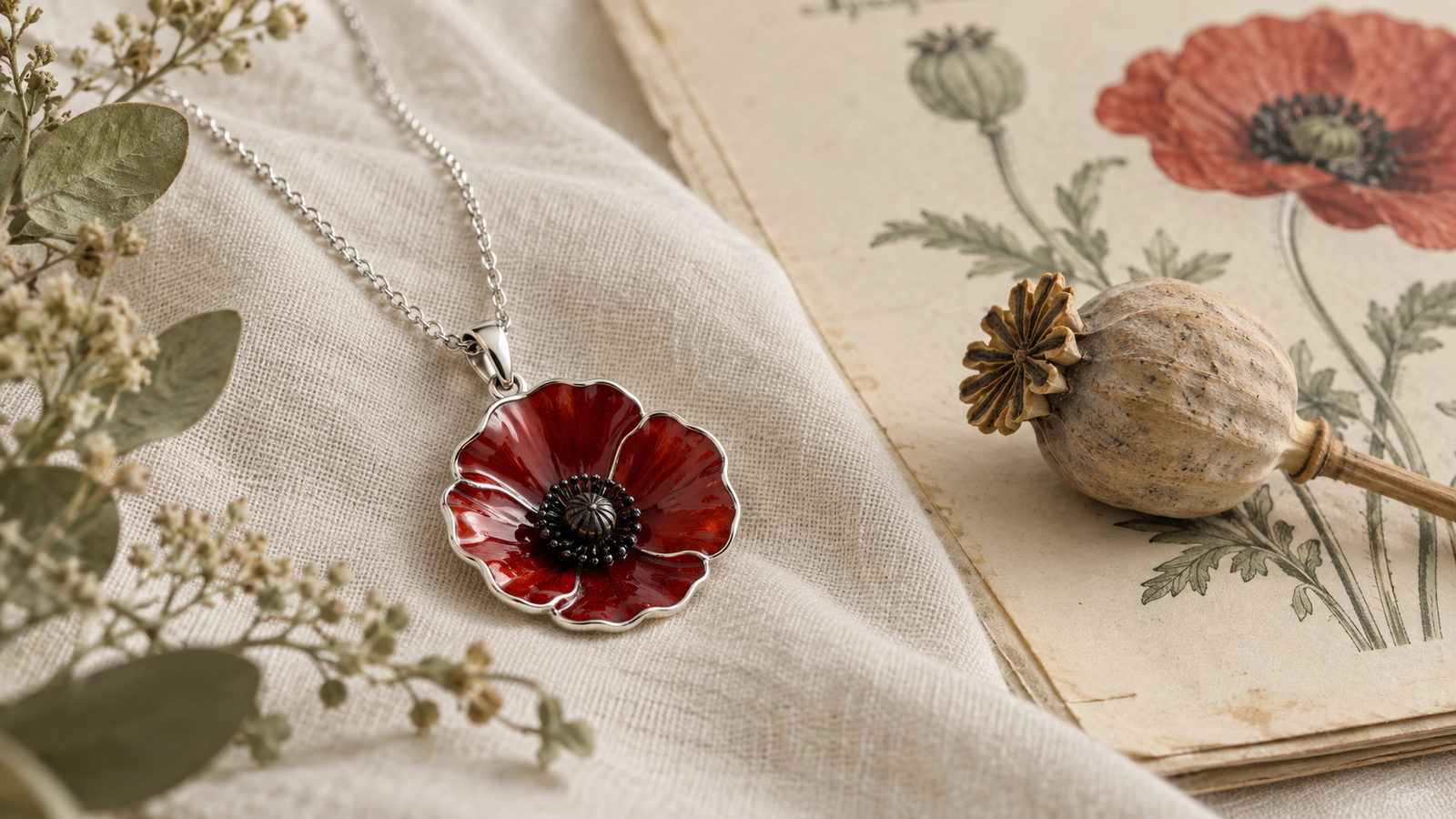
Meaning at a glance
Poppy jewelry can express remembrance, sleep, consolation, hope, or a personal love of flowers; these meanings arise from different poppy species and historical contexts rather than from a single universal symbolism.
Historical evidence and cultural specifics
The best-documented historical sources separate three different strands that feed modern poppy jewelry meanings. First, the modern red-poppy symbol of wartime remembrance and commemoration emerged after the First World War. The Canadian War Museum describes how the poppy became tied to remembrance through wartime poetry, appeals, and fundraising campaigns in the years following 1918, and the Library of Congress has summarized how Poppy Day observances consolidated into public practice in the United Kingdom during the same period.
Second, poppies have long appeared in imagery of sleep and dreams, while the strongest linguistic and pharmacological connection belongs to the opium poppy, Papaver somniferum, whose name means sleep-bringing. The Royal Botanic Gardens, Kew explains that the common or field poppy and the opium poppy are distinct species. That distinction matters when interpreting jewelry: a seed-pod form may invoke older sleep imagery, while a bright red field-poppy emblem in a modern commemorative setting more often references remembrance.
Third, beads and pendants shaped like poppy buds or seeds appear in very early jewelry. Museum objects identified by The Metropolitan Museum of Art and the British Museum show that makers in ancient Egypt and Nubia adopted floral and bud forms—including items described as poppy-seed pendants or poppy-bead necklaces—long before modern national remembrance practices. Those records demonstrate long-term use of the motif, but they do not establish a single universal meaning for ancient wearers.
Documented historical meanings versus modern personal interpretation
When we separate documented history from contemporary personal meanings, a clearer picture emerges. Documentary evidence supports the red poppy’s connection with post–First World War remembrance, the opium poppy’s link to sleep and narcotic imagery, and the motif’s long presence in ancient jewelry collections. These are discrete, traceable lines of meaning supported by museum records and botanical scholarship.
By contrast, modern personal interpretation is much broader. Contemporary wearers and designers may choose poppy jewelry to signify private grief, hope after loss, solidarity with veterans, an interest in sleep and dream imagery, or simply an aesthetic preference for a floral motif. In this guide, color, context and wearer intention are therefore treated as essential clues rather than fixed rules. Two people might wear visually similar poppy pendants with very different meanings in mind, and no single interpretation should be assumed from appearance alone.
How the poppy motif and related traditions appear in jewelry
Poppy imagery appears in jewelry in several recurring ways: naturalistic floral renditions, stylized buds or seed-pod forms, symbolic red poppy emblems, and beaded or inlaid interpretations. Ancient examples in museum collections are often small beads or seed-pendant shapes that reference the flower bud or seed capsule rather than large, open petals. The Metropolitan Museum of Art and the British Museum catalogue objects described as poppy-bead necklaces and poppy seed pendants, showing how makers used the bud and seed form in personal ornaments.
Modern makers often use color and material to convey particular references. A red enamel or fabric poppy worn in November in Commonwealth countries commonly signals remembrance because of the post–First World War tradition. Conversely, a pendant with a sculpted seed capsule, darker tones, or opulent materials might intentionally evoke the opium poppy’s associations with sleep and dreaming, whether to reference myth, medicine or poetic imagery. Designers also adapt the form into minimalist gold outlines, sterling silver botanicals, diamonds set as flower centers, or hand-painted enamel for a botanical look. The visual choices—color, degree of realism, and the presence of textual or other symbolic elements—shape how viewers are likely to understand the piece.
Practical and respectful selection or gifting guidance
Choose a poppy piece with an awareness of context. If you are buying or gifting a red poppy emblem close to Remembrance Day, remember that many wearers will associate it specifically with wartime loss and veterans. The red poppy is an acknowledged commemorative symbol in countries such as the United Kingdom and Canada as described by the Library of Congress and the Canadian War Museum, so wearing or gifting that symbol in those contexts can be meaningful but should be done with sensitivity.
When the intended meaning is private—consolation, personal memory, or simply floral taste—consider explicitly communicating your intent to avoid misunderstanding. A short note that explains why you chose the piece, or a card describing the poetic meaning you intend, helps the recipient understand whether the gift honours a bereavement, celebrates survival, or is purely decorative.
Respect historical and botanical distinctions. If you want to reference sleep or dream imagery, a seed-pod form can make that intention more legible than a bright red memorial-style emblem. If you wish to avoid a wartime connotation, choose an abstract or clearly botanical design and explain the personal meaning rather than assuming another flower color is culturally neutral.
Consider the recipient’s background and public setting. Some people wear remembrance poppies publicly for commemorative events but prefer not to display such motifs in everyday social or workplace environments. If you are gifting to someone with military ties or a known family history, a remembrance poppy may be welcomed. If the recipient’s relationship to those topics is unknown, a neutral, botanical poppy design accompanied by your explanation is often the most respectful choice.
Materials and craftsmanship matter practically as well as symbolically. Choose durable metals and secure settings for frequently worn pieces, and be mindful of allergies and preferences for sustainable or conflict-free materials if those values are important to the recipient. A well-made poppy brooch, pendant or pair of earrings will communicate care and thoughtfulness regardless of the symbolic nuance you intend.
Closing considerations
Poppy jewelry can communicate several different messages, and those messages depend on species reference, historical context and wearer intention. The red poppy’s role in twentieth-century remembrance is a distinct cultural development documented by war museums and national libraries. Sleep and narcotic imagery are tied most directly to the opium poppy as noted by botanical authorities, while museum collections demonstrate a long history of poppy-shaped ornaments without proving a single ancient meaning.
When choosing or giving poppy jewelry, attend to colour, form and context and, where appropriate, make your intention explicit. That approach respects both the historical record and the wide range of personal meanings people attach to this versatile floral motif.
Frequently asked questions
Does a red poppy always mean remembrance?
No. A red poppy commonly signals remembrance in many Commonwealth countries because the modern memorial use developed after the First World War, but meaning depends on place and wearer. The red-poppy commemorative tradition after World War One is documented by the Canadian War Museum and the Library of Congress, and the same visual motif can carry different personal meanings in other contexts.
Is the sleep symbolism tied to all poppies?
Poppies broadly appear in sleep and dream imagery, but the strongest linguistic and pharmacological connection belongs to the opium poppy (Papaver somniferum), whose name means sleep-bringing. Royal Botanic Gardens, Kew explains that the common field poppy and opium poppy are distinct species.
Did ancient cultures use poppy motifs in jewelry?
Yes. Museums including The Metropolitan Museum of Art and the British Museum catalogue beads and pendants identified as poppy or poppy-seed forms from ancient contexts, showing that floral and bud shapes appear in early personal ornaments. Museum identifications are descriptions of form and do not necessarily establish a single ancient symbolic meaning.
Is it appropriate to gift poppy jewelry to a veteran?
It can be appropriate and meaningful, but sensitivity matters. Many veterans and families appreciate remembrance symbols, especially around commemorative dates. If you are unsure, consider asking discreetly or include a note explaining your intent so the recipient understands whether the gift is meant to commemorate service, to console, or to celebrate personal taste.
Can poppy jewelry mean different things to different people?
Yes. Modern poppy symbolism is flexible: people may wear poppy jewelry for remembrance, consolation, hope, dream imagery, or simply because they love the flower. Color and context can suggest a tradition, but the wearer's stated intention is the safest guide.
How should I choose a poppy design to avoid misunderstanding?
Select color, form and material with intention. Avoid a bright red memorial poppy if you do not intend a remembrance message. Choose stylized, multicolored or botanical designs and accompany the piece with a note explaining your meaning when gifting, so the recipient receives the intended message.
Sources and further reading
- A tale of two poppies — Royal Botanic Gardens, Kew
- A poppy's tale — Royal Botanic Gardens, Kew
- Remembrance: The Poppy — Canadian War Museum
- 100 Years of Poppy Day in the United Kingdom — Library of Congress
- Poppy-Bead Necklace — The Metropolitan Museum of Art
- Poppy seed pendant and beads from Amara West — The British Museum