Meaning at a glance
Explain the documented history and changing contexts of the lion motif, separate cultural or religious evidence from later popular interpretations, and give practical guidance for choosing and wearing the motif in modern jewelry.
What the historical record shows — evidence and cultures
Surveys of jewelry history held and published by the Victoria and Albert Museum (V&A) demonstrate that animal motifs, including lions, appear across a wide range of times and places. The V&A's work on the history of jewellery emphasizes that motifs are adopted and adapted differently by different cultures, and that similar shapes do not imply identical meanings across time or region.
The V&A collection and interpretive materials point to recurring contexts in which lions appear: in objects associated with rulership and public display, on personal adornment worn by elites, and in decorative arts that signify status. Examples in the museum literature span ancient and classical periods through medieval and modern Europe, as well as objects from South Asia and other regions where the museum collects and interprets material culture. The archaeological and museum record thus documents a long, cross-cultural use of the lion as an emblematic motif rather than a single, universal symbol.
Because the V&A frames these uses within changing social and political contexts, the historical evidence supports reading lion imagery as a contextual sign — often linked to authority, courage, guardianship, or prestige in particular settings — rather than assuming a single fixed meaning across all cultures.
Separating documented historical meanings from modern interpretations
Museum documentation such as the V&A’s focuses on how objects functioned where and when they were made and used. From that documentation we can say what the motif meant in those particular contexts: for instance, a lion motif on a royal seal or architectural frieze is best read in relation to rule and public authority in that setting. The museum distinction between object use and later storytelling is central: museums report provenance, function, and context when possible rather than imposing a universal symbolism.
Modern personal interpretation — for example, reading a vintage lion brooch as an assertion of personal bravery or wearing a lion pendant as a zodiac sign for Leo — is valid as a contemporary choice, but it should be distinguished from what historical evidence actually demonstrates. In short: documented historical meanings are context-specific and established by archaeological, archival, or curatorial evidence; personal or popular meanings are contemporary layers people add when they wear or gift lion jewelry today.
How the lion motif appears in jewelry (forms, techniques, and gemstones)
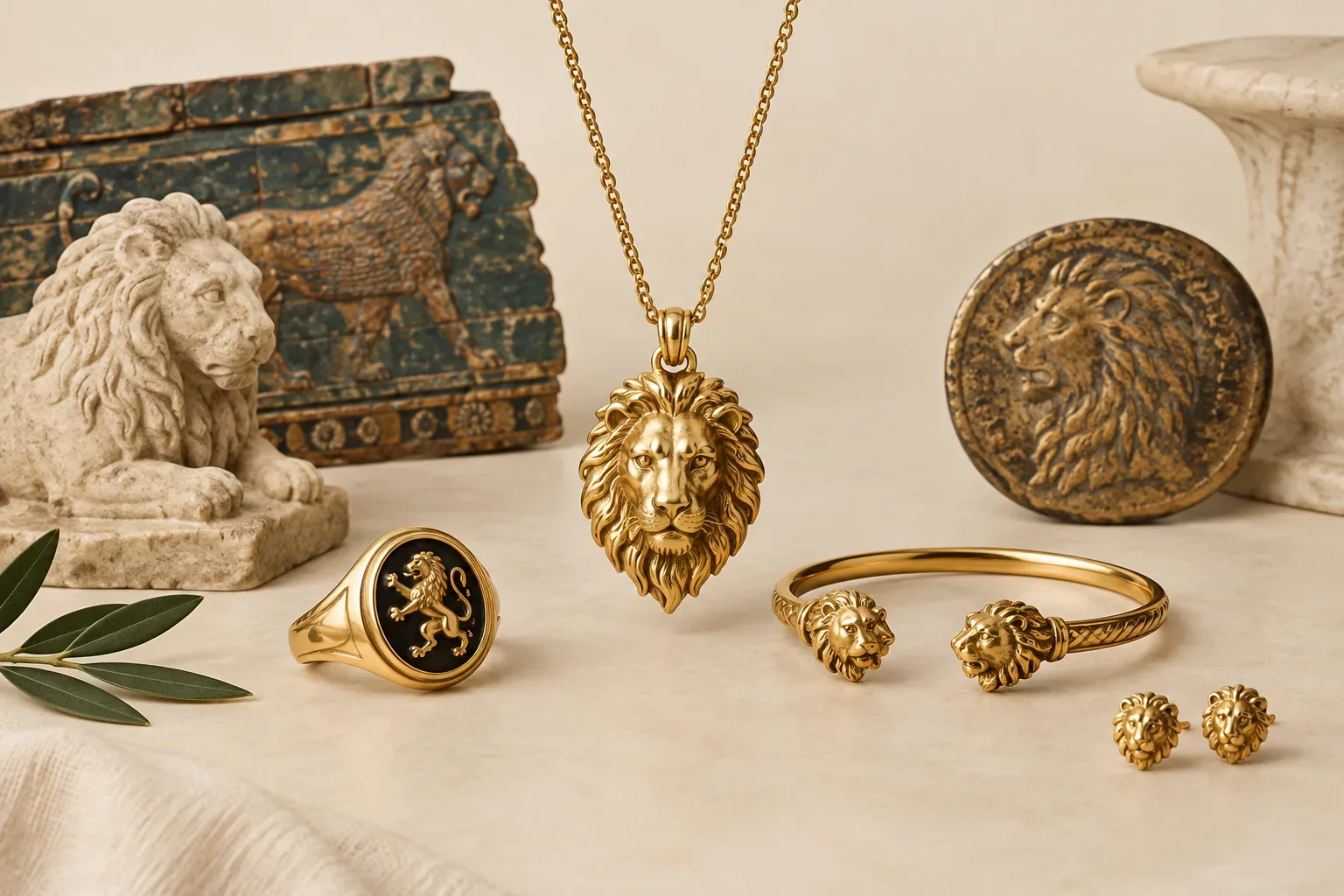
Across periods, the lion motif is executed in many jewelry forms. The V&A’s accounts of jewellery history describe rings, brooches, pendants, cufflinks, and decorative fittings that bear animal motifs, including lions. Lions have been incorporated in low-relief metalwork, high-relief carving, openwork gold, engraved signet faces, and cast or chased mounts on larger pieces.
Gemstones and colored materials are commonly used to emphasize the lion motif or to signify value. The V&A’s A-Z of Gemstones explains how jewelers historically selected stones for color, hardness, and symbolic associations; stones such as sapphires, rubies, garnets, and later diamonds have been used in lion-themed pieces to add color, contrast, or a focal point for eyes, manes, or heraldic shields. Enamel, glass paste and later synthetic materials have also been used to bring color to figurative motifs when gem budgets were limited or when the technique was stylistically preferred.
Jewelry traditions sometimes place lion imagery in particular settings. For example, heraldic or signet rings may bear a stylized lion as part of a coat of arms, while pins and brooches can present naturalistic lion heads. Larger object types — such as belt buckles, watch chains, and ceremonial pendants — allow more elaborate sculptural treatments. The V&A’s survey emphasizes that the technical approach (engraving, casting, stone-setting, enamel) and the choice of metal and stone were shaped by the social function and intended audience of each object.
Modern meanings and personal symbolism
Today people choose lion-themed jewelry for many reasons: aesthetic preference, family or cultural heritage, astrological identity (Leo), or to project qualities such as courage, leadership, or protection. These modern meanings are personal and cultural choices rather than direct continuations of a single historical meaning.
It is common for contemporary fashion and media to layer additional associations onto the lion motif — for example, luxury branding often borrows regal imagery, and popular culture may highlight the lion as a symbol of fierce independence. These are modern reinterpretations that sit alongside the historically documented uses described by museum scholarship.
Choosing or gifting lion jewelry: practical, ethical, and respectful guidance
Begin by considering why you or the recipient wants a lion motif. If the choice is about family history or cultural continuity, research the specific tradition and, where possible, select makers who work within that cultural style respectfully. If the choice is symbolic — for courage or leadership — be explicit about the intended message when gifting so it carries the meaning you intend.
Consider scale, wearability, and context. Small lion motifs on rings, studs, or pendants make discreet, everyday statements; larger sculptural pieces suit ceremonial or statement use. Match the piece’s scale to the recipient’s wardrobe and comfort. Materials matter for durability and care: solid gold or platinum settings will outlast plated pieces, while alternative metals and treated stones will have different maintenance needs.
Ask about gemstone treatments, origin, and disclosure. The Federal Trade Commission’s guidance on buying gemstones underscores that sellers should disclose treatments, synthetic substitutes, and origin information when known. For higher-value stones, request written information about treatments and certification if authenticity is important to you or the recipient.
Be mindful of cultural meanings and potential sensitivities. Although lions appear across many cultures, particular representations (for example, religious icons or sacred regalia) may have specific cultural or spiritual significance. When in doubt, consult credible sources or practitioners from the culture in question, and avoid using sacred imagery in ways that could be disrespectful.
Finally, prioritize trustworthy sellers and documentation. The V&A’s approach to collection and interpretation reminds buyers that provenance, maker information, and historical context add meaning and value to an object. Choose dealers who provide clear information about materials, techniques, and provenance, and keep receipts and any certificates or maker marks for future care or resale.
Care, conservation, and resale considerations
Lion-themed pieces with detailed relief, enamel, or mounted stones require appropriate care. Follow care instructions for the metals and stones involved and consult a professional conservator or reputable jeweler for cleaning complex surfaces or repairing settings. The V&A’s literature on jewelry history and conservation highlights that historic or antique objects often need specialist handling.
If buying antique or vintage lion jewelry, ask about prior restorations, alterations, and any documentation of provenance. Such information influences conservation needs and market value. For high-value gemstones, certificates from recognized labs can support authentication and resale.
Final thoughts
The lion motif in jewelry is best understood through a layered approach: the museum record documents a variety of culture-specific uses linked to power, protection, and prestige in defined historical contexts, while modern wearers freely add personal and fashionable meanings. Following the practical advice above — clarifying intended meaning, checking materials and disclosures (per FTC guidance), and choosing respectful, well-documented pieces — will help you select or gift lion jewelry that is meaningful, appropriate, and durable.
Frequently asked questions
Does a lion motif always mean royalty?
No. Museum documentation shows lions are often associated with rulership or status in specific contexts, but the motif has also been used decoratively or for protection in other settings. Meaning depends on the artifact’s provenance and use rather than the motif alone.
What gemstones are traditionally used with lion-themed jewelry?
Historically, jewelers have used a range of stones for figurative motifs depending on cost, color, and technical needs. The V&A’s A–Z of Gemstones explains that sapphires, rubies, garnets and later diamonds are among stones commonly set into decorative jewelry, while enamel and glass have been used for color when gems were not practical.
How can I be sure a gemstone in lion jewelry is genuine?
Follow the Federal Trade Commission’s guidance: ask the seller about treatments and origin, request written disclosure for known treatments or synthetics, and seek certification for higher-value stones from recognized gemological labs.
Is it cultural appropriation to wear lion imagery?
Not necessarily. Lions appear across many cultures. The respectful approach is to learn the specific cultural or religious meanings of a particular representation, avoid using sacred or ceremonial imagery disrespectfully, and consult knowledgeable members of the relevant community when uncertain.
Are antique lion pieces harder to care for?
They can be. Antique items with enamel, delicate settings, or historic repairs need specialist handling. Museum conservation practices recommend consulting a professional conservator or experienced jeweler for cleaning or repair.
What should I consider when gifting lion jewelry?
Consider the recipient’s style, the intended meaning, material durability, and whether they prefer subtle or statement pieces. Clarify any cultural significance and confirm material disclosures and provenance, especially for higher-value gemstones.
Sources and further reading
- Bedazzled: A History of Jewellery — Victoria and Albert Museum
- An A-Z of Gemstones — Victoria and Albert Museum
- Buying Gemstones, Diamonds, and Pearls — Federal Trade Commission