Meaning at a glance
Explain the documented history and changing contexts of the turritella agate motif, separate cultural or religious evidence from later popular interpretations, and give practical guidance for choosing and wearing the motif in modern jewelry.
What turritella agate is and its broad natural history
Turritella agate is encountered in the jewelry trade as an agate (a form of chalcedony) that contains visible fossilized shell patterns. In museum and gem literature, such stones are discussed alongside other gemstones whose intrinsic or included patterns—banding, fossils, or mineral inclusions—make them visually distinctive and desirable. The Victoria and Albert Museum’s resources on gemstones explain how collectors and jewellers have long selected stones for their natural character as much as for color alone, and how identification and classification of gem materials evolved as part of jewellery history.
Because descriptions of individual specimens and local deposits are matters of geological record, museum overviews focus on the broader phenomenon: gem materials with visible natural features have been appreciated and worked into settings across cultures and eras rather than carrying a universal, unchanged meaning.
Documented historical uses and the limits of the evidence
Surveys of jewellery history by established institutions show that craftsmen in many periods incorporated materials with natural patterns into personal adornment for aesthetic, emblematic, or technological reasons. The Victoria and Albert Museum’s exhibition and articles on jewellery history place such choices in social context, demonstrating that what materials meant changed depending on fashion, technology, and the wearer’s status.
However, careful museum-based scholarship does not support a single historical narrative that assigns a specific, continuous religious or cultural symbolism exclusively to turritella agate across time and place. Where a gemstone does have an attested cultural meaning, museum sources identify that meaning with a named culture or period. For turritella agate specifically, the published museum overviews cited here do not record a distinct, widely documented religious or ritual role that persists across multiple cultures. In short, the historical record—so far as summarized in museum gem and jewellery resources—shows appreciation and use but does not sustain claims of a single ancient symbolic meaning tied to the stone.
How documentary evidence differs from modern interpretation
Museum writing distinguishes what is documented in the historical record from later or modern attributions. A material may be used as personal jewellery for reasons of fashion, local availability, or technique, and later generations can add interpretive layers—sentimental associations, metaphysical claims, or marketing narratives—without those being present historically.
Modern meanings ascribed to turritella agate—such as ideas about grounding, connection to the earth, or fossil-time symbolism—are contemporary interpretations or spiritual readings made by individuals, communities, or retailers. Those modern meanings may be meaningful to wearers today, but they are not the same as documented historical uses unless a primary historical source explicitly records them. The Victoria and Albert Museum’s resources emphasize this distinction between documented historical context and modern reinterpretation in jewellery studies.
How the motif and stone appear in jewellery
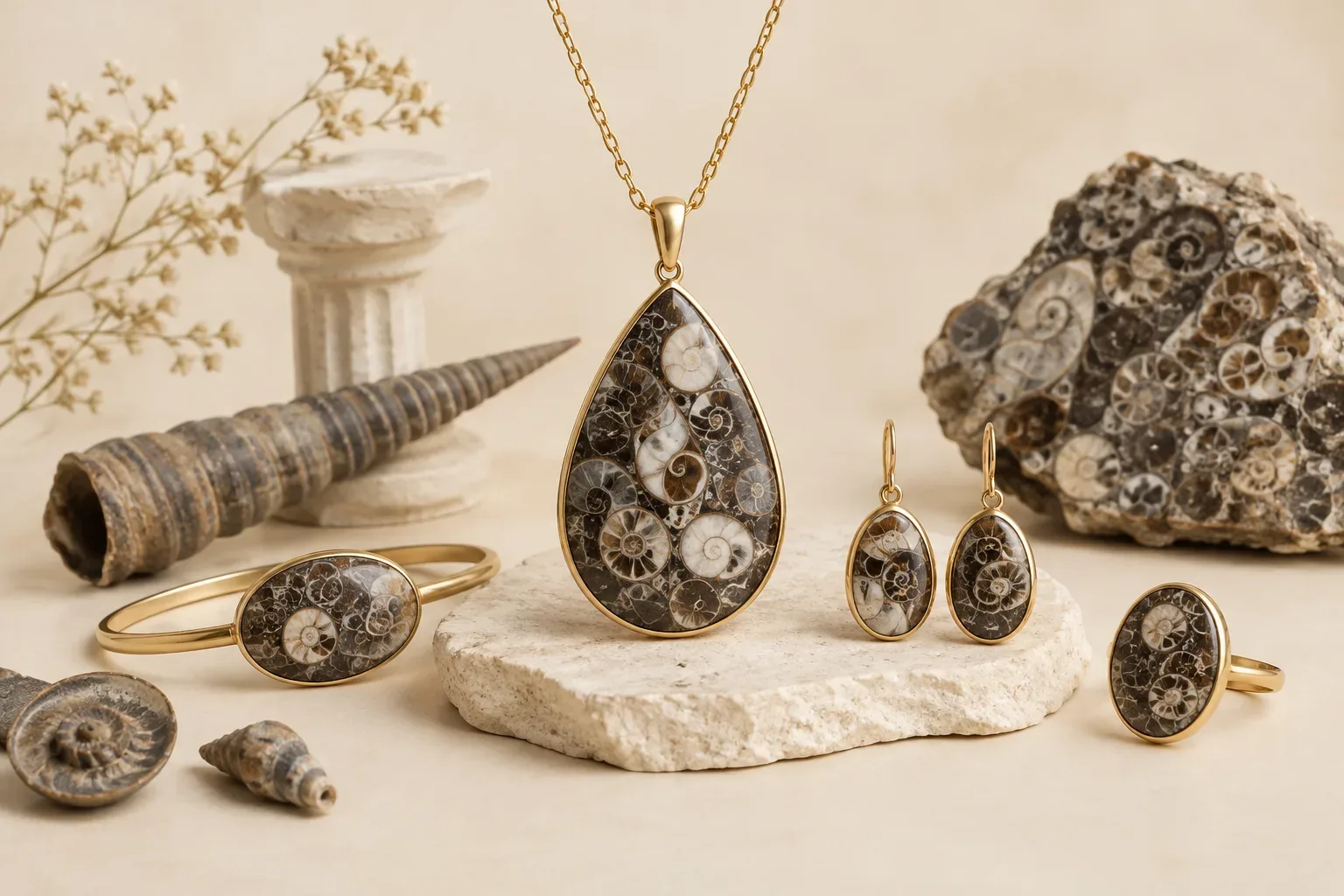
In modern jewellery, turritella agate most often appears as a polished specimen used for its visual interest. Jewellery-makers work such stones as cabochons for rings and pendants, as beads for necklaces and bracelets, and occasionally as larger display stones in signet-style settings or simple mounts that show the fossil pattern clearly. The aesthetic emphasis is usually on the contrast between the stone’s host chalcedony and the embedded fossil traces.
Museums’ general guides to gemstones and jewellery note that the way a stone is cut and set responds to its visual properties: materials with distinctive internal patterns are often cut en cabochon or kept in a minimal bezel so the internal features remain visible. This practical approach to cutting and setting is how turritella agate is most commonly presented in contemporary and historically inspired jewellery.
Practical guidance for choosing turritella agate jewellery
When selecting turritella agate jewellery, start with the visual qualities that matter to you: pattern contrast, size, and how a stone will sit in the intended setting. Because these stones are chosen for their fossil patterns, look for pieces where the polishing and cutting preserve the feature rather than obscuring it.
Check descriptions and ask sellers about treatments and enhancements. The Federal Trade Commission advises buyers to seek clear disclosure about treatments, synthetics, and imitations when purchasing gemstones. Reputable dealers will state whether a stone has been stabilized, dyed, or otherwise treated, and will provide clear information about metal content and construction.
Responsible and respectful gifting guidance
If you are buying turritella agate as a gift and want the recipient to appreciate any symbolic meaning, have a conversation first or choose neutral language. Because there is no single historic symbolic meaning documented in the museum literature for this specific stone, avoid asserting a universal ancient significance when the recipient may have different beliefs or expectations.
Be mindful of provenance and sourcing. Ask sellers where a stone was sourced and whether the material was collected responsibly. For sentimental gifts, pair an explanation of why you chose the piece—its pattern, its look, or a personal reason—with care instructions so the recipient understands both the aesthetic and practical considerations.
Care, ethics, and verification
Caring for turritella agate jewellery follows standard guidance for chalcedony-based stones: avoid harsh chemicals, extreme heat, and prolonged exposure to ultrasonic cleaners unless a professional confirms it is safe for a particular setting or any treatments applied. Museum resources emphasize that how a stone is mounted affects both its visual presentation and its care needs.
Ethically, prefer sellers who provide treatment disclosures and provenance information. The FTC’s guidance on buying gemstones recommends transparency about treatments and imitations and encourages consumers to seek written confirmation of what they are buying. When a piece is expensive, consider an independent appraisal or gemstone report from a recognized laboratory.
Contextual closing: meaning is often personal
Historic surveys of jewellery show that meanings shift over time; institutions such as the Victoria and Albert Museum document how materials move in and out of fashion and how social context shapes what jewellery signifies. For turritella agate, the safest historical claim is that it fits a long tradition of using visually striking natural materials in personal adornment. Any symbolic meaning beyond that—be it metaphysical, sentimental, or fashion-related—is a modern layer that individuals and communities may adopt.
Wearers and givers can therefore responsibly embrace both the stone’s natural history and their personal reasons for choosing it. Being clear about what is historically documented versus what you personally assign will make the piece more meaningful and more respectful of both the object and its audiences.
Frequently asked questions
Does turritella agate have a documented ancient symbolism?
Museum surveys and gem reference guides do not record a single, documented ancient or cross-cultural symbolism specifically for turritella agate. Institutions such as the Victoria and Albert Museum show that gemstones with distinctive natural features were used for many reasons—aesthetic, social, or sentimental—but specific symbolic claims about this stone are modern interpretations unless supported by a named historical source.
How can I verify whether a turritella agate has been treated or dyed?
Ask the seller for written disclosure about treatments and, if necessary, seek an independent appraisal. The Federal Trade Commission advises that dealers should clearly reveal treatments, enhancements, or imitations when selling gemstones.
Is turritella agate suitable for everyday jewellery like rings?
Turritella agate is a form of chalcedony and is typically durable enough for everyday wear when set securely, but any piece’s longevity depends on the cut, mounting, and presence of treatments. Verify how the stone is set, avoid harsh chemicals and extreme heat, and consult a jeweller about appropriate care for the specific piece.
What should I say if I give turritella agate as a symbolic gift?
Be explicit about why you chose the piece: note its natural beauty, the fossil pattern you liked, or your personal sentiment. Avoid asserting a universal historical meaning unless you can cite a specific historical source; personal explanations make gifts meaningful without overstating historical claims.
Where can I learn more about the historical context of gemstones in jewellery?
Museum publications and exhibitions are a reliable starting point. Resources such as the Victoria and Albert Museum’s articles on gemstones and its surveys of jewellery history provide context about how materials were chosen and used across periods.
Sources and further reading
- Bedazzled: A History of Jewellery — Victoria and Albert Museum
- An A-Z of Gemstones — Victoria and Albert Museum
- Buying Gemstones, Diamonds, and Pearls — Federal Trade Commission