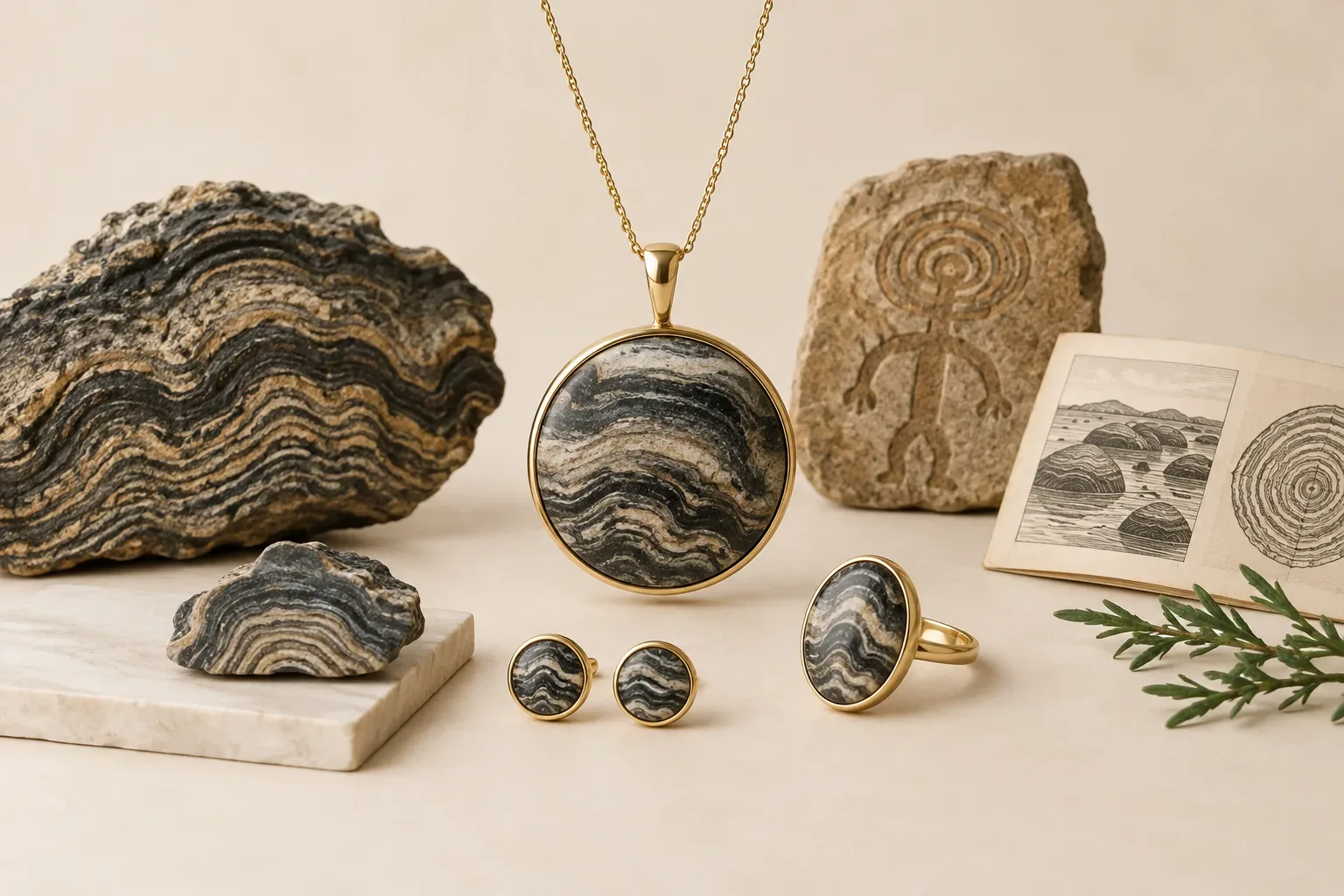
Meaning at a glance
Documented historical uses of stromatolite motifs in jewellery are minimal; modern interest comes from makers and collectors who value fossil patterns as a visual and conceptual link to deep time. This article separates the limited historical record from contemporary personal meanings, describes how the motif appears in jewellery, and offers practical selection and gifting guidance grounded in museum standards for jewellery history and consumer-protection requirements for material disclosure.
What the historical record shows (and what it does not)
Surveying museum and reference material on jewellery and gemstones indicates that stromatolite motifs are not a prominent, documented symbol across well-documented historical jewellery traditions. Works that chart jewellery history and the shifting social uses of decorative objects emphasize changing materials, motifs, and meanings through time, but do not record stromatolite as a named or widely attested symbol in classical, medieval, or early modern material culture (Victoria and Albert Museum).
The Victoria and Albert Museum’s general histories of jewellery and their A–Z treatment of gem materials demonstrate how museums document the provenance and social context of materials that were frequently used or named historically, and they show the kinds of evidence scholars rely on when tracing long-standing symbolic meanings. For stromatolite specifically, a straightforward reading of those museum resources shows an absence of a continuous, named tradition comparable to, for example, carved shells, cameos, or religious emblems (Victoria and Albert Museum).
Because the peer-reviewed museum record for jewellery does not present stromatolite as a discrete historical motif in multiple cultures, claims that it had a particular symbolic meaning in antiquity should be treated as modern interpretations unless supported by explicit archaeological or textual evidence. For detailed natural-history or paleontological information about stromatolites themselves, consult specialist scientific literature; the scope of the museum sources used here is the social and material history of jewellery making and gemstone use.
Documented meanings versus modern personal interpretations
Documented meanings are meanings that appear repeatedly in the historical record and are supported by dated objects, inventories, or contemporary texts. The V&A’s surveys of jewellery history indicate which motifs have such documentary support. When a motif or material is absent from that record, it cannot reliably be assigned a historical cultural meaning on the same footing as well-attested symbols (Victoria and Albert Museum).
Modern personal interpretations of stromatolite jewellery meaning often draw on the visual character of the material and contemporary cultural interests. Many owners and designers today interpret stromatolite patterns as reminders of deep time, origins of life, ecological continuity, resilience, or the beauty of natural processes. Those are valid personal or contemporary artistic meanings, but they are not the same as a documented traditional symbol embedded in a particular culture’s ritual or social practice.
Treat those two categories—documented historical meaning and modern symbolic interpretation—separately. If you are researching a piece you own or considering a purchase as a historically meaningful gift, treat contemporary narratives about an object’s 'ancient symbolic power' as an interpretive layer added by modern makers or marketers unless provenance and primary evidence demonstrate otherwise.
How the stromatolite motif or material appears in jewellery today
In contemporary craft and commercial jewellery, stromatolite appears in two overlapping ways: as a decorative motif inspired by the layered concentric patterns associated with certain fossil or sedimentary forms, and as an actual fossil or polished slice set as a focal stone. Contemporary jewellers and lapidaries may select slices or cabochons that show distinctive banding or concentric textures and set them in pendants, rings, or brooches to highlight the pattern.
Museum descriptions of how unusual materials become part of jewellery practice help explain this pathway: new materials enter jewellery through makers’ experiments, collector interest, and changing fashions, and museums document these shifts when they are sufficiently widespread (Victoria and Albert Museum). Likewise, reference guides that treat gemstones and materials emphasize the need for clear identification and context for unusual materials introduced into jewellery (Victoria and Albert Museum).
When actual fossil material is used, makers typically polish and stabilise thin sections for use as inlay or single-stone settings. Because such treatments and stabilisation affect both appearance and value, accurate disclosure by sellers is important for buyers to understand what they are purchasing.
Responsible selection: what to ask and what to check
Start by asking the seller for clear, written information about material identification, treatments, and provenance. Consumer-protection guidance for gemstone and pearl purchases stresses the importance of disclosure about material treatments, enhancements, and imitations; reputable sellers will provide details and welcome technical questions (Federal Trade Commission).
If a piece claims to contain genuine stromatolite material, ask whether the material has been stabilised or impregnated, whether it is a section, slice, or composite, and whether any adhesives or resins have been used. Request close-up photographs and, where possible, a return policy or third-party verification. For high-value purchases, consider independent gemological verification.
Consider ethical and conservation questions. Buyers who value natural-history connections may wish to know whether specimens were collected legally and whether the removal of material could have conservation implications for scientifically important fossils. Sellers should be able to describe how and where material was sourced and whether any documentation accompanies it.
Finally, evaluate the setting and construction. Fossil materials, like many organic or sedimentary materials used in jewellery, can be softer or more fragile than traditional gemstones. A well-made mounting will protect the material and allow for reasonable care. The V&A emphasises the changing material requirements and social uses of jewellery across periods, and that context helps buyers understand why makers adapt settings for unusual materials (Victoria and Albert Museum).
Gifting stromatolite jewellery respectfully
When giving stromatolite jewellery as a gift, be clear about whether the piece is intended primarily as an aesthetic object, a natural-history conversation piece, or a symbol carrying a personal meaning you share with the recipient. If you present the piece as historically symbolic or carrying specific cultural significance, be prepared to explain the distinction between modern interpretation and documented historical tradition.
Share any provenance and care information with the recipient so they can appreciate and preserve the piece correctly. If the piece is a specimen with scientific value, consider whether the recipient would prefer a replica, photograph, or ethically sourced minimal specimen instead of material removed from a scientifically sensitive context.
Match the piece to the recipient’s lifestyle. Because fossilized or sedimentary materials may require more careful handling than durable faceted gemstones, choose a design suitable for the recipient’s wear habits. A pendant or brooch designed to protect the surface may be better for everyday wear than an exposed ring.
Care and long-term considerations
Treat stromatolite material like other sensitive gems or fossils: avoid harsh chemicals, ultrasonic cleaners, and extreme temperature changes. Clean gently with a soft cloth and mild, soapy water if appropriate for the stabilisation used. When in doubt, consult the seller or a conservator.
Document ownership and provenance. If the piece has any scientific or collecting value, keeping records and photographs will help future stewardship. Museums and collectors routinely document the history and context of materials they hold; adopting that habit for personal collections aids long-term care and responsible disposal or sale if that becomes necessary (Victoria and Albert Museum).
Frequently asked questions
Is there historical evidence that stromatolite had symbolic meaning in ancient cultures?
Museum surveys of jewellery history do not record stromatolite as a named, widely attested symbol across multiple historical cultures; when such evidence is absent, attributions of a specific ancient symbolic meaning are modern interpretations rather than documented historical facts (Victoria and Albert Museum).
How can I verify that a piece contains genuine stromatolite material?
Ask the seller for written identification, treatment disclosures, and provenance. Reputable sellers will state whether material has been stabilised, sliced, or treated. For high-value purchases, seek independent verification from a qualified gemological or conservation professional, and follow consumer-protection advice about disclosures (Federal Trade Commission; Victoria and Albert Museum).
What should I consider when gifting stromatolite jewellery?
Be transparent about whether the piece is intended as a historical symbol or a modern artistic interpretation, provide provenance and care information, and choose a design suitable for the recipient’s wear habits. If the material might have scientific value, consider whether a replica or image would be a more respectful gift than removing a specimen from a collection context.
How do I care for stromatolite jewellery?
Treat stromatolite material cautiously: avoid ultrasonic cleaners, harsh chemicals, and abrupt temperature changes. Clean gently with a soft cloth and mild soapy water when appropriate, and follow any specific care guidance from the seller or a conservator. Document provenance and any treatment histories for long-term stewardship (Victoria and Albert Museum).
Are there standards for disclosing treatments or composites in jewellery?
Yes. Consumer-protection guidance for gemstones and pearls emphasises that sellers should disclose treatments, enhancements, and composite constructions. Buyers should request clear, written information about any stabilisation, adhesives, resins, or other interventions used on the material (Federal Trade Commission).
Sources and further reading
- Bedazzled: A History of Jewellery — Victoria and Albert Museum
- An A-Z of Gemstones — Victoria and Albert Museum
- Buying Gemstones, Diamonds, and Pearls — Federal Trade Commission