Meaning at a glance
This article explains the documented history and changing contexts of the Scorpio motif in jewelry, distinguishes historical evidence from later popular meanings, and provides practical guidance for choosing and gifting Scorpio-themed pieces.
What the historical evidence actually shows
Institutional sources that curate historical jewellery collections make two relevant points: first, jewellery has long used animals, celestial shapes, and symbolic motifs to signal identity, status, or belief; second, the meanings attached to those motifs change across cultures and periods as fashion and social context change. The Victoria and Albert Museum’s interpretive material on the history of jewellery emphasises how motifs and gemstones move through phases of popularity and acquire new social meanings in different eras, rather than holding a single fixed meaning.
Because the V&A discussion is about jewellery history and changing social context rather than a single fixed symbol, it is safer to say that scorpion or scorpio imagery appears in historical objects in several contexts rather than that it always meant the same thing. For example, animal-form jewellery and engraved gemstones appear in classical, medieval, and early modern collections, and later periods—especially the nineteenth century—revived classical and sentimental motifs in new ways, as the V&A notes about changing tastes and revivals. These museum-held patterns provide the documented foundation for studying any zodiac motif in jewellery: motifs exist, they travel, and their social meanings change.
Astronomy, the scorpion motif, and the zodiac
Astronomically, the name 'Scorpio' refers to the constellation Scorpius, a star pattern long identified in the night sky. Western astrology treats Scorpio as one of the twelve zodiac signs connected to the ecliptic band of the sun, and modern astrological language often appears in jewellery descriptions and marketing. That astronomical background explains why jewellery makers and wearers connect the scorpion image or the Scorpio glyph to seasonal birth signs and to broader symbolic ideas about the night sky.
Museums and historical surveys treat the connection between astronomy and jewellery as part of a general pattern: celestial motifs—stars, moons, suns and constellations—have been popular across eras for both decorative and symbolic reasons. The presence of a scorpion image in an object therefore can reflect simple natural history (a scorpion as a visually striking animal), astronomical association, or layered cultural meaning introduced later; the original, documented intent varies by object and period.
Documented historical meanings versus modern personal interpretations
Documented historical meanings are the ones we can trace through object records, maker’s marks, inventories, and museum attributions. Those records show that animal and celestial motifs served a range of functions: identification, amuletic protection, commemoration, fashion, or political symbolism. The V&A’s work on jewellery history emphasises how motifs are reused and reinterpreted, so a scorpion motif in a particular era might signify danger, protection, exoticism, or simply a fashionable animal motif without an astrological intent.
By contrast, many meanings commonly ascribed to Scorpio jewellery today—such as personality traits like secrecy, transformation, or intensity—derive from modern astrology, occult or New Age practices, and marketing language. Those contemporary interpretations are valid as personal or cultural meanings but are not equivalent to documented historical usage unless there is explicit provenance tying a historic object to astrological belief. In short: historical documentation shows motifs moving through contexts, while modern astrological meanings are layered on top and reflect contemporary belief, not necessarily the original intent of historic pieces.
How the Scorpio motif, glyph, and gemstones appear in jewellery
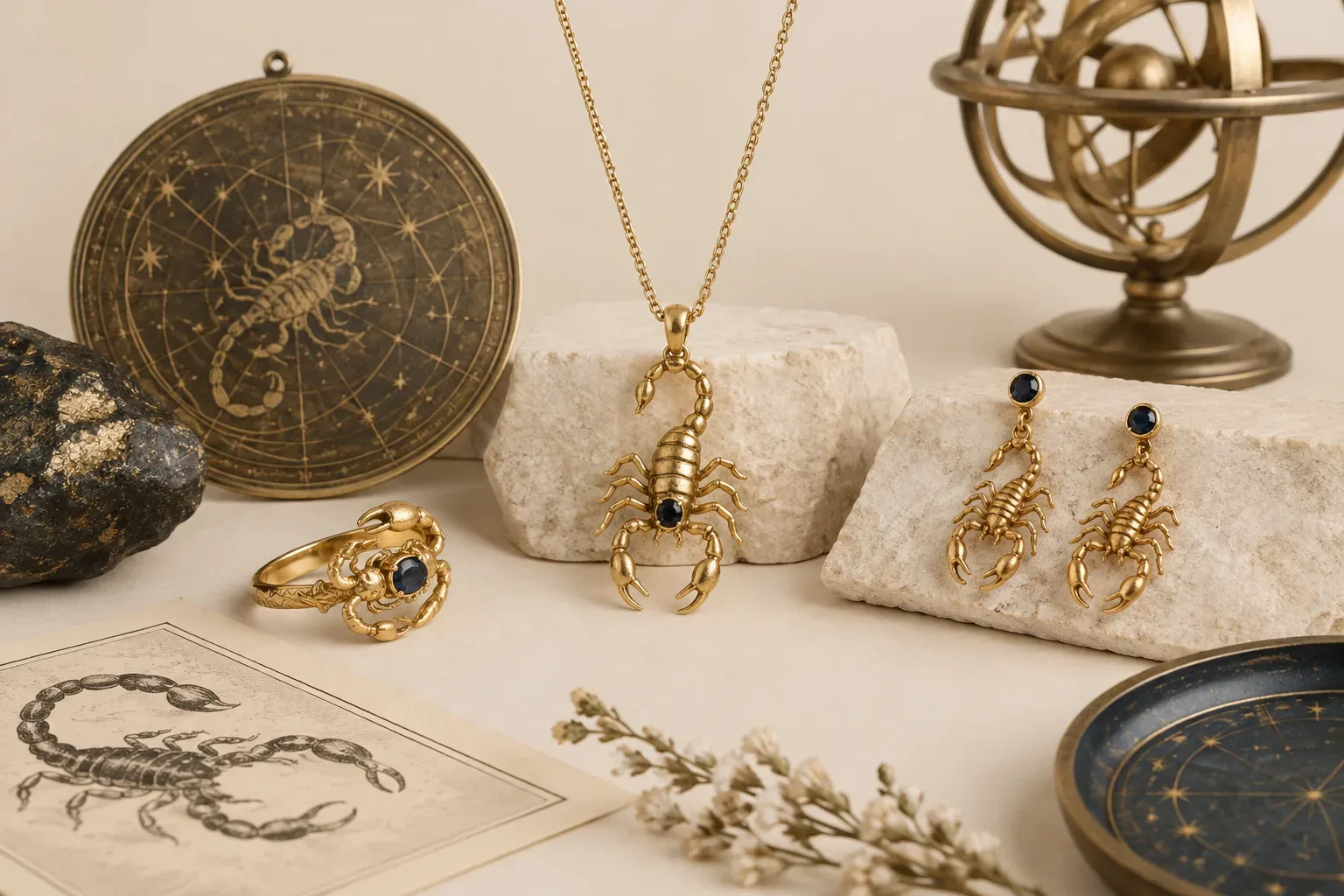
Designers draw on several visual registers when they make Scorpio jewellery. The literal scorpion—modelled in metalwork, enamel or as a carved charm—appears as a compact, three-dimensional motif in brooches, rings, and pendants. The stylised glyph for the zodiac sign (the hooked M-like symbol) is often used for minimalist or typographic pieces, printed or laser-cut into discs and bars. The constellation or celestial language—stars and arcs representing Scorpius—appears in engraved or pave work, usually on pendants and charms.
Gemstone choices for contemporary Scorpio pieces depend on the aesthetic effect designers want. Dark stones such as onyx or black spinel emphasise secrecy and intensity; deep red gems such as garnet recall the visual drama often associated with Scorpio; and iridescent or richly coloured gems are used where transformation and depth are the intended message. For historical and technical context about gemstones, consult museum guides such as the Victoria and Albert Museum’s 'An A–Z of Gemstones', which explains how different stones have been identified, valued, and treated across time.
Practical guidance for selecting or gifting Scorpio jewellery
Start with the recipient’s relationship to astrology and symbolism. If the person identifies with astrology or explicitly lists Scorpio as an important symbol, choosing a scorpion motif, glyph pendant, or birth-sign piece can be very meaningful. If the recipient does not follow astrology, consider a subtler approach: a scorpion-formed clasp, a dark-stone ring, or a piece that uses the constellation motif rather than a literal scorpion will feel less prescriptive.
Think about scale and context. Three-dimensional scorpion forms can be striking but are bolder and more visible; small glyphs, signet-style discs, or engraved constellation bars are work- and everyday-friendly. Consider metal allergies, durability needs, and the recipient’s usual jewellery style when selecting size and finish.
Check materials and disclosure. The Federal Trade Commission provides clear guidance for buyers about gemstone treatments, imitations, and accurate descriptions. Ask sellers for written confirmation of metal content, gemstone identity, and treatments. Reputable sellers will disclose heat treatments, dyeing, coatings, or synthetic materials. If you prefer untreated stones or certified gems, request lab reports or hallmarking where applicable.
Respect cultural and personal sensitivities. The scorpion carries different connotations across cultures—danger, protection, vigilance, or supernatural power—and not everyone welcomes animal or esoteric symbolism. If the recipient has cultural or religious reasons to avoid such imagery, choose an alternative symbolic language or discuss the idea beforehand.
Consider provenance and repairability. If you are buying an antique or historically styled piece, ask for provenance details and a condition report. For modern pieces, confirm repair and resizing options; practical details such as secure clasps or closed-back settings matter for frequent wear.
Presentation matters. Provide a short note that explains why you selected the motif—whether it’s a nod to birth season, an appreciation for the recipient’s resilience, or simply a design you thought they’d like. That explanation clarifies meaning and turns the item into an intentional gift rather than an ambiguous token.
Concluding notes
Scorpio zodiac jewelry meaning is a layered subject: museum-led study of jewellery history shows motifs and gemstones moving through contexts, while modern astrological and personal meanings are applied by designers, marketers and wearers today. Use documented sources like the Victoria and Albert Museum to orient historical claims, rely on consumer guidance such as the FTC when buying gemstones, and choose or gift Scorpio pieces with attention to the recipient’s beliefs, style, and practical needs.
Frequently asked questions
What does Scorpio zodiac jewelry mean?
Meanings vary: historically, animal and celestial motifs in jewellery have served many functions and their meanings change by culture and era. Modern Scorpio jewellery often borrows astrological language—ideas such as intensity, transformation, or loyalty—but those are contemporary interpretations layered onto older material practices.
Is it appropriate to gift Scorpio jewellery to a non-Scorpio?
Yes—if the design suits the recipient’s taste. If they do not follow astrology, choose subtler motifs (constellation bars, dark-stone pieces) and explain your intention; if they have cultural or religious reasons to avoid animal or esoteric imagery, respect that preference.
Which gemstones are traditionally used for Scorpio pieces?
There is no single historical gemstone tied exclusively to Scorpio in museum records; contemporary designers commonly use deep reds, dark stones, or iridescent gems to evoke Scorpio’s visual and symbolic associations. For technical and historical context about specific stones, consult museum guides such as the V&A’s 'An A–Z of Gemstones'.
How can I be sure a gemstone is genuine and ethically described?
Ask the seller for written disclosure of treatments and origin. The Federal Trade Commission advises buyers to request clear information about gemstone identity, treatments, and whether a stone is synthetic or imitation; reputable sellers will provide documentation or lab reports when available.
Are there cultural sensitivities when wearing scorpion imagery?
Yes. In some cultures a scorpion can signify protection or danger, and in others it may have religious or superstitious connotations. If you are unsure about cultural meanings for a specific community, research respectfully or choose an alternative motif.
How should I care for a Scorpio-themed piece?
Care depends on materials: clean metals and gems according to manufacturer guidance, avoid chemicals and prolonged moisture, and store jewellery separately to prevent scratches. For specific stones, follow the V&A’s general guidance on gemstone care or the seller’s care instructions.
Sources and further reading
- Bedazzled: A History of Jewellery — Victoria and Albert Museum
- An A-Z of Gemstones — Victoria and Albert Museum
- Buying Gemstones, Diamonds, and Pearls — Federal Trade Commission