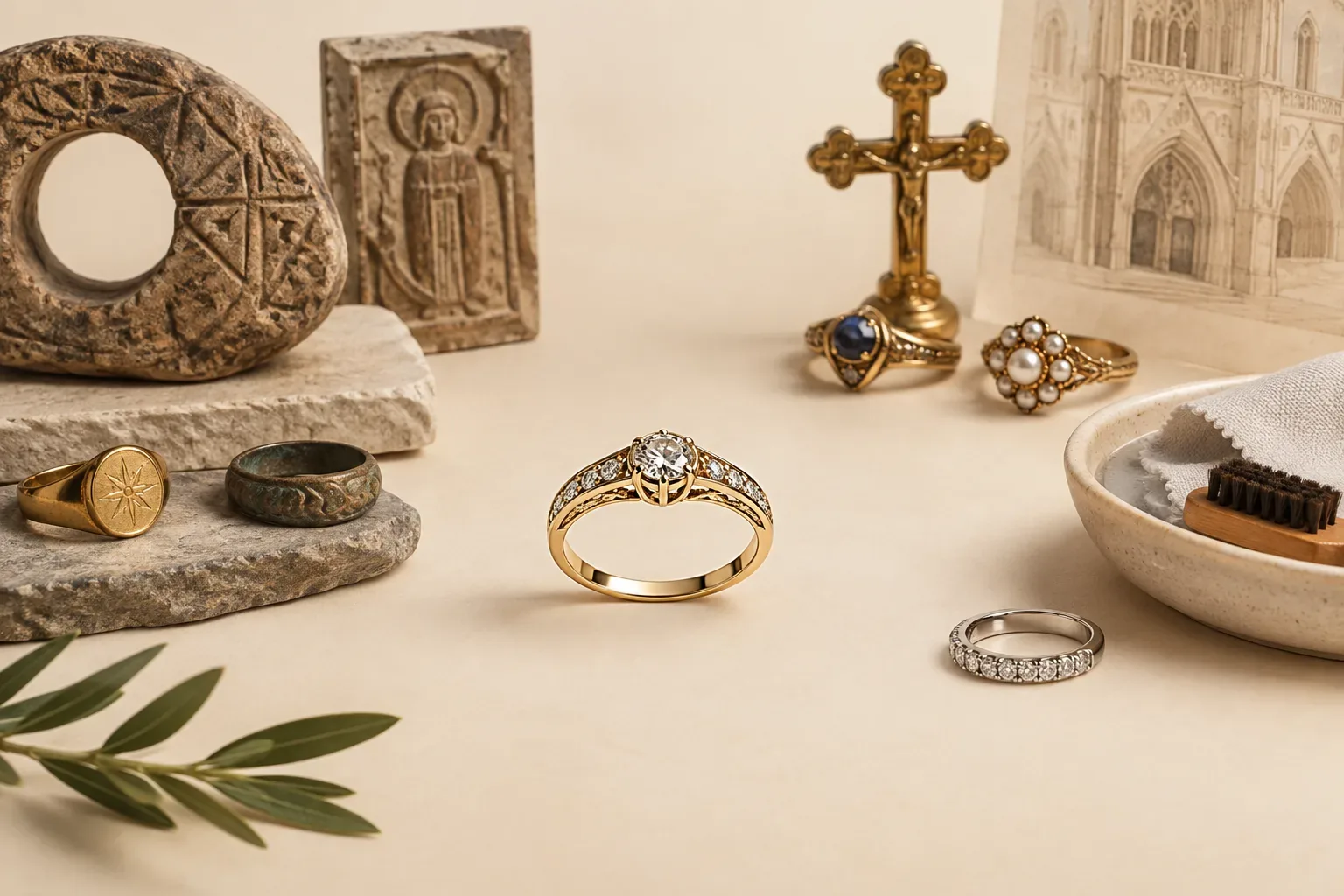
Meaning at a glance
This article explains the documented history and changing contexts of rings and the idea of repair and care, separates historical evidence from later popular interpretations, and gives practical guidance for spotting problems and choosing professional help for ring repair and maintenance.
Quick answer
Explain the documented history and changing contexts of the rings repair and maintenance motif, separate cultural or religious evidence from later popular interpretations, and give practical guidance for choosing and wearing the motif in modern jewelry. In brief: museums document that rings have long carried social and personal meanings; care and repair practices have evolved with materials and technologies; routine inspection and conservative at-home cleaning prevent most damage; seek a professional jeweler for loose stones, damaged settings, sizing, or metal fatigue; and when gifting, choose a design and maintenance plan that respects the recipient’s lifestyle and the object’s history.
Historical evidence: who wore rings and how care was practiced
The Victoria and Albert Museum presents rings and other jewellery as objects that change meaning across cultures and time, and their displays and catalogues show how materials, techniques, and social use evolve with technology and fashion. The V&A documents examples from ancient Mediterranean societies through medieval and Renaissance Europe to the modern period, showing that rings have been symbols of status, identity, and memory while also being practical objects that require maintenance.
In ancient Egypt and other early societies, metalworking and gemstone setting were specialized skills; the survival of high-quality pieces in museum collections reflects both original craftsmanship and centuries of conservation. The V&A records how medieval European rings often combined symbolic engraving with materials that were harder to repair, so mending was a craftsman’s task rather than a simple household chore. During the Renaissance and in later European periods, improvements in jewellers’ tools and techniques made more sophisticated repairs and refashioning possible, a trend the V&A traces into the Georgian and Victorian eras, when remodelling and sentimental reuse of gems became common.
In short, museum evidence compiled by the Victoria and Albert Museum shows that concern for a ring’s physical integrity and for its symbolic value has long coexisted. The ways people cared for rings—professional maintenance, household cleaning, and the decision to remount or repurpose stones—reflect technological limits and social meanings specific to each period and place.
Documented historical meanings versus modern personal interpretations
Documented historical meanings are the functions and uses recorded in museum catalogues, inventories, wills, and makers’ notes. The V&A’s materials emphasise documented uses such as signet rings for identity or legal sealing, wedding and betrothal rings as tokens of contract or status, and mourning jewelry as vehicles of memory. These are claims supported by surviving objects and historical records cited by the museum.
Modern personal interpretations are different: people today may assign private meanings—such as a repaired ring symbolising endurance, healing, or a relationship that has 'survived' hardship—that are meaningful to them but are not documented historically as universal or traditional. It is important not to conflate contemporary, individual symbolism with historical practice. The presence of repair or repurposing in a ring’s history tells us that people cared about these objects, but it does not prove a single, consistent symbolic interpretation across cultures or eras.
How repair and maintenance appear in jewellery practice and design
Repair and maintenance appear in jewellery in two clear ways: as discreet interventions to preserve function and appearance, and as visible alterations that become part of a piece’s history. Conservators and historic jewellers often mended broken shanks, retipped prongs, re-set stones, and re-plated metals. The V&A collections and exhibitions show examples where repairs are indistinguishable from original work and other instances where later additions are evident and recorded as part of an object’s biography.
Technically, the appearance of repair depends on the metal, stone, and setting. Hard-wearing metals such as platinum and gold can be reworked, prongs can be re-tipped, and shanks can be soldered or split and rebuilt. Gemstones present a separate set of considerations: some stones are robust and tolerate cleaning and setting work, while others are soft or treated and require specialist handling. The V&A’s A–Z of Gemstones provides guidance about different gemstones’ properties and their historical contexts, which informs how safely a stone can be re-set or resized around.
Practical maintenance: routine care and warning signs
At-home maintenance begins with modest, non-invasive routines: wipe rings after wearing to remove lotions and oils, remove rings for heavy manual tasks and when using household chemicals, and store them separately to avoid abrasion. Use lukewarm water, a mild detergent, and a soft brush for most metal-and-gem combinations; avoid ultrasonic cleaners for fragile, fracture-prone, or treated stones unless a trusted jeweller has confirmed the stone is safe to be cleaned that way.
Watch for warning signs that require professional attention: a stone that moves or sounds hollow when gently tapped, visible wear to prongs or the shank, a split or hairline crack in metal, persistent discoloration that does not respond to mild cleaning, caught fabric or rough edges, and sudden changes in how the ring fits (which can indicate metal fatigue or a bent shank). If a gemstone shows chips, cracks, or a cloudy surface that cleaning won’t remove, stop wearing the ring and consult a professional.
When to seek professional repair and how to choose help
Seek professional help for loose or missing stones, damaged settings, sizing that requires cutting or re-shaping, bent or split shanks, and surface restoration beyond ordinary cleaning. Professional jewellers and conservators have equipment and techniques—soldering, laser welding, re-tipping prongs, re-setting, and controlled polishing—that preserve structure and value when done correctly.
Choose a jeweller who documents their work, uses professional-quality tools, and provides a written estimate before work starts. Ask about the shop’s experience with the specific metal and gemstone, and whether they offer a warranty on repair work. For information about disclosure of treatments, imitations, or synthetics, consult guidance from consumer protection authorities; the U.S. Federal Trade Commission requires sellers to disclose material treatments, imitations, or synthetics, and that framework is useful when evaluating claims about a stone’s durability or the advisability of certain repairs. If the piece is antique or has museum-level value, consider a conservator who specialises in historic jewellery rather than a commercial restorer.
Respectful selection and gifting guidance
When selecting a ring as a gift, consider the recipient’s lifestyle and the maintenance a ring will need. A delicate cluster setting or a soft gemstone such as opal or pearl requires a different level of care than a simple solitaire in a durable stone like sapphire or diamond. The V&A’s resources on gemstones help explain how different stones behave and how they have been used historically; use those physical properties to match a design to real-world wear.
Be explicit about maintenance expectations: include care instructions, recommend an inspection interval (for example, every six to twelve months depending on use), and, if appropriate, arrange a maintenance or insurance plan at the point of sale. Respectful gifting also recognises the piece’s history; if a ring is vintage or repaired, disclose that information and frame it as part of the object’s story rather than something to hide.
Final notes
Rings carry layered meanings that museums like the Victoria and Albert Museum document through objects, contexts, and conservation histories. Those documented histories show that repair and maintenance have always been part of jewellery’s life, but the symbolic readings assigned to repair are modern and individual rather than universal historical facts. Combining historical awareness with practical preventive care and sensible professional support keeps rings wearable and meaningful across generations.
If you are unsure whether a particular problem needs professional attention, err on the side of caution and consult a trusted jeweller for an inspection. Good maintenance preserves both the physical integrity of a ring and its capacity to carry personal meaning.
Frequently asked questions
How often should I inspect my rings for problems?
Inspect rings visually every few weeks for loose stones, bent prongs, or changes in fit, and have a professional jeweller check them every six to twelve months depending on how often you wear them.
What are the first signs that a stone is loose?
A subtle wiggle when you apply gentle pressure, a rattling sound when tapped very lightly, or a visible gap between the stone and its setting are signs a stone may be loose and should prompt immediate professional inspection.
Can I clean any ring at home?
Many metal-and-gem combinations tolerate mild domestic cleaning with lukewarm water, mild detergent, and a soft brush, but soft, porous, or treated stones may be damaged by water, soap, or ultrasonic cleaners. When in doubt, consult a jeweller familiar with that stone type; the Victoria and Albert Museum’s A–Z of Gemstones is a useful starting point for understanding individual gemstone properties.
When should I choose a conservator instead of a commercial jeweller?
Choose a conservator for historically significant, museum-quality, or irreplaceable antique pieces where preservation of original materials and documentation of interventions is paramount. For everyday wearable jewellery, a reputable professional jeweller is usually appropriate.
Do sellers need to disclose gemstone treatments or imitations?
Yes; consumer protection guidance such as the U.S. Federal Trade Commission’s advice on buying gemstones, diamonds, and pearls requires sellers to disclose material treatments, synthetics, or imitations, and you should ask for written disclosure when purchasing or repairing a piece.
Will resizing damage a ring or its gemstones?
Resizing can be performed safely for many rings, but the impact depends on the metal, the presence of settings or inlays, and the stone type. Resizing around thin shanks, pavé settings, or delicate stones requires careful planning by an experienced jeweller.
Sources and further reading
- Bedazzled: A History of Jewellery — Victoria and Albert Museum
- An A-Z of Gemstones — Victoria and Albert Museum
- Buying Gemstones, Diamonds, and Pearls — Federal Trade Commission