Meaning at a glance
This guide explains the documented history and changing contexts of petrified wood in jewelry, distinguishes museum-supported historical evidence from later personal and popular meanings, and gives practical guidance on verifying authenticity, understanding common treatments and seller disclosure, selecting pieces, and caring for them in daily wear.
Quick answer
Petrified wood jewelry buying guide: know that most of what people call petrified wood in jewelry is a silicified fossil treated and polished like other gem materials; documented historical use in jewelry is limited and is best understood through general jewellery history, while many symbolic meanings are modern personal interpretations. Verify authenticity by asking for provenance and clear treatment disclosure, follow consumer-protection guidance on disclosure, and choose settings and care practices that match the stone’s condition and the wearer’s lifestyle.
What the historical evidence shows
When researching the role of any material in jewellery over time, museum scholarship places objects inside changing social contexts rather than attributing a single, fixed meaning. The Victoria and Albert Museum presents jewellery history as a sequence of uses, fashions, and techniques shaped by social change from antiquity through the nineteenth century and into contemporary design. Use that approach when you look at petrified wood: it appears in the wider story of how natural curiosities and fossil materials entered decorative arts, rather than as a continuously documented ritual gemstone across many ancient cults.
In precise historical terms, the best-documented period for widespread popular interest in fossils and fossilized materials is nineteenth-century Europe, and especially Victorian Britain, where collecting natural history specimens and incorporating them into personal objects were fashionable. The Victoria and Albert Museum’s resources on jewellery history and gemstones explain how the Victorian era’s enthusiasm for geology and natural history influenced decorative choices and created a market for unusual materials. That context explains why specimens such as silicified wood began to appear more regularly in personal ornaments in the nineteenth and early twentieth centuries.
By contrast, there is little reliable museum documentation that petrified wood had a sustained or distinctive ritual role in the religious systems of named ancient cultures in the way that gold, lapis lazuli, or certain beads did. The V&A’s A–Z of Gemstones and its historical materials emphasize established gemstone traditions and changing fashions; they do not support claims that petrified wood has a long, continuous sacred use comparable to those more widely recorded stones.
Documented historical meanings versus modern personal interpretations
Documented historical meanings are those supported by collections, catalogs, and scholarly descriptions showing how and why people used materials at particular times. For petrified wood, the clearest historical evidence is contextual: nineteenth-century collectors and makers prized fossilized and unusual natural materials as curiosities and conversation pieces, and that explains many early examples of petrified wood in jewelry and decorative objects. Museums such as the Victoria and Albert Museum frame those uses as part of a broader fashion for natural-history material culture rather than as evidence of an enduring symbolic canon tied to petrified wood alone.
Modern interpretations—statements you will see today in gift guides, social media, and popular crystal guides—often describe petrified wood as symbolizing grounding, longevity, connection to the earth, or ancestral continuity. Those contemporary meanings are personal and cultural inventions of recent decades rather than documented continuities stretching back millennia. Treat modern symbolic claims as the wearer’s or presenter’s interpretation, and not as universal or historically authenticated facts.
How petrified wood appears in jewellery
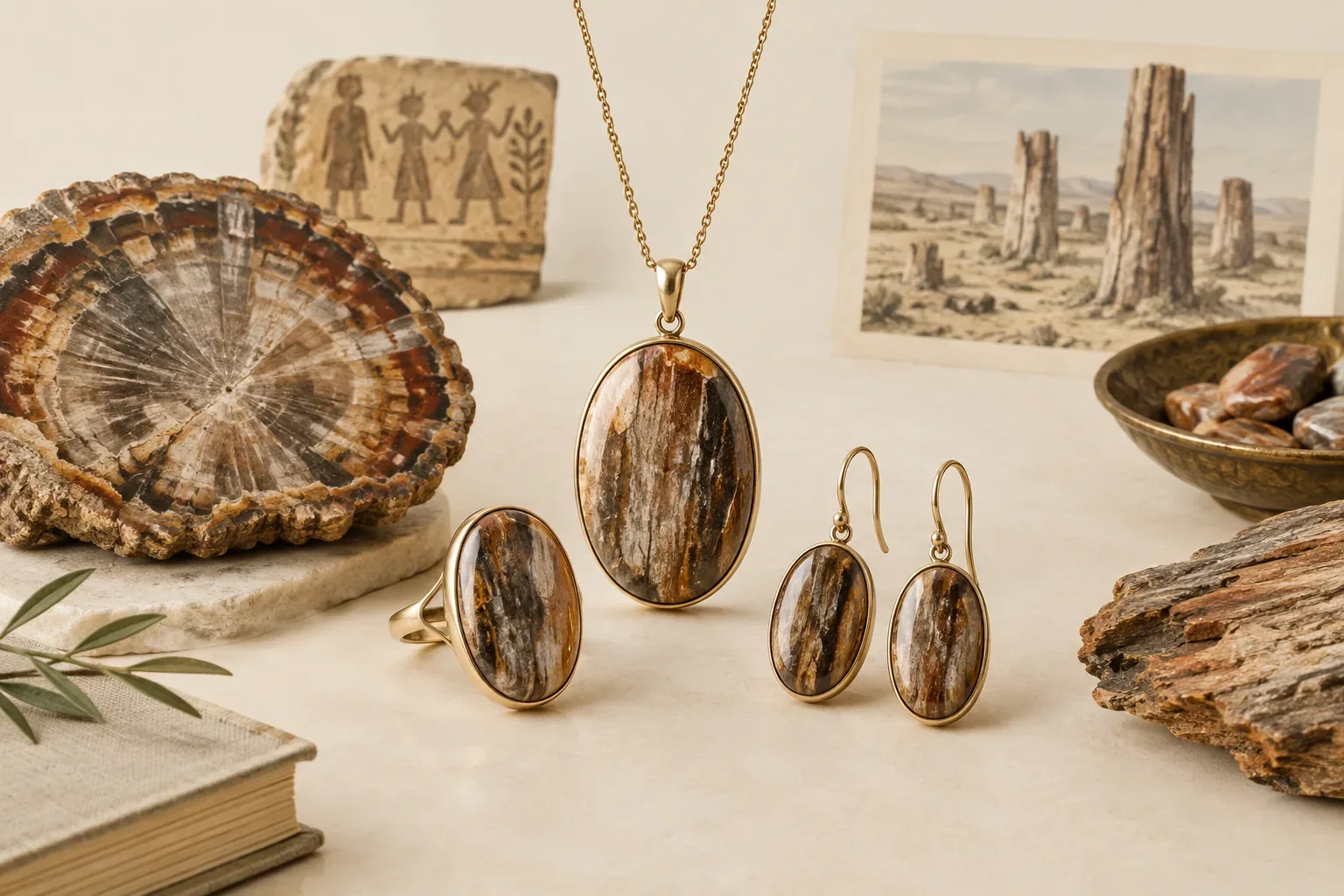
Petrified wood is fossilized wood in which organic material has been replaced by minerals, typically silica. In jewellery it is worked and finished like other opaque-to-translucent gem materials. Typical forms include polished cabochons set in rings and pendants, thin polished slices used as pendants or in inlay, rounded beads for necklaces and bracelets, and small tumbled pieces mounted in wirework or bezel settings. Contemporary makers also use cross-section slices to show annual rings or desirable patterning.
Design choices vary by maker: some present large, flat slices as statement pendants framed simply to show the pattern, while others prefer smaller polished cabochons set in metal for everyday wear. Because the material can display wood-grain-like patterns and banding, it is often chosen for its natural, organic appearance rather than for a traditional gemstone color grade.
Authenticity: what to ask and what to expect
Ask the seller for clear, written information about provenance and any treatments or stabilisation the piece has undergone. The Federal Trade Commission’s guidance on buying gemstones, diamonds, and pearls emphasizes that sellers must disclose treatments, imitations, and any material that substantially affects value or wearability. If a seller refuses to describe treatments or the specimen’s origin, consider that a red flag.
Acceptable proof of authenticity can range from a detailed sales description and photos to an independent gemological lab report for high-value pieces. For everyday items, transparent provenance from a reputable dealer, consistent photography, and clear disclosure of any stabilisation (for example, resin filling of fractures) are practical standards to expect.
Common treatments and imitations to watch for
Petrified wood pieces offered as jewellery are frequently polished and, in some cases, stabilized to reduce flaking or to improve durability. Stabilisation might involve impregnation with resins or adhesives. Sellers should disclose such treatments because they affect how you clean and wear the piece and can change the long-term appearance. The Federal Trade Commission calls for disclosure of treatments that materially change or enhance a gemstone’s appearance.
Be aware of dyed or composite items where a thin slice of fossilized wood is backed by other materials, or where color has been enhanced to make the pattern more dramatic. Imitations can include agates or jasper with woodlike patterns, and some jewelers may assemble pieces to achieve a particular look. Transparent communication from a seller is the best protection against surprises.
Care and practical wearing advice
Petrified wood is essentially a mineralized stone and is harder than untreated wood, but its porosity, fractures, or prior stabilisation determine how you should care for it. Ask the seller whether the piece was stabilised, dyed, or backed. For unstabilised or resin-treated pieces, avoid prolonged exposure to solvents, strong acids, or prolonged high heat, and avoid ultrasonic cleaners unless the maker confirms they are safe.
Clean most pieces with a soft cloth and a mild soap solution, rinsing quickly and drying thoroughly. Store petrified wood jewellery separately from harder stones and metals that could scratch it. For bracelets and rings that will see frequent impact, consider protective settings and select pieces with secure bezels or prongs sized to reduce catch risk.
Selection and gifting guidance—practical and respectful
When selecting a piece for yourself or as a gift, match the piece to the wearer’s life. Choose a sturdy setting and a low-profile stone for someone active or working with their hands. Choose a polished pendant or statement slice for someone who values visual impact and occasional wear. Consider metal choice and craftsmanship, and ask about the origin of the material if provenance matters to you.
Respect cultural or personal beliefs. If a recipient attributes a particular spiritual meaning to fossilized materials, acknowledge that those meanings are modern interpretations and vary between people. If you are unsure whether a symbolic motif is appropriate, ask discreetly or choose a neutral, well-crafted piece with transparent information about the material and its treatments.
If buying for a collector, request documentation and, for high-value specimens, an independent report. If buying from craft makers or small businesses, expect clear descriptions and artisanal details about the working process. Wherever you buy, prefer sellers who disclose treatments, country of origin when known, and any stabilisation or composite construction.
Final note
Petrified wood jewellery combines natural patterning and the look of fossil material with the practicalities of gem cutting and setting. Use museum-framed history to understand why the material entered jewellery in the nineteenth century and later craft movements, treat modern symbolic claims as contemporary personal meanings rather than historical certainties, and follow seller disclosure and care guidance when choosing and caring for pieces.
Frequently asked questions
How can I tell if petrified wood jewelry is authentic?
Ask the seller for provenance and written disclosure of any treatments. For high-value items, request an independent laboratory report. Be cautious of sellers who will not describe treatments or the specimen’s origin; transparent sellers should state whether a piece is stabilised, dyed, or a composite.
Are petrified wood pieces commonly treated?
Yes. Many specimens are polished and some are stabilised with resins to reduce flaking or meet durability needs. The Federal Trade Commission advises sellers to disclose treatments that materially change a gemstone’s appearance or durability, so you should expect that information in the product description.
What is the best way to clean petrified wood jewelry?
Clean gently with a soft cloth and a mild soap solution, rinse quickly, and dry thoroughly. Avoid ultrasonic cleaners and strong solvents unless the seller confirms the piece is safe for those methods, because stabilised or composite pieces can be affected by harsh cleaning.
Is petrified wood a traditional ritual gemstone?
Museum scholarship indicates that petrified wood does not have a long, continuously documented ritual role comparable to certain historic gemstones. The Victoria and Albert Museum frames petrified and fossil materials mainly within nineteenth-century and later decorative fashions, so many spiritual attributions you see today are modern interpretations rather than long-standing historical facts.
How should I choose petrified wood jewelry as a gift?
Match the piece to the recipient’s lifestyle and tastes. Choose sturdy settings for everyday wear and statement slices for occasional wear. Respect any personal beliefs by acknowledging that symbolic meanings are contemporary and vary by person, and choose a transparent seller who discloses treatments and provenance.
Sources and further reading
- Bedazzled: A History of Jewellery — Victoria and Albert Museum
- An A-Z of Gemstones — Victoria and Albert Museum
- Buying Gemstones, Diamonds, and Pearls — Federal Trade Commission