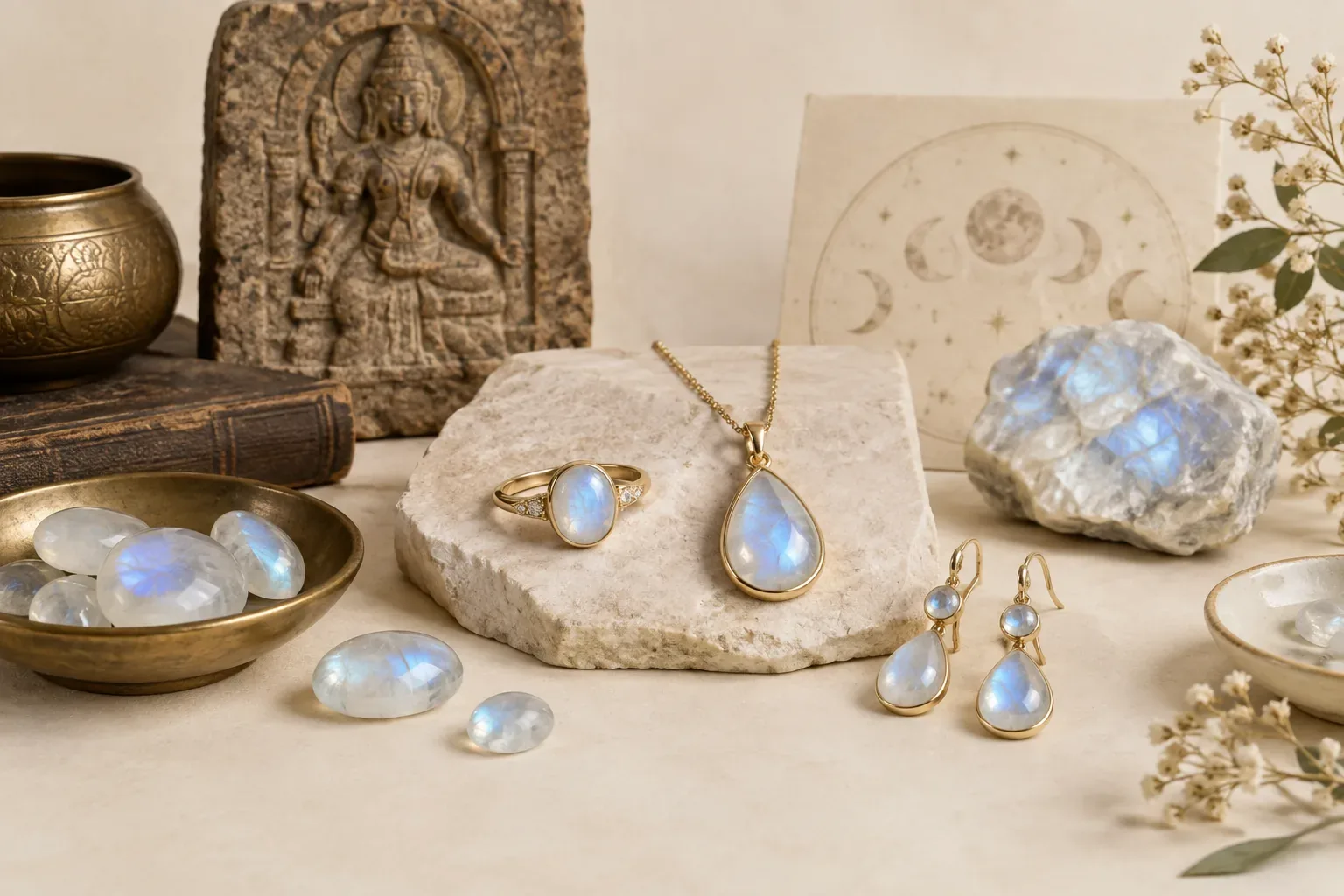
Meaning at a glance
Moonstone quality and value depend on documented gem properties—adularescence, body color, clarity, cut, and size—interpreted and valued differently across historical periods and modern markets; this guide separates museum-recorded history from contemporary personal meanings and gives practical buying and gifting steps, including asking sellers for treatment and imitation disclosures required by the Federal Trade Commission.
Quick answer
Documented moonstone quality and value factors center on its optical phenomenon (commonly called adularescence), body color and transparency, clarity and inclusions, the traditional cabochon cut that displays the flash, and size. Museums and gem reference collections record these identification and aesthetic criteria, while the commercial market adds preferences and price weightings that change with fashion and origin. Ask sellers for clear information about treatments and imitations, inspect the stone under varied light and angles, and choose settings appropriate to intended wear.
What the historical record shows
The Victoria and Albert Museum documents the long presence of gemstones in jewelry and the changing social meanings attached to particular gems in different periods. Its collections and publications record that gem specialists and jewellers have historically identified and prized optical phenomena and cutting styles that show a gem at its best, and that tastes shift as styles and technologies change.
The Victoria and Albert Museum’s A–Z of gemstones and related exhibition material describe how museums and historical jewellers treated individual stones as materials with both practical and aesthetic properties. For moonstone specifically, museum catalogues and gem guides note the importance of the stone’s internal light effect and the use of rounded, domed cuts to present that effect in rings, brooches and pendants.
Separating documented historical meanings from modern interpretations
Documented historical meanings are what historical records, museum catalogues, and period sources actually state about a gem’s use, symbolism, or social role. The Victoria and Albert Museum’s resources emphasize contextual evidence—how a gem was worn, who could afford it, and the styles in which it appeared—and avoid asserting universal symbolic meanings across cultures.
Modern personal or commercial interpretations—such as claims that moonstone universally grants emotional balance or specific spiritual powers—are contemporary layers of meaning assigned by individuals, new religious movements, or marketers. Those interpretations are not universally documented in historical sources and should be described as modern beliefs rather than historical fact.
Core quality and value factors to evaluate
Adularescence is the term gem specialists use for the bluish or white light that appears to glide across a moonstone’s surface as it moves. Institutions that catalogue gemstones note that this optical effect is the most distinctive and usually the most economically significant feature of gem-quality moonstone because it defines the gem’s visual appeal.
Body color and transparency affect how easily the adularescence is seen. Stones range from nearly colorless to warm peach, gray, or brown tones; museum descriptions of gemstones note that background color can enhance or mute the flash, and buyers and curators consider the combination when assessing aesthetic quality.
Clarity and inclusions matter for both appearance and durability. Some inclusions can create interesting visual textures and may not reduce value if they contribute positively to the stone’s look, but extensive fractures or clouding can weaken the appearance and the stone.
Cut and shape are critical because most moonstones are cut en cabochon to show the moving light. A well-proportioned dome with the flash centered and visible when the stone is turned is generally preferred; museum guides on gem cutting discuss how lapidaries orient the material to produce the best effect.
Size and weight influence price in the market; larger stones with strong adularescence command higher prices than small stones with weak effect. Historical and museum records demonstrate that rarity in any desirable combination of properties typically raises the market value.
Treatments, imitations, and disclosure—what to ask
The Federal Trade Commission requires that sellers disclose material treatments and imitations, and its guidance applies to gemstones generally. Ask a seller whether the moonstone has undergone heating, coating, dyeing, or any other enhancement, and request written disclosure. Also ask whether the stone is natural, synthetic, or assembled from multiple pieces.
Request to see the stone under different lights and to view it at multiple angles; this helps reveal the true adularescence and any surface coatings or filling. If the seller cites a laboratory report, check that the report describes treatments and that the issuing laboratory is identified on the report.
How the motif and moonstone appear in jewelry
Moonstone commonly appears in jewelry as a polished cabochon set into rings, pendants, brooches and earrings where the rounded surface can display the shifting light. Museum collections and exhibition catalogues note that lapidaries and jewellers historically used settings that protected domed stones while placing them prominently to show the optical effect.
Beyond single-stone settings, moonstone is sometimes used alongside accent diamonds or coloured gemstones to create contrast and to direct attention to the flash. Period styles recorded in museum holdings demonstrate how different eras preferred particular mountings and metalwork that changed how the stone was seen and worn.
Practical guidance for selecting a moonstone
Start by clarifying how the piece will be worn. If buying for everyday wear, choose a setting that protects the stone from knocks and abrasion; if buying for occasional wear, you may prioritize a larger or more visually dramatic stone. Consider how the metal colour and surrounding stones will influence the perceived colour and flash of the moonstone.
Inspect the stone in natural daylight as well as indoor light; move it at different angles to see how the adularescence behaves. Prefer stones where the flash is visible and moves smoothly across the dome rather than appearing weak or confined to a single spot. Be attentive to cracks or fractures and ask whether any filling has been used.
Ask for written disclosure about treatments and for provenance or origin information if available, but be aware that laboratory-grade origin reports are not available for all moonstones. Use the FTC’s guidance to insist on truthful disclosure about treatments and imitations before purchase.
Set a budget that reflects your priorities—size, strength of flash, and overall clarity—and be prepared that stronger adularescence in larger stones typically raises price. When gifting, think about the recipient’s style and daily activities and choose a setting and stone that will suit their lifestyle and tastes.
Respectful gifting and cultural sensitivity
Recognize that modern spiritual or emotional associations with moonstone are personal choices and not universal historical facts. If you are gifting a moonstone because of a cultural or spiritual association, be modest about claims and, if appropriate, ask the recipient about their beliefs and preferences rather than assuming a particular meaning.
If the gift references a cultural tradition, seek information about that tradition from reliable cultural sources and avoid appropriating sacred symbols or practices. Museums such as the Victoria and Albert Museum remind collectors and gift-givers that the context and provenance of objects matter when assigning historical meaning.
When to seek expert help
If a stone is large, unusually priced, or the seller cannot answer questions about treatments and origin, consider asking an independent gemmologist or a reputable appraiser to inspect it. Museums and gem reference resources stress the value of expert verification for items of significant monetary or historic value.
For high-value purchases, request a written report from an independent laboratory or gemmological service that details the stone’s properties and any treatments. Even when buying modest pieces, keep receipts and any written disclosure you receive so you have documentation should questions arise later.
Frequently asked questions
What is the most important visual feature to judge in a moonstone?
The most important documented visual feature is the stone’s adularescence—the moving, moon-like flash—because it defines the gem’s distinctive appearance. Museum gem guides emphasise assessing how strong and how evenly the flash appears when the stone is turned.
How can I tell if a moonstone has been treated or is an imitation?
Ask the seller for written disclosure of any treatments and for confirmation that the stone is natural. The Federal Trade Commission requires sellers to disclose treatments and imitations; if a seller cannot answer clearly, request a laboratory report or decline the purchase.
Should I choose a cabochon or faceted moonstone?
Museum and gem reference sources note that moonstone is most commonly cut en cabochon because a rounded dome best displays the adularescence. Faceting is rare for moonstone and usually used for different design effects rather than to maximize the classic flash.
Is moonstone suitable for everyday rings?
Moonstone is used in rings, but selection should consider the wearer’s lifestyle and the protective qualities of the setting. Choose secure mountings that protect the dome from knocks if the recipient will wear the ring daily, and request information about any fractures or fillings.
Do historical meanings of moonstone appear the same across cultures?
No single symbolic meaning is universal. Museum collections and scholarship show that gems acquire different meanings in different cultures and periods; modern spiritual or emotional attributions are contemporary interpretations rather than a single historical truth.
Sources and further reading
- Bedazzled: A History of Jewellery — Victoria and Albert Museum
- An A-Z of Gemstones — Victoria and Albert Museum
- Buying Gemstones, Diamonds, and Pearls — Federal Trade Commission