Meaning at a glance
Documented museum histories show natural objects have long been used in jewelry, but there is little evidence that fossil shark teeth had consistent cultural meanings; modern megalodon tooth jewelry is largely a contemporary motif symbolizing strength or connection to the sea, so buyers should verify provenance and treatment disclosures (FTC recommends) and choose settings and care that suit the material.
Quick answer
Megalodon tooth jewelry is a modern use of fossil shark teeth as a visual motif. Museums that study jewelry history show that jewelers have used natural curiosities for centuries, but there is little documented historical evidence tying a single, consistent cultural or religious meaning to large fossil teeth in the written museum record. For buyers, the practical priorities are verifying authenticity and provenance, asking about common treatments and repairs, and choosing a setting and care regimen suited to a brittle fossil—matters the Federal Trade Commission explicitly advises sellers to disclose when they alter or imitate natural materials.
What the historical record shows (and what it does not)
Scholars and museums that document the history of jewelry note that human makers have used natural materials—stones, shells, teeth, and fossils—for personal adornment across many times and places. The Victoria and Albert Museum describes how jewelry’s materials and social meanings change depending on context and period, from antiquity to modern design, and stresses that objects often move between decorative, symbolic, and scientific roles over time.
That broader museum record supports two clear points: natural teeth and fossil objects have been adopted as decorative items, and their meanings vary with culture and period rather than being fixed. It does not, however, supply evidence that "megalodon teeth" as a specific motif carried a single, widely documented cultural or religious meaning in historic societies. References in public museum material focus on material use and changing social contexts rather than on a particular sacred or ritual role for large fossil shark teeth.
Documented historical meanings versus modern interpretations
Documented historical meanings for natural-material jewelry tend to be local and specific: for example, shells have been currency in some cultures, teeth sometimes marked trophies or status in others, and fossil objects occasionally featured as curiosities in cabinets of natural history. The museum literature emphasizes that these uses are culture- and period-specific rather than universal.
Modern uses of the "megalodon tooth" motif are largely contemporary reinterpretations. Today people commonly attribute meanings such as protection, power, connection to the sea, or a nod to paleontology and deep time. These contemporary associations are personal or pop-cultural choices rather than documented continuations of a historic religious or cultural tradition. When gifting or wearing such a piece, treat these meanings as modern personal symbolism unless you have seller-provided provenance showing a specific historic or cultural origin.
How the motif appears in jewelry today
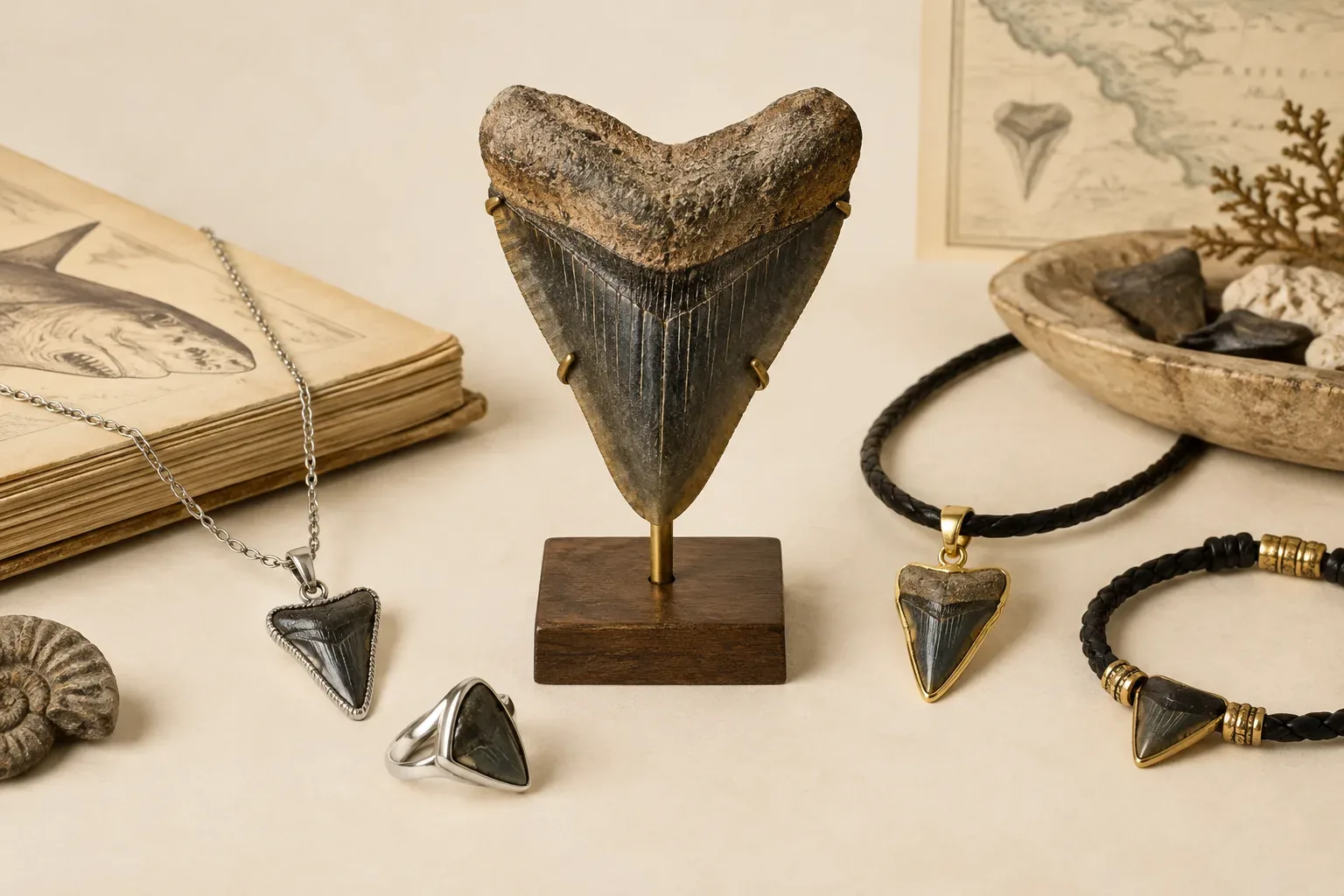
In contemporary jewelry the large triangular fossil tooth functions visually as a focal element. Jewelers and makers commonly present teeth as drilled pendants on cords or chains, bezel-mounted pendants, or set as a centerpiece in mixed-material necklaces. Smaller fossilized teeth may be strung into bead-like necklaces or used as accents alongside metals and gemstones.
Designs range from raw and natural presentations—displaying the tooth’s original serration and root—to stabilized and polished mounts where the tooth is trimmed, filled, or set in a metal frame. Some pieces pair a tooth with metalwork or inlays; others embed the fossil in resin or composite material to create a lighter, more durable wearable. The look you prefer will affect both the price and the care needs.
Authenticity, common treatments, and what to ask sellers
Because sellers sometimes stabilize, repair, or replicate fossil teeth, buyers should ask clear, specific questions before purchase. The Federal Trade Commission advises that sellers disclose material treatments and imitations for gemstones and natural materials; that same principle applies to fossils used in jewelry. Ask whether a tooth is original fossil material, a composite (for example, real tooth with resin fill), or a full replica made of cast resin or other materials.
Common interventions include drilling to create a hole for suspension, filling or stabilizing cracks with epoxy or resin, dyeing to change color, and mounting that includes added metal or backing to strengthen the tooth. Some sellers produce high-quality replicas; others combine real and synthetic materials. Request written confirmation of treatment and, when available, provenance information such as where and when the fossil was obtained and any paperwork that confirms legal collection or sale.
For higher-value purchases, consider asking for high-resolution photos from multiple angles, a magnified image to examine surface structure, and, if relevant, a certificate of authenticity or return policy. If you suspect a replica or are uncertain about a seller’s claims, buy from a reputable dealer or an institution that provides clear documentation.
Choosing and gifting respectfully
Select a piece that matches the recipient’s style and practical needs. If they prefer minimalist jewelry, choose a small, bezel-mounted tooth on a fine chain. If they like statement pieces, a larger, raw presentation on a leather cord may be appropriate. Consider how often the wearer will use the piece: settings that protect the fossil (bezel or cage mounts) are better for daily wear than exposed drilled pendants.
Be mindful of ethical and legal considerations. Many collectors and buyers value documented provenance because some fossil collecting is regulated or contested in certain places. When gifting, ask the seller for any provenance documentation and include it with the gift so the recipient has the information if they later choose to resell or repair the piece. Treat the motif as a contemporary aesthetic choice rather than a claim of ancestral cultural meaning unless the seller can demonstrate a specific historic provenance. Finally, presenting the piece with a short note about its modern symbolism—if you intend a particular meaning—helps communicate your thoughtful intent without asserting a universal cultural meaning.
Care and maintenance
Fossil teeth, even when mineralized, can be more brittle than most gemstones and may contain repaired or stabilized areas. Clean gently using a soft brush and mild soap and water; avoid strong solvents, ultrasonic cleaners, or abrasive materials that can damage repairs or remove stabilizers. If a tooth has metal components, follow metal-care guidance for those parts while avoiding soaking the fossil for prolonged periods.
Store fossil-tooth jewelry separately from harder stones and metals to avoid scratches, and keep pieces away from prolonged exposure to heat or chemical products such as pool chlorine and household cleaners. If a piece shows cracks, loose mounts, or failing stabilizers, have it inspected and, if necessary, conserved by a jeweler experienced in stabilizing fossils or by a conservator familiar with natural-history materials.
Frequently asked questions
How can I tell if a megalodon tooth is real?
Look for natural surface texture, subtle layering, and weight appropriate to mineralized material; request detailed photographs and written confirmation from the seller about authenticity and any treatments. If in doubt, buy from a reputable dealer who can provide provenance or a return policy.
What treatments should sellers disclose?
Sellers should disclose stabilizing repairs (epoxy or resin fills), dyeing, composite construction (real tooth combined with synthetic material), and full replicas. The Federal Trade Commission advises sellers to disclose material treatments and imitations for natural materials.
Are megalodon teeth legal to buy and sell?
Legality depends on where and how the fossil was collected; some regions restrict or regulate fossil collecting. Ask the seller for provenance and documentation indicating legal collection and compliance with local laws before purchase.
How should I clean and store megalodon tooth jewelry?
Clean gently with a soft brush and mild soap and water; avoid strong solvents, ultrasonic cleaners, and harsh abrasives. Store pieces separately from harder stones and metals, out of direct sunlight and away from chemicals.
Is it better to choose a raw or mounted tooth for daily wear?
Mounted or bezel-protected teeth are usually a better choice for daily wear because the setting helps protect brittle edges and any repairs. Raw, exposed teeth are visually striking but are more vulnerable to damage.
What determines the price of megalodon tooth jewelry?
Price depends on size, preservation, whether the tooth is original or a replica, the quality of any restoration or stabilization, craftsmanship of the mounting, and seller reputation. Clear documentation and treatment disclosure often add to a piece’s resale value.
Sources and further reading
- Bedazzled: A History of Jewellery — Victoria and Albert Museum
- An A-Z of Gemstones — Victoria and Albert Museum
- Buying Gemstones, Diamonds, and Pearls — Federal Trade Commission