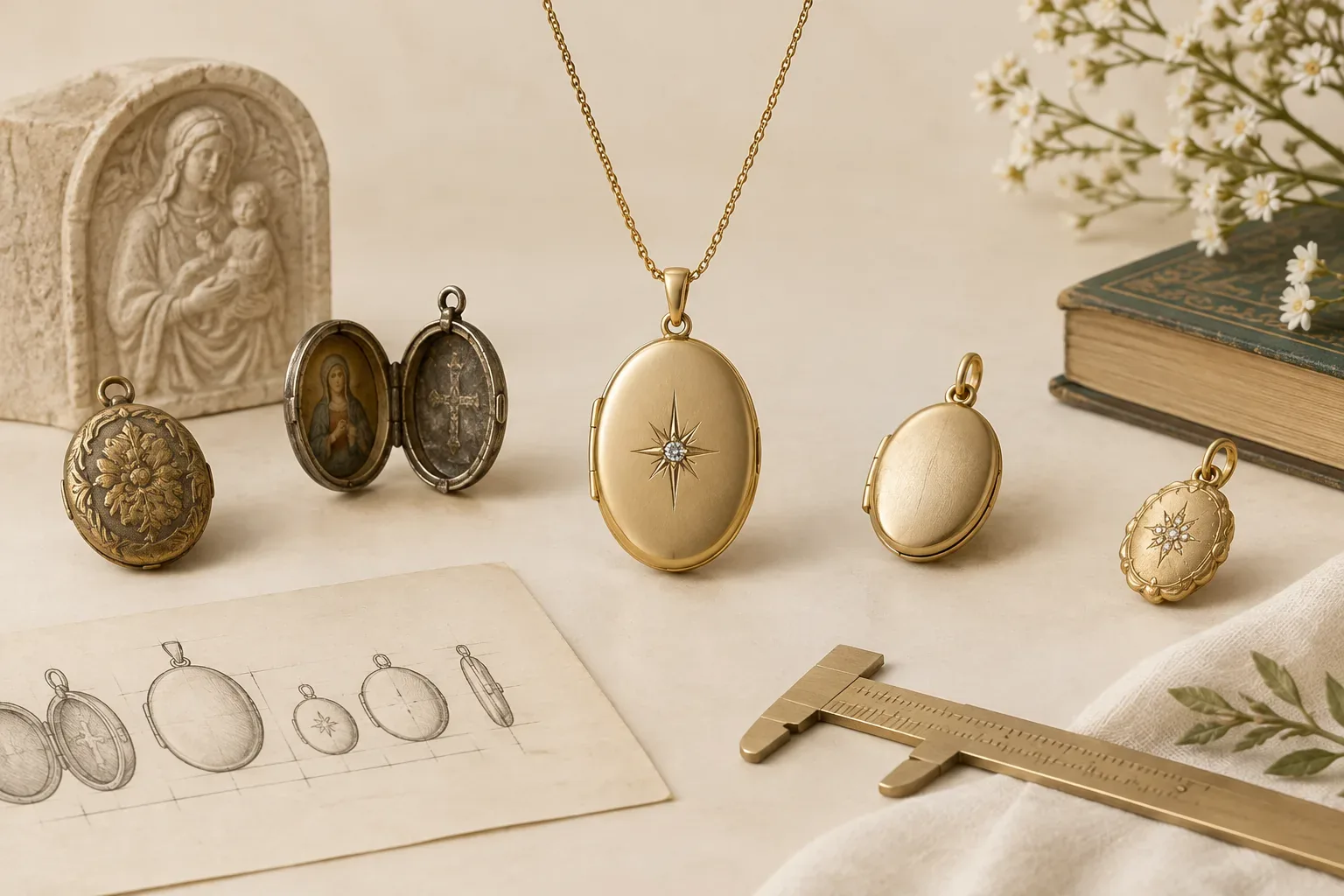
Meaning at a glance
Measure the interior compartment, exterior dimensions, bail and chain clearance, weight, and photo or keepsake size before buying or gifting; understand that historical meanings (portrait miniatures, reliquaries, Victorian mourning) are documented by museum research while many sentimental interpretations are modern and personal.
Why size and fit matter
Lockets combine function and meaning: they carry a physical token and act as visible jewelry. Size affects what fits inside and how comfortable the piece is on the body. A shallow, small locket may be ideal for a single tiny photograph or a thin strand of hair, while a deeper or larger locket is necessary for several keepsakes or a thicker gemstone cabochon. Bail and chain fit determine whether a pendant sits flat or twists, and overall weight influences whether the wearer will use the locket often or reserve it for special occasions.
Documented historical evidence (by culture and period)
The long history of small containers worn as jewelry is well documented by museum scholarship. According to the Victoria and Albert Museum, early European uses of portrait miniatures and small reliquaries influenced the development of what we now call lockets. These containers sometimes held painted portraits, religious relics, or personal keepsakes and were an established element of personal adornment in Western collections described by the museum.
The Victoria and Albert Museum also records the particular rise in popularity of sentimental and mourning jewelry during the 19th century. In that period—often identified as the Victorian era—lockets commonly held hair, miniature portraits, and other tokens associated with remembrance. Museums like the V&A document how changing social practices, such as commemorating the dead or signaling intimate ties, shaped the use and design of lockets in European material culture.
Across different cultures and periods the functions varied: some small containers were explicitly religious (reliquaries or amulets) while others served as status markers or private mementos. The V&A’s histories emphasize these shifting social contexts rather than a single, universal symbolism.
Separating documented meanings from modern personal interpretations
Museum research documents how lockets were used and understood in particular times and places, but that documentation does not mean a single, permanent meaning applies to every locket today. The Victoria and Albert Museum traces historical uses—portrait miniatures, reliquaries, mourning keepsakes—yet museums do not claim these meanings are universal.
Modern wearers, designers, and gift-givers often layer new personal meanings onto historical forms. Wearing a locket today may reference Victorian sentimentality, reference a family story, or simply be an aesthetic choice. Those modern interpretations are valid as personal or cultural signals, but they are different in kind from the historically documented practices recorded by museum scholarship. Treat historical meanings as contextual information and modern sentimental meanings as individual or cultural choices.
How motifs, gemstones, and traditions appear in lockets
Lockets carry motifs and gemstone settings the same way other jewelry does: as surface decoration, set stones, enamel work, engravings, or integrated compartments. Gemstones appear as decorative elements on the exterior or as functional parts of the closure and hinge. The Victoria and Albert Museum’s guide to gemstones explains how different stones were historically valued and worked into jewelry designs; historically popular stones and cutting styles influenced how jewelers balanced appearance with the locket’s thickness and hinge design.
Because gemstones and treatments affect price and durability, consumer guidance from the Federal Trade Commission is relevant: treatments, enhancements, and imitations should be disclosed at sale. Buyers of lockets that include gemstones should ask whether stones are natural, treated, synthetic, or simulants. The presence of a sizable cabochon or faceted stone will increase the locket’s thickness or weight and may change what keepsakes will fit inside.
Motifs—flowers, hearts, initials, religious symbols—appear as engraved or applied decoration and can signal a historical style (for example, mourning iconography in the Victorian era) or a contemporary design language. Whether a motif is presented as historical reference or modern reinterpretation depends on maker intent and wearer reading.
Measurements that matter and how to take them
Start with the internal compartment. Open the locket and measure the usable length, width, and depth of the recess where a photograph or keepsake will sit. If the locket has a frame for photos, measure the visible aperture as well as the internal recess to ensure the image will be held flat. Measure in millimeters or inches and record those numbers before attempting to resize photos or choose a keepsake.
Measure the exterior dimensions next: overall height, width, and thickness. Consider how those dimensions relate to the wearer’s body and clothing. A wide, heavy pendant will sit differently on thin fabrics than on knitwear.
Check the bail or loop opening and compare it to the chain thickness. The bail must be slightly larger than the chain for the pendant to slide freely. Also consider the distance from the top of the bail to the top of the pendant to understand how the piece will hang and whether it will tuck under collars.
Weigh the locket if possible. Weight predicts comfort during daily wear. Consider whether the item will be worn alone or layered with other necklaces, and account for how weight changes with or without a keepsake inside.
If you plan to place a photograph, trace and cut a test paper to the internal shape and size, then slide it in and close the locket. This simple mock-up avoids ruined photos and confirms fit. For hair or thicker objects, account for depth and whether the locket will close fully without distorting the keepsake.
Practical selection and respectful gifting guidance
Begin selection by matching function to recipient. If the intention is daily wear, choose a comfortable weight and a secure closure; for a commemorative piece, prioritize durable hinges and a design that protects fragile keepsakes. Ask the recipient (or the person who will help you choose) about metal sensitivities and preferred chain lengths.
Be respectful about meaning. When a locket is intended as a memorial or contains a cultural or religious symbol, research its historical use and contemporary sensitivity; museum sources such as the Victoria and Albert Museum provide context for historical practices. Do not assume a symbol’s meaning is universal—present it as either your interpretive choice or a documented tradition, and let the recipient weigh its personal relevance.
When the locket includes gemstones, request written disclosure about treatments, synthetics, or simulants in line with Federal Trade Commission guidance so the recipient understands value and care requirements. Ask the seller for care instructions; some stones and finishes require gentle cleaning or professional maintenance.
If the gift is meant to contain a photograph or lock of hair, prepare the keepsake in advance and verify the fit. For photographs, use archival paper and consider placing a thin protective cover (acid-free) between the image and the metal to slow deterioration. For hair, avoid adhesives that will damage metal or the hair itself.
Consider personalization options like engraving, but check closure and hinge integrity first. Engraving the exterior is reversible enough for many recipients; engraving the interior is more intimate and should reflect the recipient’s acceptance of the item’s meaning.
Care, authentication, and buying tips
When buying a locket with gemstones or antique materials, ask for documentation about metal purity and gemstone treatment. The Federal Trade Commission advises that sellers disclose treatments and whether gems are natural, laboratory-grown, or simulants. Museums such as the Victoria and Albert Museum provide context on how materials were historically used but do not substitute for an up-to-date appraisal.
For antiques, request provenance and condition reports; hinges and catches that have been heavily repaired may reduce the piece’s ability to protect keepsakes. For modern pieces, insist on a return policy if internal measurements do not meet expectations.
Store lockets flat in a dry place, and avoid storing photographs directly against reactive metals. For long-term preservation of sensitive keepsakes, consult a conservator or follow archival storage practices.
Frequently asked questions
What exact measurements should I check before buying a locket?
Measure the internal compartment length, width, and depth; measure the exterior height, width, and thickness; check the bail opening versus your chosen chain thickness; and weigh the piece to assess comfort. If you plan to add a photo, cut a paper mock-up to the internal aperture size and test-fit it.
Can any gemstone be set on a locket without changing the fit?
Not always. Large or high-profile stones increase thickness and weight and may reduce internal space. Ask the seller for dimensions and whether the stone is a cabochon or faceted. Also request disclosure of treatments or simulants in line with Federal Trade Commission guidance.
How do historical meanings affect whether I should gift a locket?
Historical meanings—such as portrait miniatures or Victorian mourning uses—are part of the locket’s context, as documented by museums like the Victoria and Albert Museum. Use those histories as background, but recognize that contemporary recipients will assign personal meaning. If the locket carries cultural or religious motifs, research their significance and consider whether the recipient will welcome such associations.
How should I prepare a photograph for a locket?
Measure the visible aperture and the internal recess, then cut an archival-quality paper test to that size for trial. Use acid-free paper or a protected cover to help slow deterioration. Avoid adhesives that could damage the image or metal; if uncertain, consult a conservator or professional jeweler.
Are antique lockets safe for storing keepsakes?
Antique lockets can be appropriate, but verify hinge integrity and ask for a condition report. Heavily repaired catches or thin metal walls may not protect fragile keepsakes. For valuable or delicate items, seek a conservator’s advice on safe storage and long-term preservation.
Sources and further reading
- Bedazzled: A History of Jewellery — Victoria and Albert Museum
- An A-Z of Gemstones — Victoria and Albert Museum
- Buying Gemstones, Diamonds, and Pearls — Federal Trade Commission