Meaning at a glance
This article explains the documented history and changing contexts of lapis lazuli quality and value factors, distinguishes historical evidence from modern personal meanings, describes how lapis appears in historic and contemporary jewelry, and gives practical selection and gifting advice supported by museum scholarship and consumer-protection guidance.
Direct answer — the short thesis
Lapis lazuli quality and value factors center on color intensity and evenness, the presence and balance of natural inclusions, material stability and finish, and transparent disclosure of treatments or imitations. Museum scholarship shows that lapis has been prized in many historical cultures for its deep blue and decorative properties, but the social meanings attached to the stone have varied by time and place. For modern buyers, rely on visible stone attributes, reputable disclosure about enhancements, and your own aesthetic and cultural considerations when assessing worth.
Historical evidence and cultural contexts
Documented use of lapis lazuli stretches back many centuries, and museum research situates the stone in distinct cultural and chronological contexts rather than ascribing a single, continuous meaning. The Victoria and Albert Museum describes how lapis was used in decorative objects and jewellery across different eras, including ancient Near Eastern and Egyptian contexts, later medieval and Renaissance Europe, and subsequent decorative traditions. The V&A’s materials support reading lapis as a material prized for its color and decorative potential, appearing in inlay, beads, and set stones within a broad historical sweep.
Because the V&A treats lapis in the larger history of jewels and gemstones, its account highlights changing social uses: in some periods artisans valued lapis for ornamental inlay or small carved objects, while in other eras the stone entered painted pigment and luxury jewellery traditions. Those shifts reflect changing tastes, technologies, and trade networks rather than a single symbolic meaning shared by all users.
Documented historical meanings versus modern interpretations
Museum records show that lapis’s historical meanings were contingent: in specific eras and regions the stone could signify wealth, be used for ritual or funerary objects, or be chosen for purely decorative reasons. The V&A emphasizes the object histories—how and where lapis was used—without asserting a universal symbolic program for the gemstone.
Modern personal interpretations—such as wearing lapis for spiritual protection, inner truth, or emotional balance—are contemporary meanings layered onto the material by individual wearers, jewelry designers, and new-age communities. These modern attributions are valid as personal or cultural choices but should be distinguished from what the historical record documents. In other words, museums document use and material value; modern symbolic meanings often reflect current fashion, personal belief, or marketing rather than a single historical narrative.
What determines lapis lazuli quality and value today
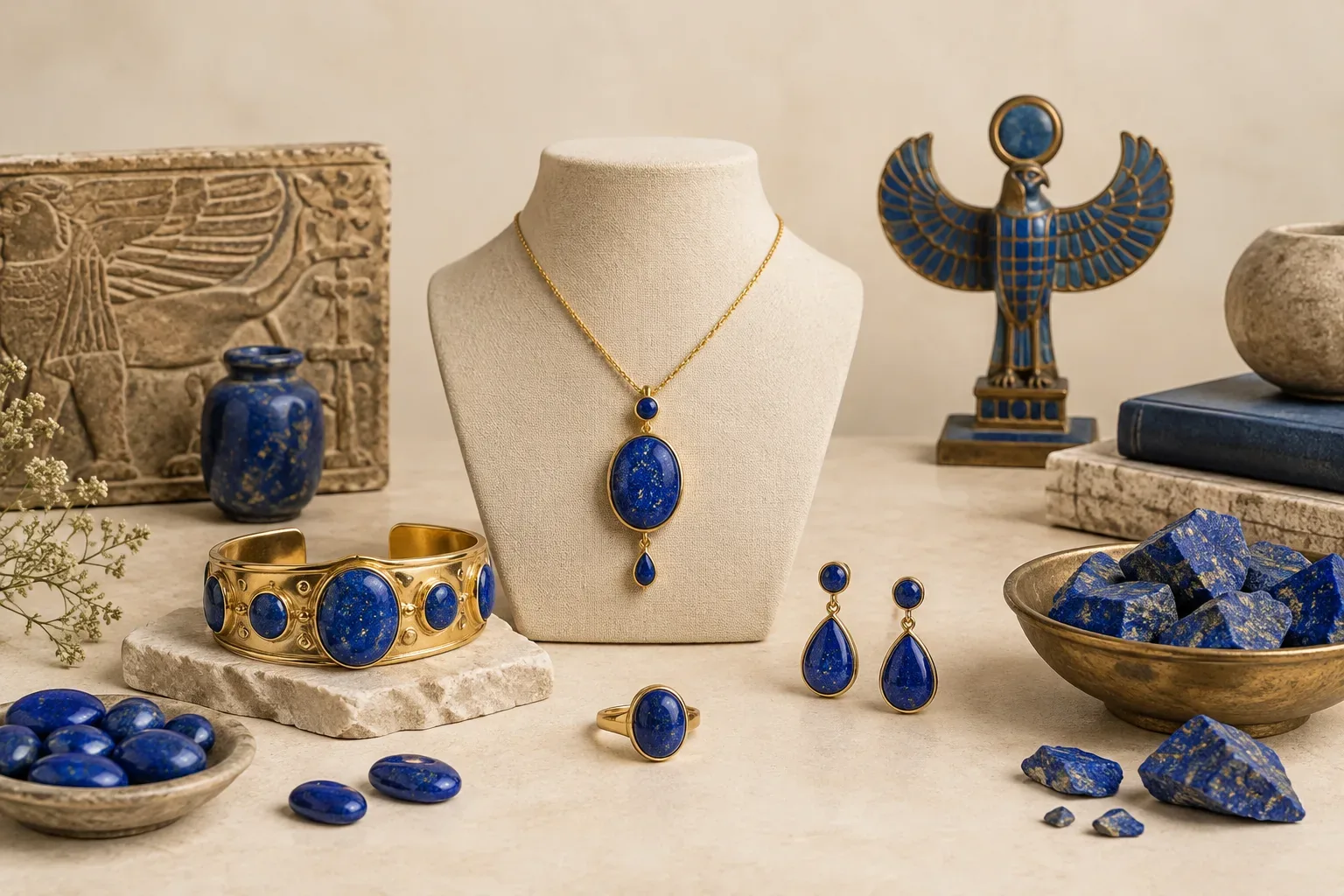
Contemporary appraisal of lapis focuses first on color. Deep, saturated blue that reads uniformly across the stone is generally preferred in both historic and modern markets because it highlights the material’s most distinctive visual quality. Slight variation can be attractive, but patchy or washed-out color typically reduces value.
A second visible factor is inclusions. Lapis naturally contains mineral inclusions; small, evenly distributed metallic flecks are commonly regarded as a positive visual counterpoint, whereas large patches of pale matrix material or excessive veining can reduce the perceived quality. Historically and today, buyers and curators look for a pleasing balance between blue ground and contrasting inclusions.
Cut, polish, and size matter. Well-shaped cabochons, uniformly cut beads, or finely inlaid panels that show even polish and minimal surface damage will command higher prices than poorly finished pieces. Larger specimens with good color are rarer in finished jewellery sizes and therefore tend to be more valuable.
Treatment and imitation affect both quality and legal disclosure. The Federal Trade Commission requires that sellers be transparent about treatments and imitations of gemstones. Surface treatment, dyeing, reconstitution, or composite stones can alter appearance and price; buyers should request clear disclosure and, for higher-value purchases, consider independent verification.
How lapis lazuli appears in historic and contemporary jewelry
Museum collections and exhibitions record lapis in a range of objects: small carved elements, beads strung into necklaces, inlay panels in metalwork, and cabochons set into rings and brooches. The V&A’s historical surveys show that lapis was used both as an element of complex multi-material objects and as a standalone focal stone, depending on the period and object type.
In modern jewellery, lapis most commonly appears as polished cabochons, beads, and inlay. Designers may pair it with gold or silver mounts to emphasize color contrast, or use it alongside other stones as an accent. Because of its surface texture and typical inclusion patterns, lapis is often cut en cabochon rather than faceted; cabochon cutting presents the stone’s color and inclusions attractively and is a historically continuous technique.
Practical buying and gifting guidance
Decide what matters to you first: color purity, visible inclusions, durability, or provenance. Inspect lapis in natural light when possible; photographs can misrepresent tone and saturation. For online purchases, ask the seller for unretouched photos in daylight and clear close-ups of the stone under different lighting conditions.
Ask direct questions about treatments, enhancements, and whether the piece is natural, dyed, assembled, or stabilized. The Federal Trade Commission advises that sellers disclose treatments and imitations, so a reputable vendor should be willing to explain what, if any, interventions have been made to the stone and provide written confirmation when appropriate.
Consider settings and wearability. Lapis is commonly used in beads and cabochons; choose a setting that protects edges from knocks and that suits the recipient’s lifestyle. If you are buying a gift for everyday wear, prefer secure mountings and protective bezel settings. For special-occasion jewellery, a more delicate setting may be appropriate if the wearer is unlikely to expose the piece to impact or harsh chemicals.
Respect cultural meanings and personal associations. If the recipient values a traditional or regional meaning attached to lapis, ask about those preferences, or choose a design that acknowledges the cultural context. When gifting to someone from a cultural tradition that uses lapis in specific rituals or symbols, be mindful and, when in doubt, ask a relative or the recipient about appropriateness.
Document and verify higher-value purchases. For important or expensive stones, seek certification or a written appraisal from a recognized gemological or jewelry authority and retain receipts and return-policy information. Clear documentation of treatment status and any guarantees will protect both buyer and seller in resale or repair situations.
Final considerations
Lapis lazuli’s desirability rests on a combination of visual qualities, historical prestige as recorded in museum scholarship, and contemporary tastes. Distinguish historical documentation of use from modern personal meanings, insist on transparent disclosure about treatments and imitations, and choose settings that suit the piece’s intended use. Doing so will help you select lapis jewellery that meets aesthetic, ethical, and practical expectations.
Frequently asked questions
How can I tell good-quality lapis lazuli?
Look for a deep, even blue tone with attractive, balanced inclusions. A well-polished cabochon or bead with minimal surface damage generally indicates higher quality. Ask the seller about treatments and request clear photos in natural light for online purchases.
Are the metallic flecks in lapis desirable or a flaw?
Natural metallic flecks occur in many lapis specimens; small, evenly distributed flecks often enhance the stone’s visual interest, while large or uneven patches of contrasting matrix can reduce perceived value. Preferences vary, so consider the overall appearance and harmony of color and inclusions.
Is lapis lazuli treated or imitated, and how should sellers disclose that?
Treatments and imitations exist for many gemstones. The Federal Trade Commission advises that sellers must disclose treatments and whether a material is natural, stabilized, dyed, reconstituted, or simulated. Ask for written confirmation of any treatment, and for significant purchases consider third-party verification.
How should I care for lapis jewellery?
Because lapis is often cut into cabochons and beads, protect it from abrasion, hard knocks, and prolonged exposure to chemicals or ultrasonic cleaners. Clean gently with a soft cloth and mild soapy water, and store separately to avoid scratching.
Is lapis suitable for everyday rings or bracelets?
Lapis can be worn daily, but choose protective settings—such as bezels—and avoid exposing the stone to harsh impacts or chemicals. For active wearers, consider pendants or necklaces that are less likely to be struck than rings or bracelets.
Sources and further reading
- Bedazzled: A History of Jewellery — Victoria and Albert Museum
- An A-Z of Gemstones — Victoria and Albert Museum
- Buying Gemstones, Diamonds, and Pearls — Federal Trade Commission