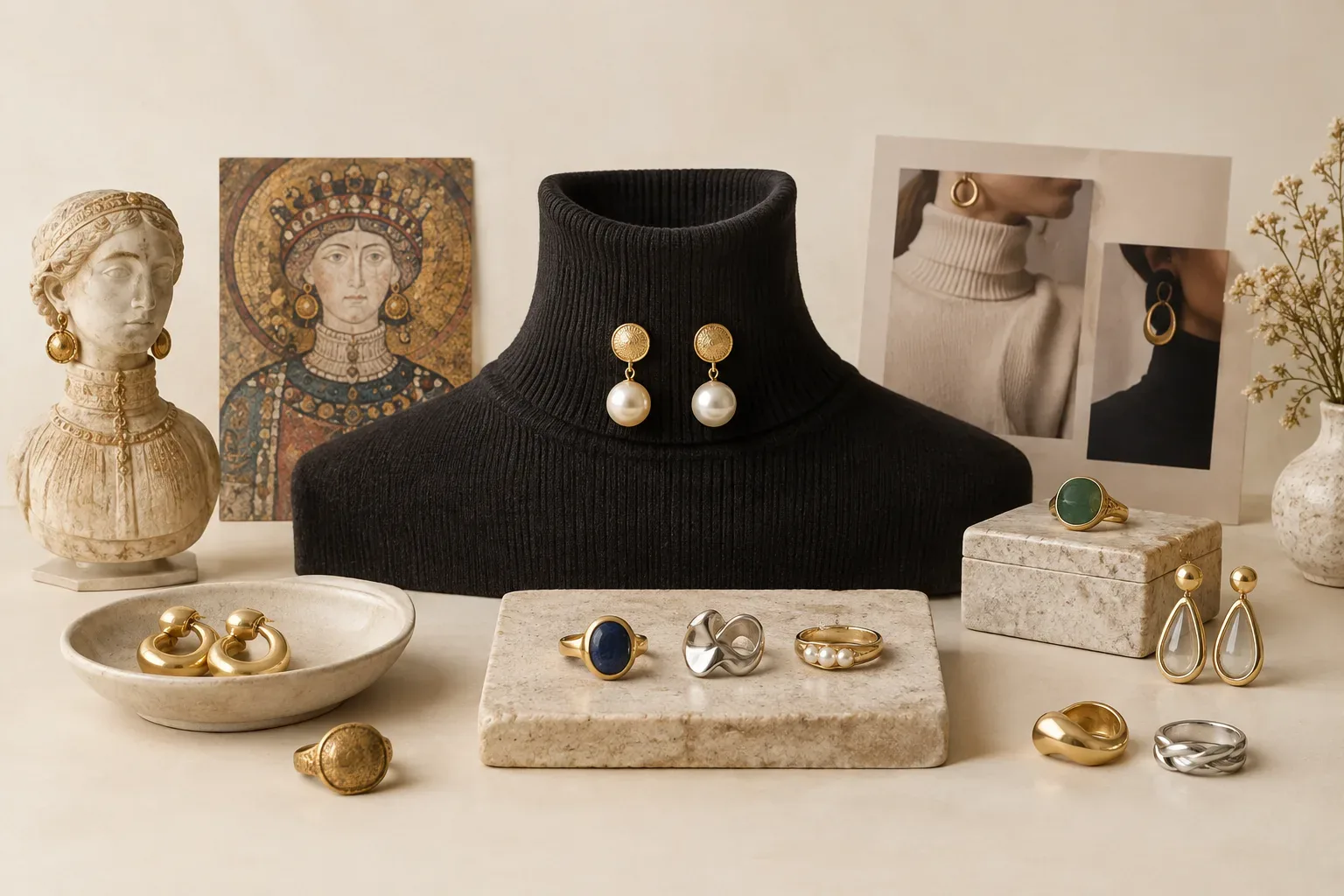
Meaning at a glance
When wearing a turtleneck, choose earrings that clear the collarline and balance your face, favor lighter weights and secure backs for comfort, and select rings with comfortable profiles or stackable options; consult documented historical meanings (as recorded by museums) separately from modern personal symbolism and follow consumer advice about gemstone disclosure when buying gifts.
What history tells us about jewelry, necklines, and social context
Museums and curatorial histories make a clear point: jewelry has never been only decoration; its forms, placement and uses have shifted as clothing, social norms and technology changed. The Victoria and Albert Museum’s overview of jewellery history stresses how the same object or motif can mean different things in different periods because wearing practices and social contexts change, and because makers reuse forms and materials over time.
From functional dress fasteners to overt status symbols and intimate memorials, jewelry historically interacted with garments and necklines. The V&A collection records how brooches, chokers, pendants, and chains were adapted to specific collars and bodices in different eras, which is why scale and attachment matter today when you pair jewelry with a high collar like a turtleneck.
Separating documented meanings from modern interpretations
Documented meanings are those supported by historical records, museum cataloguing, or contemporaneous sources. For example, many objects in museum collections are labeled with proven functions—mourning rings, portrait lockets, or dress-fastening brooches—because curators have traced their use and provenance. The V&A’s historical framing helps identify those documented roles for jewelry.
Modern personal or popular interpretations—what a wearer today chooses to feel or say with a motif—are separate. A motif reused today (for example, a heart, a whale, or a cross) may carry sentimental or fashion meanings for contemporary wearers that were not intended in earlier periods. Do not assume a single, universal meaning for any symbol: documented usage in one culture or era does not necessarily transfer as fact to another, and contemporary symbolism often blends personal, cultural and commercial meanings.
How motifs, gemstones and traditions appear in earrings and rings
Motifs reappear across jewelry types. Animal shapes, botanical engraving, geometric forms and religious symbols can be rendered as small studs, dangles, signet faces or ring bezels depending on intended visibility and function. When a motif is historically documented, museums like the V&A catalogue how it was executed—engraved, cast, inlaid or set with stones—which helps identify whether a contemporary piece follows a long tradition or is a modern reinterpretation.
Gemstones and pearls have distinct practical and cultural histories. Pearls and other near-neck gems were historically associated with closeness to the throat and therefore often used in collars or chokers; modern earring and ring designs still place pearls near the face or finger because of their classic look. When buying gemstones, follow consumer-protection guidance: verify treatment, origin claims and imitation disclosures because many stones are heat-treated, dyed or simulants, and reputable sellers should disclose that information, as the Federal Trade Commission advises.
Scale and shape: earrings that suit a turtleneck
A turtleneck creates a continuous plane up the neck that visually shortens the space between face and garment. To make your earrings read clearly, consider scale: a small stud can be elegant and subtle if it contrasts in shape or sparkle, while a short drop or modest hoop that ends above or just at the collar will register without being swallowed by fabric.
Long chandeliers or very heavy statement drops may compete with the high collar and can become uncomfortable because they catch on knit. If you love longer earrings, choose lightweight construction—openwork, hollow metal or thin chains—and secure backs such as screw-backs, locking lever-backs or threaded posts to reduce movement and snag risk.
Earring shape, face balance and comfort
Choose shapes that balance your face shape and the turtleneck’s visual weight. Round faces often pair well with angular or elongated earrings that add vertical emphasis above the collar. Angular faces can be softened with circular hoops or rounded studs. If you want a classic, fuss-free option, studs or small hoops are versatile: they sit close to the lobe and won’t tug at knit fabric.
For pierced ears, consider back types that increase comfort when wearing a high collar: flat, wide backs distribute weight more comfortably against the lobe and reduce pressure when the collar brushes the ear. Clip-on options today offer improved comfort and security for non-pierced ears, but test them with similar-weight pieces before committing to an extended wear.
Ring choices to complement turtlenecks
Rings and turtlenecks interact indirectly: sleeves and gloves, hand activity and how often you move your neck influence what ring profile feels comfortable. Low-profile rings, slim stackables and signet rings with rounded edges can be worn all day without catching on sleeve cuffs. Oversize cocktail rings look dramatic when you are stationary for photos or events, but they can feel clumsy under long-sleeved garments or during active tasks.
If you are gifting rings for someone who wears many turtlenecks, prioritize fit and versatility. Consider slightly narrower bands for colder months when fingers can swell less, and choose comfort-fit interiors if the recipient values long wear. If you expect hand washing or cleaning where you will wear gloves, choose designs without deep stone settings that trap dirt or snag.
Material, weight, and allergy considerations
Metal weight influences both the comfort of earrings and how rings feel on the hand. For earrings, mixed-metal designs can reduce overall weight while achieving a substantial appearance; hollow or filigree construction gives drama without heaviness. For rings, avoid overly wide bands if the wearer prefers dexterity; narrow stacked bands can achieve visual weight without a single heavy ring.
Metals and surface treatments can cause irritation for some people. If you are buying for someone with unknown sensitivities, choose hypoallergenic metals like surgical steel, titanium, or higher-karat gold, and check seller disclosures for plating or treatments. The FTC’s consumer guidance about gemstones, diamonds and pearls also applies to metals and treatments broadly: reputable sellers should disclose plating, coatings and any material treatments.
Respectful selection and gifting guidance
When a motif has documented cultural or religious meaning, research it before gifting or wearing. Museums and catalogues, such as the Victoria and Albert Museum’s gathered histories, help identify when a motif had a particular social role. Separate those documented uses from modern reinterpretation and, if in doubt, ask about the recipient’s relationship to the symbol or choose a neutral alternative.
For thoughtful gifting: choose sizes you can exchange, include the purchase’s treatment and care information, and prefer sellers who disclose gemstone treatments and origins. If the piece has precious stones or pearls, verify the seller’s disclosure policies in line with Federal Trade Commission guidance to avoid surprises about treatments or simulants. Finally, include a note explaining why you selected the piece for the recipient—this makes modern personal meaning explicit rather than assuming historical symbolism.
Practical outfit pairings and everyday tips
For a minimalist daytime look, wear small studs or thin hoops and a slim signet or stackable rings for a neat silhouette with a turtleneck. For evening, a single mid-length drop or a lightweight chandelier that ends just above the collar can read like jewelry framing the face. If you layer necklaces over a turtleneck, choose short chains or collar-length chokers designed to sit on top of fabric; avoid long pendants that disappear beneath the knit.
Always test a new earring with the exact turtleneck you plan to wear: different knit thicknesses change how jewelry sits and how likely it is to catch. When packing travel jewelry, store earrings with backs secured and rings in individual compartments so pieces do not tangle while folded against fabric.
Final note on symbolism and personal voice
Historical documentation and museum curation provide a foundation for understanding jewelry’s changing meanings, but contemporary wearers freely adapt motifs to express personality, memory and fashion. Treat documented cultural or religious meanings with respect, follow seller disclosure practices for materials, and choose forms that are comfortable and authentic to the wearer’s life.
Frequently asked questions
Can I wear long statement earrings with a thick turtleneck?
Yes, but choose lightweight construction and secure backs. Very long or heavy earrings can be visually swallowed by a high collar and may snag on knit; openwork, hollow metal and thin-chain drops reduce weight while preserving length, and locking lever-backs or threaded posts help prevent movement.
Are pearls appropriate with turtlenecks?
Pearls work well because they sit close to the face and contrast nicely with knit textures, but consider the pearl size and setting. Large, high-set pearls can catch on fuzzy knits, while small studs or low-set baroque pearls will be more comfortable. When buying pearls as a gift, check seller disclosures about whether they are cultured, treated or imitation per consumer guidance.
What rings are best for everyday wear with long sleeves?
Low-profile rings, slim stackables and signet rings with rounded edges are comfortable with long sleeves. Avoid oversized cocktail rings for active daily wear; if you want noticeable rings, spread them across different fingers rather than stacking one very large piece on a single finger.
How should I approach motifs that might have cultural or religious meaning?
Research documented uses via museum catalogues or trusted sources before wearing or gifting a symbol you suspect has cultural significance. Treat documented historical meanings as distinct from modern fashion uses and, when uncertain, ask the intended wearer about their comfort or choose a neutral design.
What should I look for when buying gemstone jewelry for someone who wears turtlenecks often?
Look for secure settings that won’t snag on knit, verify disclosures about treatments or simulants, and choose stones that sit low to the metal surface for hands and earrings. The Federal Trade Commission recommends that sellers disclose material treatments and imitation practices, so prioritize vendors with clear policies.
How can I test whether an earring will catch on a specific turtleneck?
Bring the earrings and the exact turtleneck to a fitting, or try the turtleneck on with the earrings for a few minutes while moving your neck. Notice if the fabric pulls at the earlobe or if the earring's back presses uncomfortably; adjust choice or back type accordingly.
Sources and further reading
- Bedazzled: A History of Jewellery — Victoria and Albert Museum
- 11 Cool Facts About Whales, Dolphins, and Porpoises — NOAA Fisheries
- Buying Gemstones, Diamonds, and Pearls — Federal Trade Commission