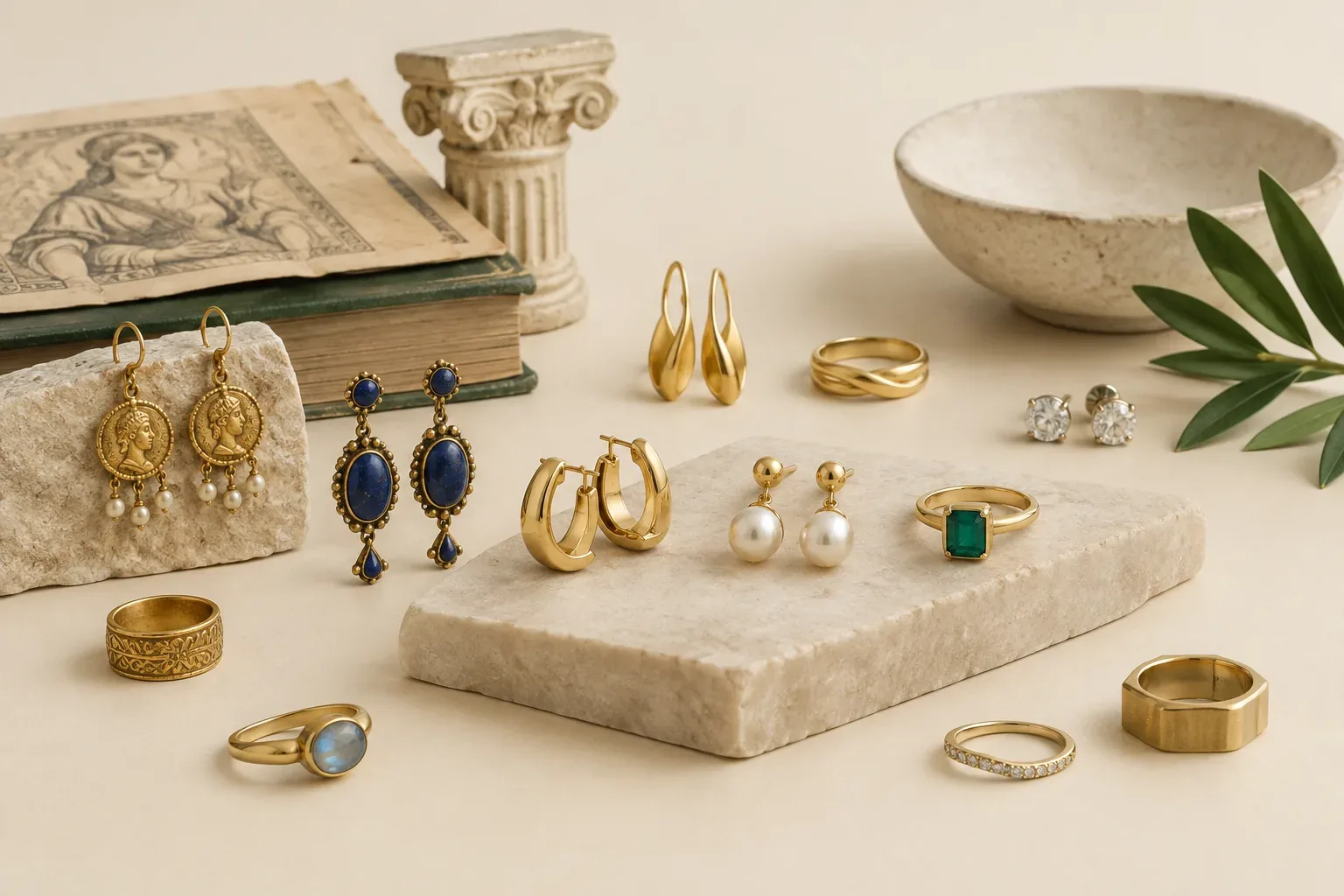
Meaning at a glance
This article explains the documented history and changing contexts of earrings and rings used in professional dress, distinguishes recorded cultural meanings from modern personal readings, and offers practical guidance on selecting and gifting office-appropriate earrings and rings focusing on scale, shape, and comfort.
What the historical record shows (and which cultures it comes from)
The long history of personal adornment shows that earrings and rings have been used for status, identity, trade and sentiment across many cultures. The Victoria and Albert Museum documents jewellery across historical periods and regions and emphasizes that forms, materials and social meanings change with social structures and fashion. For example, in many historical European contexts rings served as markers of marital status, legal authority or familial identity, while in other periods and regions ornament functioned primarily as wealth display or amulet.
Museum scholarship also traces the formal evolution of earring and ring shapes. Hoop and drop earrings, signet and posy rings, and simple metal bands have long precedents in archaeological and decorative collections. The V&A’s surveys of historical jewellery detail how fashionable proportions and materials shift: what was large, ostentatious or meaningful in court dress of one century became unfashionable or differently coded in another. These museum-held patterns of change remind us that any modern reading of a motif must be anchored to the culture and era that produced it.
Documented meanings versus modern personal interpretations
When studying jewellery, separate documented historical meanings from later or popular interpretations. A motif or gem recorded by a museum as associated with a given belief in a specific culture should not be assumed to carry that same connotation automatically today. For example, a particular gemstone may have been prized for protective properties in a given historical community; museum catalogues present that as historical evidence for that community’s beliefs, not as an enduring, universal property.
Modern wearers frequently reassign meanings to jewellery for personal, fashion or branding reasons. A wearer today might choose a gemstone for its color, a ring form for its minimalist look, or an earring shape because it flatters their face. Those contemporary readings are valid as personal statements, but they are not the same thing as the culture-specific meanings documented by historical sources such as museum collections or period records. A careful approach distinguishes the two: cite historical evidence for what a symbol meant in its original context, and treat modern meanings as subjective and contingent.
How motifs, gemstones and traditions appear in earrings and rings
Motifs show up in jewellery as shapes, reliefs, engraved patterns, and settings that foreground particular stones. A floral motif may appear as delicate openwork on an earring or as an engraved band on a ring; a geometric motif might inform the overall silhouette of a drop earring or the faceting and bezel of a ring stone. Museum surveys such as those at the Victoria and Albert Museum help trace these formal continuities and variations across time and region, showing how motifs travel and transform.
Gemstones are used both for their physical properties and for their historical associations. Historic catalogues classify gems by source, color and cutting style; this context helps identify when a particular gem became fashionable and why. In modern commercial jewellery, the same gemstones appear mounted in simple studs, halo rings, or low-profile bezels designed for daily wear in professional settings. Keep in mind that treatments, substitutes and imitations are common in the modern market. The Federal Trade Commission provides guidance on material disclosure: sellers should disclose treatments and whether a stone is synthetic, simulant or natural, which is useful to know whether you value authenticity, durability or budget.
Scale: choosing the right size for the office
Scale is primary when tailoring jewellery to a workplace. Historically larger, more ornate pieces signaled rank or ceremonial function in many contexts, while everyday dress favoured smaller items. For contemporary office outfits, select earrings and rings that are visually proportional to your clothing and to the professional setting. Small studs, short drops that do not catch on clothing, and slim bands create a quieter silhouette that reads as polished and intentional in most offices.
Consider body scale as well: what reads as small on one person may be delicate on another. When in doubt, choose a moderate silhouette rather than extremes and test pieces with the clothes you commonly wear to work. If your workplace has specific safety or uniform rules, prioritize compliant shapes such as close-to-ear studs over long chandeliers.
Shape: silhouettes that flatter and fit environments
Shape affects both appearance and practicality. Clean geometric shapes—round, oval, rectangle—tend to integrate well with tailored office clothing, while organic or highly ornate shapes can appear more expressive. For earrings, consider studs, huggies and short drops that echo the lines of collars and necklines. For rings, flat or low-domed profiles and smooth settings are less likely to snag paperwork or clothing.
Shape also communicates style. A simple square-cut stone or polished signet ring reads as modern and restrained; a filigree ring or elaborate drop earring signals vintage or boutique taste. Use historical knowledge to inform choices: if you choose a historically inspired motif, make clear whether you are referencing an antique form for aesthetic reasons or wearing something for cultural or ritual significance.
Comfort and daily wear considerations
Comfort is essential for jewellery worn through a workday. Heavy earrings can pull at the earlobe and cause discomfort over hours. Look for secure fastenings, balanced weight distribution and materials that are unlikely to irritate. Rings worn for many hours should have smooth interiors, secure settings for stones, and appropriate widths to avoid pinching. Try on pieces for several hours where possible to check for fatigue or irritation.
Materials matter both for comfort and longevity. Hypoallergenic metals such as surgical stainless steel, platinum or well-marked nickel-free alloys reduce the risk of reactions for many people. The Federal Trade Commission’s guidance on material disclosure is useful when you need to confirm whether a product’s description matches its materials and whether any stones have been treated or imitated.
Selection and gifting guidance—practical and respectful
When selecting or gifting jewellery for office wear, be explicit about intent and context. If the goal is a professional, versatile piece, describe the workplace environment and typical outfits to the seller or gift recipient. Choose modest scale, secure settings and neutral shapes so the piece is adaptable across outfits. If gifting to someone from a distinct cultural or religious background, research whether the intended motif has specific cultural or ritual meaning; museum resources such as those at the Victoria and Albert Museum can help you identify historically documented uses, but always ask or consult family members if the piece might touch on living customs.
Respect requires that you do not assume a motif’s meaning without supporting evidence from the culture in question. If you are unsure whether a symbol might have sacred or community-specific significance, avoid presenting it as a casual accessory and instead opt for universally neutral alternatives like plain metal bands or simple gemstone studs. For purchases, ask sellers about gemstone origin, treatments and whether stones are natural, synthetic or simulant; the Federal Trade Commission advises that consumers should expect material disclosures. Finally, include a gift receipt and a clear return option: professional contexts and personal taste vary, and allowing an exchange reflects thoughtfulness.
Practical styling examples for common office looks
For a tailored blazer and blouse combination choose small to medium studs or short drop earrings that fall close to the jawline and a slim band or low-profile gemstone ring. This keeps lines clean and avoids movement that distracts in meetings. Where a collar is high or ornate, prefer smaller earrings or none at all so attention stays on the outfit’s structure rather than on ornament.
For business-casual or creative offices, you may experiment with slightly larger shapes—huggies, small hoop earrings, or a signet ring with a discreet motif—while maintaining a restrained overall palette. Avoid pieces that jingle or snag. In roles involving manual tasks, frequent typing, or safety considerations, prioritize close-to-ear studs and minimal protrusion from rings.
Final note on provenance, disclosure and ethics
Provenance, material disclosure and ethical sourcing are increasingly relevant to office-appropriate jewellery choices. The Victoria and Albert Museum’s work on gemstone history underlines that materials carry shifting social meanings tied to trade and fashion. The Federal Trade Commission advises transparency about treatments and imitations; use that guidance to ask sellers clear questions about origin and processing. If ethical sourcing matters to you or your recipient, request documentation and consider reputable vendors who provide clear information.
Frequently asked questions
What earring length is best for the office?
Short drops, huggies and studs are typically best for offices because they minimize movement and the chance of catching on clothing; choose proportions that sit close to the jawline or earlobe and test for comfort over several hours.
Are signet rings appropriate for professional settings?
Yes, simple signet rings with clean profiles can be appropriate and read as classic and restrained; avoid highly ornate or oversized signets in conservative workplaces and consider a low-domed or flat profile for comfort and safety.
How can I confirm whether a gemstone is natural or treated?
Ask the seller for clear disclosure about treatments, whether the stone is natural, synthetic or a simulant, and any certification. The Federal Trade Commission recommends that sellers provide material information, so request written details if provenance is important to you.
Should I avoid culturally specific motifs when gifting jewellery?
If a motif is tied to a living religious or cultural practice, research documented uses and, ideally, consult members of that community before gifting. When in doubt, choose neutral designs such as plain metal bands or simple studs to avoid unintentional offense.
How do I balance personal style with workplace norms?
Start with modest scale and neutral shapes that suit your work environment, then introduce one distinctive piece—such as a small motif ring or a single pendant earring—to express personal style while keeping the overall appearance professional.
Sources and further reading
- Bedazzled: A History of Jewellery — Victoria and Albert Museum
- An A-Z of Gemstones — Victoria and Albert Museum
- Buying Gemstones, Diamonds, and Pearls — Federal Trade Commission