Meaning at a glance
Short answer: Present green stones and enamels accurately while treating growth, renewal, prosperity, and nature as evolving cultural or personal readings.
What the historical evidence shows
When we look for documented historical meanings, we must rely on direct studies of surviving objects, inventories and contemporary descriptions. The Metropolitan Museum of Art’s catalog on Islamic jewelry examines materials, color use and enamel practice in medieval and later Islamic contexts and shows that green was used in specific decorative and symbolic registers within those societies; the Met’s publication places those meanings in the precise context of Islamic art and material culture rather than treating them as universal statements.
Gemological institutions such as the Gemological Institute of America (GIA) document how green colors in gems are produced, how they affect a stone’s market value, and how treatments or origin affect identification. GIA’s value-factor guidance explains that hue, tone, saturation and color uniformity are primary determinants of a colored gemstone’s appearance and value, and its colored-stone research discusses the identification, origin, and treatments that matter when assessing historic and modern stones. These technical records inform how green jewelry can be dated, described, and understood as material culture, but they do not by themselves assign fixed symbolic meanings across cultures.
Precisely separating documented historical meanings from modern interpretations
Documented historical meanings must be tied to the records that attest to them. For example, the Met Museum’s treatment of Islamic jewelry ties certain color and enamel uses to courtly, religious or regional aesthetic systems in Islamic societies. Those are specific, contextual readings based on object study and museum scholarship. We should not extrapolate those findings to unrelated cultures or periods without direct evidence.
Modern meanings—such as reading green broadly as growth, renewal, prosperity, or an expression of ecological values—are often contemporary, syncretic, or personal. These modern attributions draw on widely shared associations with plant life and money in some societies, but they are culturally contingent and have evolved. Present-day wearers, designers, and gift-givers commonly adopt these associations; they are valid personal or cultural interpretations but should be presented as evolving readings rather than universal, historically constant facts.
How the motif, gemstone, or enamel appears in jewelry
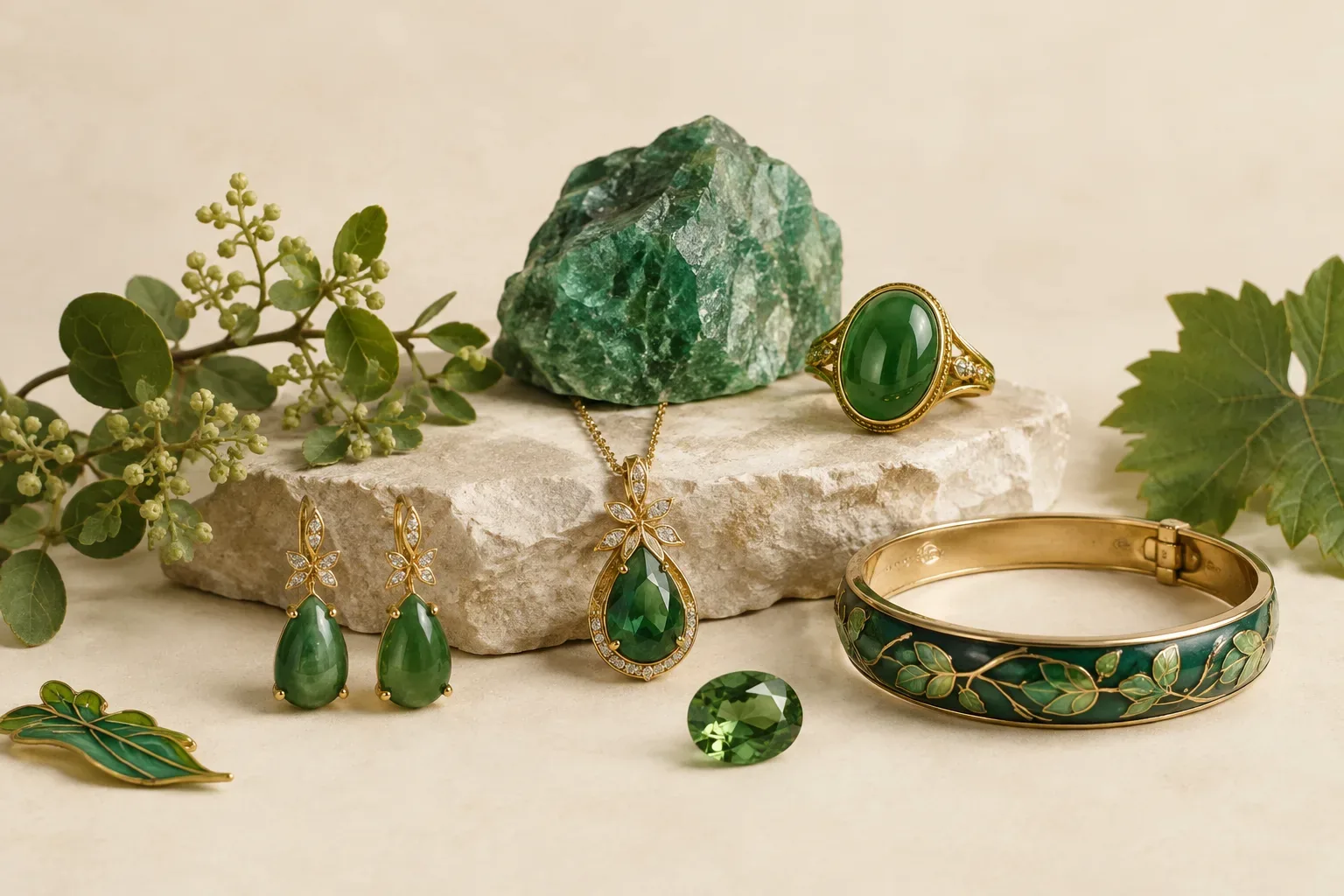
Green appears in jewelry in several technical and aesthetic ways: as natural or treated green gemstones set into rings, pendants and earrings; as colored glass or imitation stones used in costume jewelry; and as colored enamels applied to metal surfaces to produce flat or painted green areas. The Met Museum’s work on Islamic jewelry documents enamel techniques and the deliberate use of color as a design element in metalwork, showing how craftsmen combined metal, stone and enamel to achieve green surfaces that interacted with other colors and decorative motifs.
From a gemological perspective, GIA’s research explains that the specific green tone, its saturation, and its uniformity determine how vivid or muted a gem appears and how it is categorized and valued. In practical terms, a jeweler or collector will describe a green gem by its hue (for example, bluish green vs. yellowish green), the brightness of that color (tone), and the intensity (saturation). Those visual distinctions appear on finished jewelry: a deep, saturated green stone reads differently on a gold cluster ring than a pale green, translucent stone in a minimalist pendant.
Common green gemstones and materials (how to read them accurately)
When describing or evaluating green jewelry, use accurate gemological language rather than broad symbolic claims. GIA’s guidance on colored-stone identification and treatments is the basis for accurate labeling: identify whether a stone is natural, treated, lab-grown or an imitation, and whether color is intrinsic or the result of enhancement. This matters both for historical objects and for contemporary purchases because treatments and origin affect durability, value and care.
Naming specific materials in conversation or labels is helpful but make clear whether your identification is technical. For example, instead of saying a ring is “green for prosperity,” record that it contains a green stone with X hue and a Y treatment history (if known). If you need specific buying or care information, link to specialized resources such as focused articles on emeralds or on natural versus lab-grown stones.
Selecting and gifting green jewelry: practical and respectful guidance
Be explicit about what you mean when you gift green jewelry. If the intention is to convey growth, renewal, prosperity or a connection to nature, state that plainly so the recipient understands the sentiment and can situate it within their beliefs. Conversely, if your choice is aesthetic, emphasizing color or a designer’s work, say so to avoid imposing symbolic readings.
Consider cultural context. Some communities attach particular meanings to colors, materials, or motifs. If you are uncertain about the recipient’s cultural background or how they read colors, opt for a neutral and thoughtful presentation: explain why you chose the piece and invite the recipient to make their own meaning of it. This approach is respectful and avoids assuming that a single symbolic reading applies to everyone.
Check technical details that affect long-term enjoyment. Use gemological guidance when evaluating a stone: ask whether a gem is natural or treated, whether it is durable enough for everyday wear, and what care it needs. GIA’s value-factor framework is useful here: inquire about the stone’s hue, tone and saturation, the presence of any treatments, and whether the piece requires special cleaning or settings to protect softer green materials.
When sourcing, consider ethical and environmental factors. If provenance and mining or production ethics matter to you or the recipient, request documentation from sellers and prefer vendors who disclose origin, treatment and supply-chain practices. For heirloom or historical pieces, ask for condition reports and, when relevant, museum or specialist input about conservation rather than everyday cleaning.
Interpreting green jewelry today without overstating the past
It is fine and common for contemporary wearers to read green jewelry as a sign of growth, renewal, good fortune or environmental commitment. Those readings resonate widely because many cultures associate green with plant life and, in some places, with wealth. However, a responsible description distinguishes those modern sentiments from documented historical meanings shown in object studies and museum research.
If you are writing labels, giving a gift, or buying an antique piece, keep two notes clear: first, report the stone’s material and color properties accurately; second, present any symbolic claims as cultural or personal interpretations. That dual practice respects both the material evidence and the living lives of wearers and owners who will continue to make meaning from the piece.
Practical care and display notes
Durability varies by material. Many green stones, enamels and glass imitations have different hardness and sensitivity to heat, chemicals and abrasion. Always check a stone’s identity and recommended care before wearing it while gardening, cooking or exercising. For antiques, follow conservation advice rather than home remedies; museums such as the Met emphasize careful, specialist treatment for historic enamels and settings.
For display or storage, keep green gemstones away from prolonged exposure to direct sunlight if the stone or its dyeing treatment is light-sensitive. Store pieces separately to avoid scratching, and consult a trusted jeweler or gemological laboratory when in doubt about cleaning or repair.
Where to read more and related resources
For technical background on how color influences gemstone value and how gems are identified and treated, consult the Gemological Institute of America’s guidance on colored gemstone value factors and its colored-stone research. For documented historical studies of color and enamel practice in a major corpus, see the Metropolitan Museum of Art’s catalog on Islamic jewelry.
If you want practical buying and care guidance or need to research the symbolic history of a specific motif, our related articles provide step-by-step help on choosing meaningful jewelry, the particular history of emeralds, researching jewelry symbols, and the differences between natural, lab-grown and imitation stones.
Frequently asked questions
Does green jewelry always mean growth or prosperity?
No. While many modern readers connect green with growth, renewal or prosperity, those are contemporary or culturally specific interpretations. Historical meanings must be demonstrated by direct study of objects and texts; museum and gemological records show variation rather than universal equivalence.
How can I tell whether a green stone is natural or treated?
Ask for a gemological report from a reputable laboratory or request full disclosure from the seller. GIA’s colored-stone research explains common treatments and identification protocols; treatments will affect appearance, durability and value.
Are green enamels historically significant in any culture?
Yes: museum scholarship, including the Metropolitan Museum of Art’s catalog on Islamic jewelry, documents the use of enamel and color in Islamic metalwork and ties certain enamel practices to regional and courtly aesthetics. Interpretations are specific to the studied context.
What should I consider when gifting green jewelry to someone from a different culture?
Be explicit about your intention, research whether the recipient’s culture attaches particular meanings to the color or material, and favor a respectful conversation. When unsure, present the piece as a personal or aesthetic choice and invite the recipient’s interpretation.
How do color factors affect a green gemstone’s value?
According to GIA, hue, tone, saturation and color uniformity are key value factors for colored gemstones. The precise green tone and its saturation strongly influence desirability and price, alongside cut, clarity and origin.
How should I care for green gemstone jewelry?
Care depends on the material. Ask about hardness, treatments and recommended cleaning methods. Softer green materials and certain enamels may require gentler care and professional conservation for historic pieces.
Sources and further reading
- Colored Gemstone Value Factors — Gemological Institute of America
- GIA Colored Stone Research — Gemological Institute of America
- Islamic Jewelry in The Metropolitan Museum of Art — The Metropolitan Museum of Art