Meaning at a glance
Documented museum evidence shows the flame motif appears in many periods and contexts; this article separates those historical usages from later personal and commercial interpretations and offers practical guidance for choosing and wearing flame-themed jewelry today.
What the historical evidence shows (and where it comes from)
The Victoria and Albert Museum’s broad overview of jewellery history emphasizes that motifs migrate across time and context and that the same image can carry different meanings in different cultures. Examples in museum collections trace decorative motifs, including flame-like forms, from antiquity through medieval and Renaissance Europe to the nineteenth and twentieth centuries, each with distinct social uses and visual languages, as summarised in the V&A’s 'Bedazzled' material on jewellery history.
In ancient and classical objects preserved in museum collections, stylised flame or tongue-like forms sometimes appear as decorative motifs on metalwork and gems; in medieval and Renaissance contexts, religious iconography and devotional objects in collections can show literal flames associated with specific narratives or saints. The V&A’s catalogue and exhibitions document how these images were integrated into brooches, reliquaries, and other objects, often tied to a particular symbolic vocabulary of the time rather than a single universal meaning.
In nineteenth-century Europe, the V&A collection and related curatorial texts point to a highly codified visual language in sentimental and mourning jewellery where motifs were chosen for their understood references. Museum documentation shows that jewelers and patrons used imagery deliberately to convey messages acceptable to their social milieu, and flame-like motifs appear among other signs of devotion, memory, and emotion in that period’s repertoire.
By the twentieth century and into contemporary design, museum holdings and contemporary cataloguing show the flame motif reappearing in new styles—Art Nouveau, modernist abstraction, and contemporary minimalism—where the motif is reinterpreted for aesthetic or conceptual reasons rather than following earlier, fixed symbolic readings. The V&A’s historical narrative stresses changing social and stylistic contexts rather than implying one continuous meaning for a motif across all these periods.
Documented historical meanings versus modern personal interpretations
Documented historical meanings are those that museum objects, maker records, or contemporary writings support. For example, in various periods the depiction of flame-like imagery in religious objects is attested in museum collections as part of specific narratives or devotional programs, and nineteenth-century sentimental jewellery used motifs within an established language of signs recorded in period sources. These are the kinds of claims that the Victoria and Albert Museum’s material supports: motif, object type, and cultural context are recorded together so scholars can say how an image functioned in that time and place.
Modern personal interpretations are the meanings wearers and designers assign today—ideas like 'inner fire,' personal transformation, vitality, or resilience. These contemporary associations are widespread in modern marketing and personal storytelling but are not interchangeable with the historically documented uses. They are valid as personal symbolism but should be presented as recent, individual, or commercial layers added to older visual forms, not as historically continuous meanings.
How the flame motif appears in jewellery: motifs, materials, and gemstones
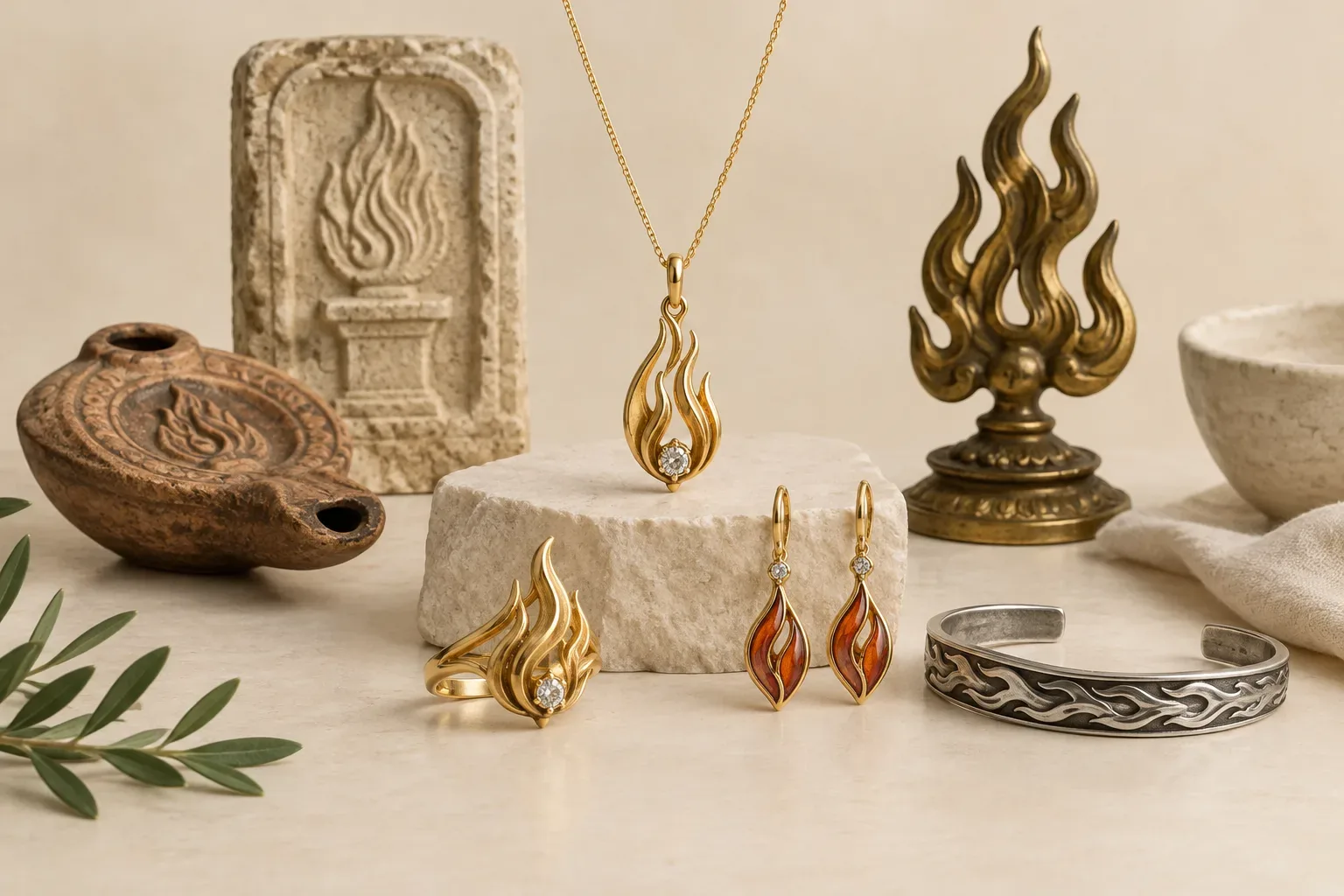
The flame motif appears in jewellery in several visual and technical ways. Historically and today you will find literal flame silhouettes, stylised tongues of flame, flicker-like openwork, scrolling lines evocative of fire, and abstracted ‘inner light’ designs. These have been executed in relief, openwork, enamel, and stone inlay, depending on the period and the maker’s technique, as reflected across museum collections and curatorial notes in the V&A’s historical overview.
Gemstones may be selected for a perceived visual connection to fire. Gems whose appearance evokes warmth or internal glow—such as fire opal, garnet, citrine, and certain types of tourmaline—are commonly used in designs intended to read as 'fiery.' The Victoria and Albert Museum’s A–Z of Gemstones provides historical context for many of these materials, showing how gem choice contributes to an object’s visual and cultural effect.
Techniques that enhance a flame-like impression include graduated cuts, cabochon polish to emphasize internal colour, use of red and orange enamels, and paired metal finishes that suggest movement. Contemporary designers also use negative space and layered silhouettes so that a simple pendant or brooch reads as a flicker or stylised flame at a glance. The motif’s flexibility makes it suitable for fine historic pieces and contemporary minimal jewellery alike.
Practical guidance for choosing, wearing, or gifting flame jewellery
Begin by clarifying what meaning you or the recipient intend the piece to carry. If you want a historically informed gift, choose a piece whose documented provenance or maker’s statement aligns with the intended message. If you want a contemporary symbol of personal strength or transformation, select a modern design whose aesthetic and materials fit the wearer’s style.
Be sensitive to cultural and religious contexts. Because flame imagery appears in devotional contexts in some museum-held objects, consider whether the design could have specific religious connotations to the recipient. When in doubt, ask or choose an abstract design and explain the personal intent behind the gift to avoid unintended offense.
Match materials to lifestyle. For daily wear choose durable metals and stones; for heirloom pieces consider traditional techniques and craftsmanship. The V&A’s gemstone guides show how different gems age and how treatments affect appearance, and the Federal Trade Commission advises buyers to ask for disclosure of treatments and imitations when purchasing gemstones or pearls. Always request written information on treatments and, if applicable, certification for high-value gems.
When gifting, include a short note explaining the meaning you attach to the piece. A simple written line gives the recipient historical context or a personal interpretation and transforms the object into a deliberate keepsake rather than a purely decorative item. If you want to highlight both history and personal meaning, mention the design’s historical appearances in museum collections and then offer your contemporary sentiment.
Buying, care, and authenticity considerations
Ask sellers for clear disclosure about treatments, imitations, and metal content. The Federal Trade Commission provides consumer guidance recommending that buyers seek full disclosure about gem treatments, synthetics, and enhancements and request receipts or certificates for significant purchases. This is particularly important for gemstones marketed as having a 'fiery' appearance, where heat treatment, dyeing, or other enhancements are common.
Consider how the piece should be cared for. Gemstones and enamels that emphasize 'fire' effects may require special cleaning or handling. When buying from a maker or retailer, ask for care instructions and consider insurance for high-value jewellery. For everyday wear, look for robust mountings and secure settings.
If provenance or maker information matters to you, prefer pieces from reputable dealers, museum shops, or makers who provide detailed history and materials lists. For historically significant or antique flame-motif pieces, consult curators or documented catalogues—museums like the V&A maintain records that can help place a design in a historical context.
Closing note
Flame imagery in jewellery is a resilient visual idea that has been used in many different eras and roles. Museum documentation makes clear that the motif’s meanings are historically specific: a motif that signified devotional reference in one era might be a purely aesthetic flourish in another, and modern wearers freely adopt the image for personal and expressive reasons. Knowing the distinction between documented historical meaning and contemporary interpretation helps collectors, givers, and wearers make thoughtful choices that respect both history and personal significance.
Frequently asked questions
Does flame jewellery always have religious meaning?
No. Museum records show flame imagery in religious objects in some contexts, but flame motifs also appear as decorative or abstract forms. Whether a piece has religious meaning depends on its provenance, maker’s intent, and the cultural context in which it was made and used.
Which gemstones are commonly used to suggest a flame or 'fire' effect?
Gems that display warm colours or internal glow—such as fire opal, garnet, and citrine—are often used to convey a fiery appearance. The Victoria and Albert Museum’s A–Z of Gemstones provides historical context for many materials used to evoke colour and light.
How can I be sure a 'fire' gemstone is genuine and untreated?
Ask the seller for written disclosure of any treatments, test results, or certificates. The Federal Trade Commission recommends that buyers request full disclosure about treatments, synthetics, and enhancements and obtain receipts or certification for significant purchases.
Is it appropriate to gift flame jewellery as a symbol of transformation?
Yes, many people today use flame motifs to signify personal growth or inner strength. Be mindful of the recipient’s beliefs and preferences; including a short note explaining the personal meaning you attach to the piece helps ensure the gift is received as intended.
Where can I learn more about the historical use of symbols in jewellery?
Museum catalogues and contextual exhibitions are good starting points. The Victoria and Albert Museum’s resources on jewellery history are especially useful, and our site’s guides on symbols and researching meanings can help you go deeper.
Sources and further reading
- Bedazzled: A History of Jewellery — Victoria and Albert Museum
- An A-Z of Gemstones — Victoria and Albert Museum
- Buying Gemstones, Diamonds, and Pearls — Federal Trade Commission