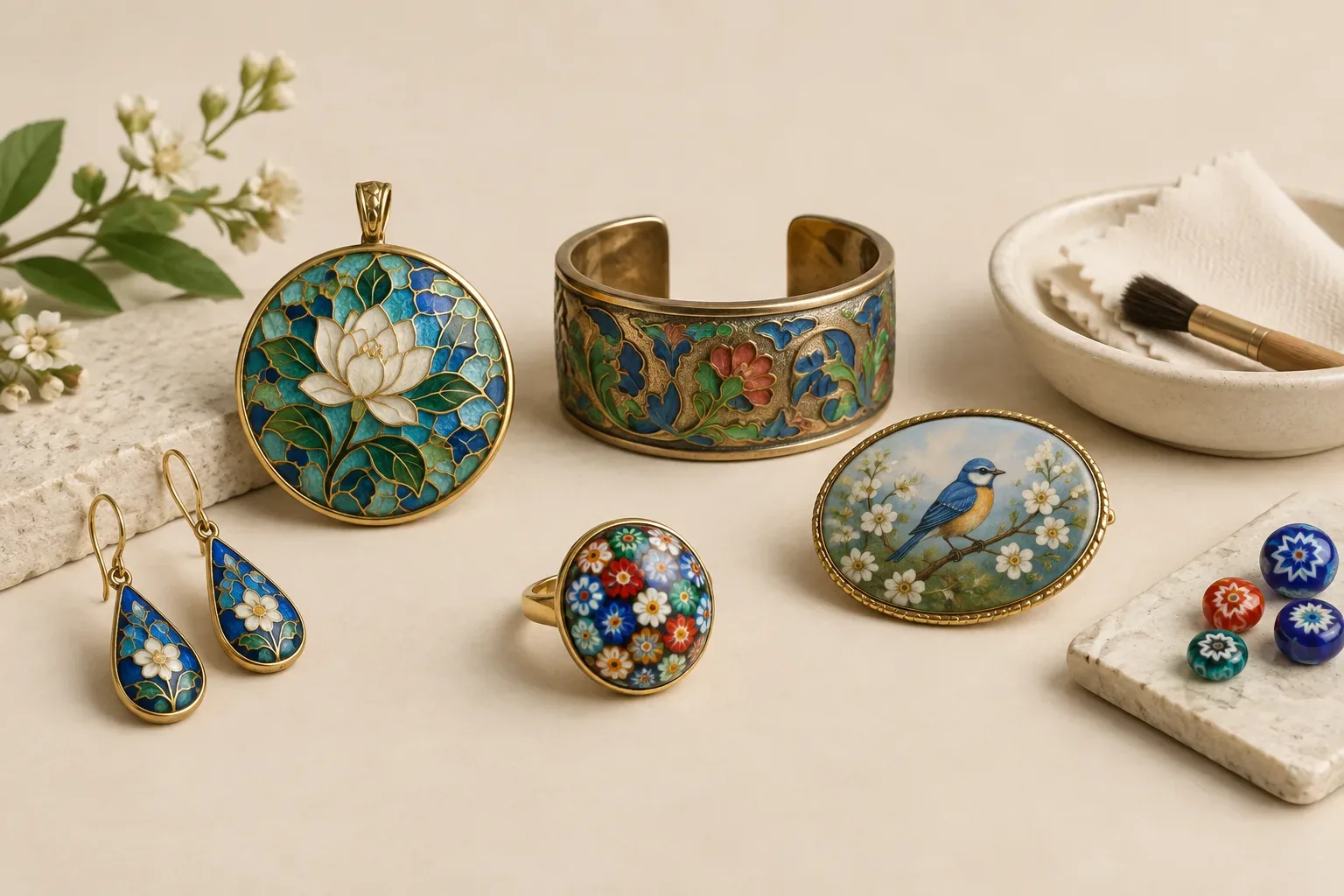
Meaning at a glance
Enamel colors in jewelry most commonly appear through cloisonné, champlevé, painted (painted-on) enamel, and millefiori-related contexts; these are glass-on-metal techniques with distinct production methods and conservation needs, so choose and care for pieces with attention to technique, wear patterns, and gentle cleaning.
Techniques: cloisonné, champlevé, painted enamel, and millefiori-related contexts
Cloisonné constructs narrow metal wires or strips on a metal base to form cells; each cell is filled with powdered glass and fired so that distinct colored compartments remain separated by visible metal lines. The metal partitions create a linear, graphic look that shows the technique clearly in the finished surface.
Champlevé removes or casts away areas on a metal plate to produce shallow cells; these cells are then filled with enamel and fired so that the colored glass sits nearly flush with the surrounding metal. The effect is often a simpler, broader color field than cloisonné and can be identified by the smooth transition between metal and enamel.
Painted enamel is applied like paint: thin layers of enamel powder mixed with a medium are brushed onto a metal ground and fired between layers to build up color and detail. This method is used for miniature scenes, portraits, or finely graduated color and requires multiple firings and considerable control.
Millefiori-related enamel incorporates thin slices of patterned glass canes—each slice a small, pre-made ‘flower’ or motif—fused into a metal surface or set within enamel fields. The Metropolitan Museum of Art documents objects using millefiori enamel that show how patterned glass pieces can be combined with metalwork for multicolored decorative effect.
Historical evidence and cultural contexts, cited precisely
Museum documentation records enamel use across many regions and periods. The Metropolitan Museum of Art specifically illustrates millefiori enamel in objects such as the Disk Brooch with Millefiori Enamel, providing a concrete object context for multicolor patterned glass in jewelry and small metalwork. This object-based evidence shows the technical possibility and aesthetic use of millefiori-related decoration in metal objects, without implying a single cultural meaning for the colors used.
The Metropolitan Museum of Art’s publication 'Islamic Jewelry in The Metropolitan Museum of Art' catalogues enamel and colored decoration within Islamic-period jewelry contexts and discusses how color and material combine with form and motif in those collections. That institutional research provides reliable examples of enamel in Islamic-world jewelry, where geometric and vegetal patterns and precise inlay techniques appear alongside other decorative arts.
For color evaluation and the role of hue, tone, and saturation when pairing colored materials, the Gemological Institute of America (GIA) explains how hue, tone, saturation, and uniformity affect perceived value and appearance in colored gemstones. While GIA’s research focuses on gemstones, the same visual principles—how a saturated hue reads at different sizes, how tone affects legibility, and how uniformity alters perceived quality—apply when choosing enamel colors to harmonize with gemstones or metal tones.
Documented historical meanings versus modern personal interpretation
Documentation held by museums and professional institutions typically identifies how and where techniques were used, and may note recurring motifs, but it rarely supports universal symbolic meanings for particular colors across time and place. For example, the Metropolitan Museum of Art and catalogues such as the Met’s Islamic jewelry publication present enamel examples and associated motifs without asserting that a given color has a single fixed meaning for all users.
Modern personal interpretations commonly assign meanings to enamel colors—red for love, blue for protection, green for growth, and so on—but these contemporary attributions are subjective and culturally contingent. They can be meaningful as personal or familial symbols, yet they should not be presented as historically universal facts.
When using historical pieces as inspiration, separate what a museum catalogue documents (technique, typical motifs, object function) from the modern symbolic stories you might attach to a color or piece. That distinction keeps historical evidence and contemporary sentiment both clear and honest.
How motifs, gemstones, and traditions appear with enamel in jewelry
Motifs in enamel jewelry range from stylized florals and geometric interlacing to tiny pictorial scenes in painted enamel. In Islamic contexts catalogued by the Metropolitan Museum of Art, geometric and vegetal forms are frequent and integrate with enamel inlays; in other museum-documented traditions, enamel serves as background color, accent band, or focal ornament.
Gemstones are commonly set alongside or within enameled areas. Design choices typically consider color harmony: a saturated blue enamel field will read differently next to a deep sapphire than next to a light topaz. The GIA’s explanations of hue, tone, and saturation provide a useful framework for pairing gemstone color characteristics with enamel surfaces so that neither element overpowers the other.
Traditions such as portrait miniatures in painted enamel or the use of millefiori slices for vivid patterned fields reflect specific workshops and markets rather than universal practice. Museum objects show that specific communities adopted and adapted these techniques to local tastes, so similar visual effects may arise for different cultural reasons.
Practical and respectful selection or gifting guidance
When selecting enamel jewelry as a gift, start with observation: note whether the recipient prefers glossy or matte finishes, bold color, or subtle accents. Technique matters; cloisonné and champlevé often read as more structural and graphic, while painted enamel can be intimately detailed and delicate. Choose a technique that matches the wearer’s lifestyle and aesthetic.
Consider durability: enameled jewelry can be robust, but painted enamels and very thin vitreous layers are more vulnerable to abrasion and sharp knocks. If the recipient is active or likely to wear the piece daily, prefer sturdier constructions and securely set gemstones rather than excessively raised enamel work.
Respect cultural origins by learning and, where appropriate, acknowledging them. If a piece clearly draws on motifs from a specific cultural tradition—geometric inlays from Islamic metalwork, for example—mention that context as part of the gift’s story, and avoid simplifying or claiming universal symbolism where none is documented.
If you want color to carry personal meaning, explain that meaning when you give the gift. Personal symbolism—matching a color to a birth month or a shared memory—can make enamel jewelry especially meaningful, provided you present that symbolism as a contemporary choice rather than an ancient fact.
Conservative care for glass-on-metal enamel surfaces
Treat enamel as glass: avoid sudden temperature changes, avoid exposure to household chemicals, and keep pieces away from abrasive surfaces. Rapid heating or cooling during cleaning or repair can cause crazing or cracking in vitreous enamel.
Avoid ultrasonic cleaners and steam treatments for enameled jewelry unless the maker explicitly states the piece is safe for those methods. Mechanical vibration can loosen enamel or its bonding to the metal ground, and steam/heat can compromise delicate painted layers.
For routine cleaning use a soft, lint-free cloth and, if necessary, a very lightly dampened cloth with plain water. For persistent grime, consult a qualified conservator or a reputable jeweler with experience in enamel; they can recommend non-invasive cleaning methods and determine whether professional consolidation or restoration is appropriate.
Store enameled pieces separately so that metal clasps, prongs, or other jewelry cannot rub the enamel. Wrap items in soft fabric or store them in padded compartments. For long-term care, keep them away from direct sunlight and humidity extremes that could stress the materials.
Conclusion
Enamel colors in jewelry offer a wide visual range produced by clearly defined techniques—cloisonné, champlevé, painted enamel, and millefiori-related approaches—each with its own aesthetic and conservation implications. Museum documentation from the Metropolitan Museum of Art and technical guidance from institutions such as the Gemological Institute of America help separate documented fact from modern interpretation and provide practical standards for pairing color with gemstones and for conservational choices.
Choose enamel jewelry with attention to the technique, the wearer’s lifestyle, and the piece’s cultural context, and care for it with conservative, glass-aware practices to keep colors vibrant and surfaces intact.
Frequently asked questions
How can I tell which enamel technique a piece uses?
Look closely at the metal-to-enamel junction: cloisonné shows thin metal wires or partitions that separate colored fields, champlevé has recessed cells with enamel nearly flush to the surrounding metal, painted enamel presents brushwork and layered pictorial detail, and millefiori-related work displays tiny, patterned glass slices embedded in the field. If uncertain, ask a museum cataloguer or a knowledgeable jeweller for identification.
Is enamel durable enough for everyday wear?
Many enamel techniques produce long-lasting surfaces, but durability depends on thickness, technique, and how the piece is used. Sturdier cloisonné and well-fired champlevé tolerate more wear than very thin painted enamel. Avoid high-impact activities while wearing enameled jewelry and choose sturdier constructions for daily use.
Can I clean enameled jewelry with an ultrasonic cleaner?
No—avoid ultrasonic cleaners and steam for most enameled pieces because mechanical vibration and heat can damage glass-on-metal layers. Use a soft, dry or slightly damp cloth and consult a conservator for stubborn grime.
Do enamel colors fade over time?
Vitreous enamel is a stable glass surface and generally resists fading like dyed materials do, but painted or surface-applied enamels exposed to repeated abrasion, chemicals, or improper heating can deteriorate or change visually. Protect enamel from harsh light and chemicals and store pieces carefully.
Should I be concerned about matching gemstones to enamel color?
Yes—consider hue, tone, and saturation. Use the same visual principles that gem specialists apply: ensure the enamel color complements the gemstone rather than visually competing with it. The GIA resources on color factors can help when assessing pairings.
Sources and further reading
- Disk Brooch with Millefiori Enamel — The Metropolitan Museum of Art
- Islamic Jewelry in The Metropolitan Museum of Art — The Metropolitan Museum of Art
- Colored Gemstone Value Factors — Gemological Institute of America
- GIA Colored Stone Research — Gemological Institute of America