Meaning at a glance
Dolphin jewelry meaning is best understood as a motif with multiple, changing contexts: museum and collection records document the dolphin as a recurring decorative and emblematic motif across different periods, while modern wearers layer personal associations—playfulness, intelligence, protection—onto that history; this article separates documented cultural evidence from later popular meanings and gives practical guidance for choosing, buying, and gifting dolphin-themed pieces.
What the historical record actually documents
The documentary evidence for animal motifs in jewellery comes mainly from museums and collection-based scholarship rather than a single authoritative origin story. The Victoria and Albert Museum’s overview of jewellery history emphasizes that motifs—including animals and marine life—appear across many cultures and periods, and that their meanings and uses shift with social context and fashion. The V&A’s work shows that we should read individual dolphin pieces against the time, place and collection they come from, rather than assuming a single historical meaning.
In practice this means looking at object-level evidence. Museum records and catalogues often identify dolphin motifs on jewellery, decorative objects and small bronzes, and attribute different functions: decorative ornamentation, maritime emblems for ships or ports, or details in luxury objects intended to signal taste and learning. The V&A’s scholarship warns against projecting modern, sentimental meanings back onto historical objects without supporting documentation in the object’s provenance or contemporary texts.
Separating cultural or religious evidence from later popular interpretations
When historians or museums assign a symbolic meaning to an object, they do so on the basis of provenance, context and contemporary sources. If a specific piece was created as part of a religious practice, a nautical insignia, or a civic emblem, those functions will be recorded in object descriptions or archival material. The Victoria and Albert Museum’s approach to jewellery history highlights the importance of this context: the same motif can mean different things in different times and places, and documented meanings depend on supporting evidence in the object's record.
Modern popular meanings—protection, guidance, friendship, playfulness, or intelligence—are frequently applied to dolphin jewellery today but are not always documented historically for any given object. Contemporary attributions often draw on current perceptions of dolphins as intelligent and social animals; for biological facts about dolphins themselves, government science resources such as NOAA Fisheries are the appropriate reference rather than jewellery history. NOAA describes dolphins as social, communicative marine mammals, and those biological traits inform many modern personal readings of the motif, but they do not by themselves prove historical symbolic meanings.
How the dolphin motif appears in jewellery and related traditions
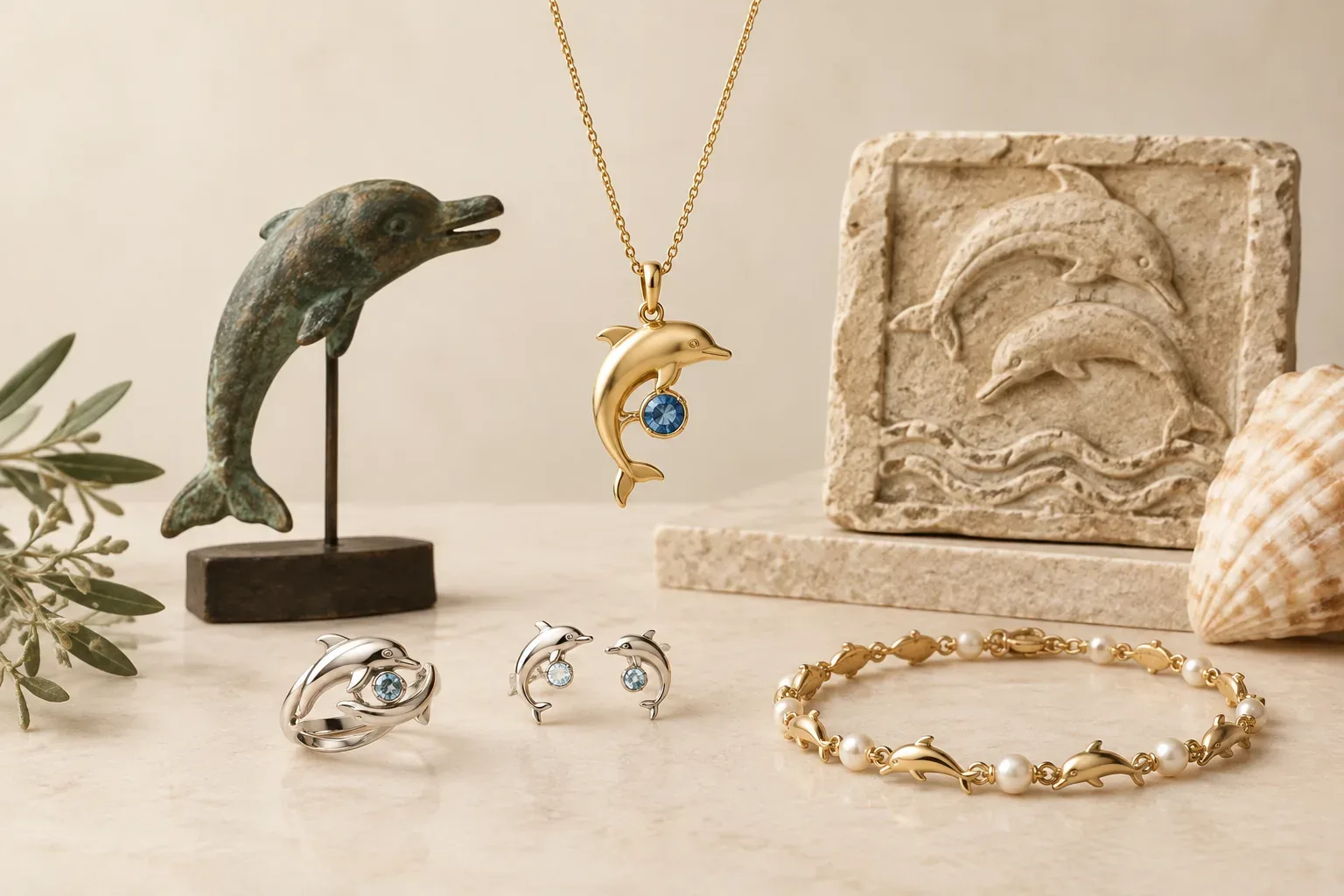
Dolphin imagery appears in jewellery in a variety of forms: as pendants, charm bracelets, brooches, intaglio or cameo ornament, enamelled scenes, and small sculptural mounts. Metals commonly used include gold and silver; designers may use flowing, curved lines to suggest movement through water, and openwork or outline forms to evoke lightness and motion. Simple outline pendants and minimalist charms are common in contemporary jewellery, while historical pieces may show more detailed carving or enamel work reflecting the maker’s techniques and the aesthetics of the period.
Gemstones and materials associated with the sea—pearls, aquamarine, turquoise and blue enamel—are often combined with dolphin motifs in modern pieces to reinforce the marine connection, though the association of a specific gem with dolphins is typically a contemporary design choice rather than a historically documented, universal practice. When gemstones are used, the Federal Trade Commission’s consumer guidance on buying gemstones, diamonds and pearls is relevant: sellers should disclose treatments, enhancements and whether a gem is an imitation, information that affects both value and care.
Modern meanings people commonly attach (and how they differ from documented history)
Contemporary wearers commonly interpret dolphin jewellery as symbolizing qualities observed in dolphins: intelligence, playfulness, sociability and guidance. These readings are meaningful at a personal level and are valid as modern symbolic uses of the motif, but they should be distinguished from historically documented religious or civic meanings unless an object’s provenance and contemporary commentary support that older meaning.
Museum curators and historians typically separate object function and original intent from later symbolic overlays. The V&A’s emphasis on changing social contexts reminds us that the same object can acquire new meanings over time: a piece that began as a fashionable ornament in one era can be repurposed as a sentimental heirloom in another, and modern resale or reproduction markets often market dolphin designs explicitly with contemporary sentiments in mind.
Practical guidance for selecting or gifting dolphin jewellery
Begin by considering the recipient’s personal connection to the motif and their daily activities. For an active person, choose a low-profile, sturdy setting in a durable metal such as 14k gold or sterling silver; for a keepsake, select a more detailed piece or a locket-style pendant that can hold a small image or message. Match scale to the wearer: delicate chains and tiny charms suit minimalist tastes, while larger sculptural pieces read as statement jewellery.
Verify materials and disclosures. Ask the seller for written confirmation about metal content, gemstone treatments and whether stones are natural, treated or simulants; the Federal Trade Commission specifically advises consumers to request such information when buying gemstones, diamonds and pearls. If provenance or age matters, seek documentation from the seller or a reputable appraiser and check museum or auction records if the item is purported to be antique.
Be culturally and personally respectful. Do not assume a single universal meaning for the motif; if the recipient has a particular cultural or religious background, a quick, respectful conversation can clarify whether the dolphin motif would be appreciated. When gifting as a symbol—of friendship, a safe voyage, or encouragement—consider adding a short note explaining why you chose the motif so the recipient understands the intent.
Care, authenticity and sustainability considerations
Care for metal and gemstone choices according to standard guidance for those materials: gentle cleaning for silver to prevent tarnish, appropriate ultrasonic or chemical care for secure gemstone settings, and careful storage to avoid scratches. When buying gemstones, ask about treatments and lab reports; the FTC’s consumer guidance explains what sellers should disclose about enhancements and imitations and why those disclosures matter for value and care.
If sustainability or ethical sourcing is a priority, ask sellers about responsible metal sourcing and whether any organic materials were collected in regulated ways. Museum and trade literature underscores that jewellery’s social meaning includes how objects were made and circulated, and many contemporary buyers factor production and sourcing into the symbolic value of a piece.
How to wear and style dolphin jewellery today
Use the motif to complement an outfit’s mood: small, outline dolphin pendants read casual and modern, while enamelled or cameo-style dolphins can look vintage or romantic. Combine marine-themed pieces—blue gems or pearl accents—with a dolphin motif for a coherent aesthetic, but avoid literal repetition if you want a subtler effect. For formal occasions, choose a single well-crafted piece rather than multiple novelty items to keep the look refined.
If layering necklaces, vary chain lengths and scales so the dolphin motif can be seen clearly and doesn’t compete with other pendants. Consider the piece’s emotional meaning when choosing wear contexts: a sentimental dolphin pendant may be best preserved for meaningful occasions if it’s fragile or of high provenance value.
Final thoughts
Dolphin jewellery meaning is plural and changing. Museum-based evidence, notably from the Victoria and Albert Museum, shows that animal and marine motifs recur across jewellery history and that their meanings are shaped by time and social context. Contemporary biological knowledge from NOAA informs modern symbolic readings but does not substitute for object-level historical evidence. Use provenance, material disclosures and thoughtful gifting practices to make choices that respect both the motif’s history and the intended sentiment.
Frequently asked questions
Is the dolphin symbol the same in every culture?
No. The meaning of dolphin imagery varies by time and place; museums such as the Victoria and Albert Museum emphasise that motifs can have different functions—decorative, emblematic or religious—depending on context, so you should not assume a single universal meaning.
Do dolphins really symbolize intelligence and friendship historically?
Those qualities are common modern associations because dolphins are social, intelligent marine mammals, a fact discussed by NOAA Fisheries, but such biological traits inform contemporary symbolic readings rather than proving a documented historical meaning for every dolphin motif.
What should I ask a seller about a dolphin-themed piece?
Ask for written confirmation of metal content, gemstone identity and any treatments or enhancements; the Federal Trade Commission advises buyers to obtain disclosures about treatments, origins and whether stones are simulants or natural to understand value and care needs.
Is dolphin jewellery appropriate as a gift for someone from a different cultural background?
Often yes, but be respectful: avoid assuming the motif has the same connotations across cultures. A brief, considerate conversation about the recipient’s tastes or a note explaining your intent will help ensure the gift is welcome.
How do I care for a silver or gold dolphin pendant?
Care depends on metal and any gemstones: polish silver gently to remove tarnish, avoid prolonged exposure to chemicals, and follow specialist advice for gemstone settings; ask the seller about recommended cleaning methods for the specific piece.
Where can I learn more about the historical meanings of jewellery motifs?
Museum publications and catalogues are the most reliable starting points; the Victoria and Albert Museum’s work on jewellery history is a useful reference for understanding how motifs change meaning over time.
Sources and further reading
- Bedazzled: A History of Jewellery — Victoria and Albert Museum
- 11 Cool Facts About Whales, Dolphins, and Porpoises — NOAA Fisheries
- Buying Gemstones, Diamonds, and Pearls — Federal Trade Commission