Meaning at a glance
This cuff bracelet online shopping guide explains documented historical uses and changing contexts of cuff bracelets, distinguishes verified historical meanings from modern personal interpretations, describes how motifs and gemstones appear in cuff designs, and gives practical, respectful advice for selecting, verifying, and gifting cuff bracelets online.
Quick answer
A reliable cuff bracelet online shopping guide combines documented history with practical verification: know that cuff bracelets appear across many periods and cultures (as documented by museum collections), treat historical meanings as context rather than universal statements, read seller photos and policies carefully, verify materials and treatment disclosures, and watch for red flags such as stock photos, missing hallmarks, or no returns.
What the historical evidence shows
Museum surveys and collection histories show that cuff-like bracelets appear in many cultures and periods rather than originating in a single place. The Victoria and Albert Museum describes how jewellery has been made and worn across ancient, medieval and modern societies and how its social roles have changed over time, from markers of status to decorative fashion items.
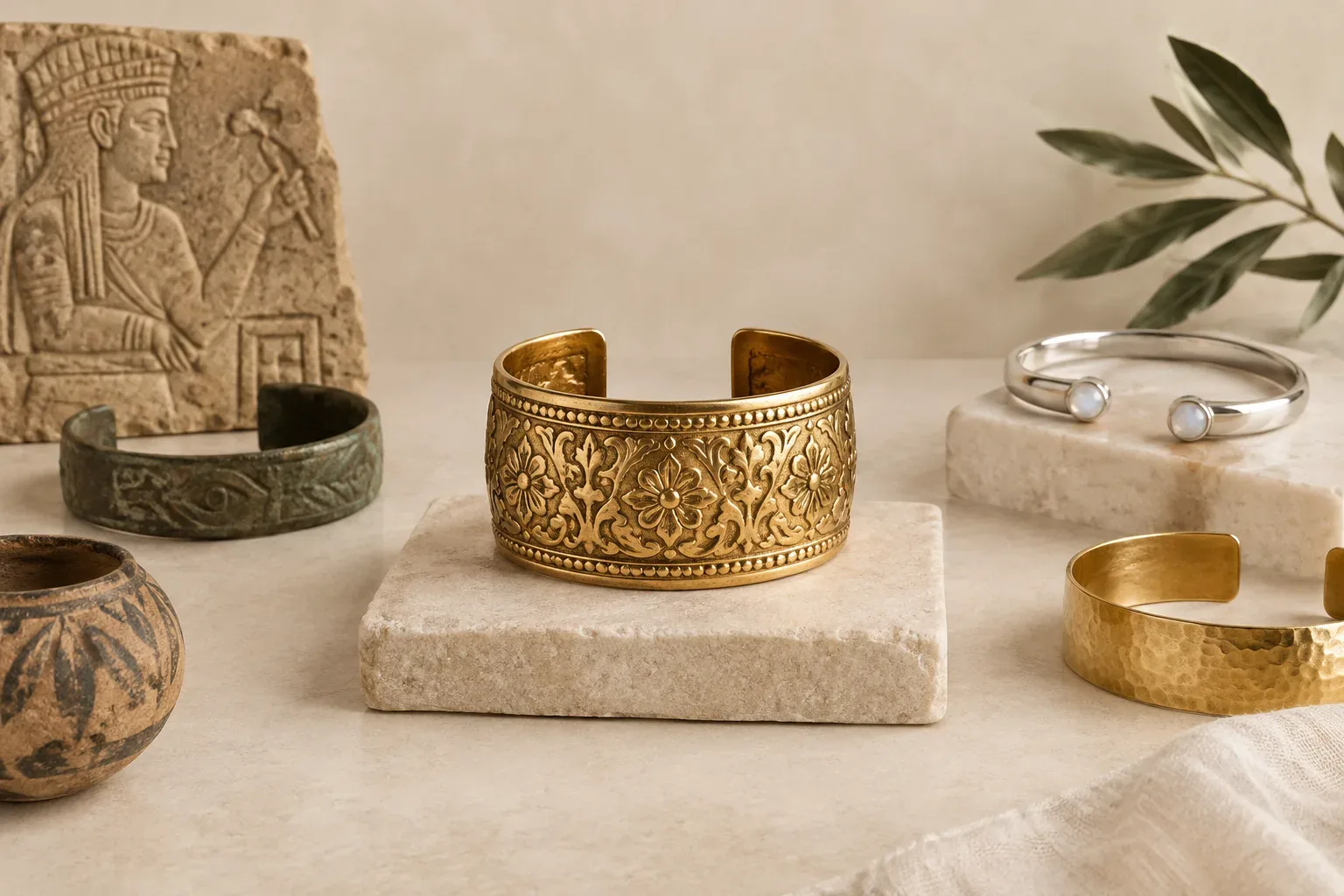
Examples that commonly appear in museum narratives include broad metal bracelets or armlets in ancient Egyptian and classical collections, open-work and inscribed bands in classical and medieval contexts, and renewed interest in wide bracelets during nineteenth-century revival styles. The V&A places these objects within changing social and technological contexts, showing that form and function evolved alongside materials and fashion.
Documented historical meanings versus modern interpretations
Where museums can support claims, the evidence usually concerns function and context rather than single, fixed symbolic meanings. The Victoria and Albert Museum highlights that jewellery has served a range of documented purposes: signaling social rank, marking life events, demonstrating wealth or trade connections, or serving as amulets in specific contexts. Those roles are demonstrable from inscriptions, archaeological contexts, and recorded provenance.
Modern personal and commercial interpretations—for example, assigning a universal protective power to a particular cuff motif or asserting that a motif has the same meaning across all communities—are contemporary readings that often mix historical precedent with present-day taste. Treat such interpretations as personal or brand narratives unless a clear, documented historical source is cited.
How motifs, gemstones, and techniques show up in cuff bracelets
Cuff bracelets are primarily a form: a rigid or semi-rigid band that usually leaves an opening to slip over the wrist. Within that form craftsmen have used a wide range of motifs—geometric patterns, vegetal scrolls, heraldic or religious imagery—and a variety of techniques such as repoussé, filigree, and enamel. Museum descriptions show these techniques across eras and places, highlighting continuity in form alongside stylistic change.
Gemstones appear in cuffs in many ways: set as singular focal stones, used in repeating settings across the band, applied as inlays, or combined with intricate metalwork. The Victoria and Albert Museum's A–Z of Gemstones explains how particular stones were used historically and how cutting and setting methods changed over time. When evaluating a modern cuff, pay attention to how the stone is mounted, whether stones are cabochon or faceted, and how treatments might affect appearance.
Photos: what to expect and what to ask for
Good product photography is essential for online cuff shopping. Ask for multiple clear views: a full shot that shows scale, close-ups of the surface, edges, and any stones, a picture of hallmarks or maker’s marks, and at least one contextual image showing the cuff on a wrist to judge size and fit. If a seller provides only a single polished studio image or uses the same picture across different listings, ask for additional photos.
If a cuff is advertised as antique or culturally significant, request provenance images such as prior auction labels, certificates, or consistent condition reports. For gemstone identification, ask for magnified photos showing inclusions or features; for unusually perfect stones, request documentation or lab reports since modern treatments and imitations exist.
Seller policies and legal disclosures to check
Read the seller’s policies carefully before buying. Important items include the return and refund policy, shipping and insurance terms, and any guarantees of authenticity. For gemstones and pearls, the Federal Trade Commission requires clear disclosure of treatments, synthetics, and imitations, and the FTC’s guidance is a practical baseline for what sellers should disclose about material treatments and origin.
Look for statements about hallmarks, metal fineness (for example, sterling silver or karat gold), and whether the piece is new, vintage, or antique. If the seller offers a certificate from a recognized laboratory for valuable gemstones, verify the lab’s name and whether the certificate matches the item listed.
Red flags that suggest caution
Several warning signs merit caution: stock or obviously edited images with no detailed views, listings that omit material descriptions or list vague terms like 'metal' without clarification, prices that are implausibly low for known materials, and sellers who refuse reasonable questions about origin or returns. A lack of clear hallmark photos or refusal to provide more images for an expensive item is another strong red flag.
For antiques or culturally specific pieces, be wary of sellers who make sweeping cultural or religious claims without provenance. Claims that a motif guarantees a particular spiritual effect or came directly from a named historical figure should be treated as marketing unless supported by reliable documentation.
Practical selection and respectful gifting guidance
Measure and fit are practical priorities. Because cuffs may be rigid, ask the seller for the internal width, opening gap, and an estimate of wrist size they consider comfortable. If the recipient has metal sensitivities, confirm the metal content and whether the piece is plated. When gifting, include the seller’s return information and any authenticity documentation so the recipient can exchange or verify the item if needed.
Be culturally respectful when selecting motifs. If a cuff uses iconography that is clearly tied to a living religious or cultural tradition, research its meaning and provenance before buying or gifting. The Victoria and Albert Museum’s approach to contextualizing objects is a good reminder: historical use does not automatically license modern appropriation, and asking about the piece’s origin is both practical and courteous.
How to verify gemstones and treatments
The Victoria and Albert Museum’s resources on gemstones describe historical and technical contexts; for modern purchases, the Federal Trade Commission’s guidance on disclosure is the practical standard. Sellers should disclose common treatments such as heating, dyeing, or surface coatings and should not pass synthetic or treated stones off as natural without full disclosure.
For high-value stones, request a recent laboratory report from a reputable gemological laboratory. For lower-value items, clear photos and a transparent description of any treatments are usually sufficient, but always combine that information with the seller’s return policy and your ability to return the item if it does not match the description.
Final checks before purchase
Before you click buy, confirm that photos match the written description, that the seller’s policies suit your needs, and that there is a sensible refund or return window. For items described as antique or culturally important, ask for provenance documentation and allow time to examine any certificates.
When in doubt, buy from sellers with transparent, consistent listings, detailed images, clear hallmarks, and open lines of communication. If a deal looks too good to be true, or if a seller insists on unusual payment methods, step back and consider alternatives.
Frequently asked questions
How do I measure my wrist for a cuff bracelet online?
Measure the narrowest part of your wrist with a flexible tape measure for the internal circumference, and also note the desired gap and internal width. Ask the seller for the cuff’s internal measurements and recommended wrist size, and compare those with your measurements before buying.
What photos should a trustworthy seller provide for a cuff bracelet?
A trustworthy seller will provide multiple clear images: a full view showing the whole cuff, close-ups of surface detail and any stones, photos of hallmarks or maker’s marks, a picture of the cuff on a wrist for scale, and images of any provenance or certificates for high-value or antique items.
How can I tell if a gemstone in a cuff has been treated or is synthetic?
Ask the seller to disclose any known treatments. For valuable stones, request a lab report. The Federal Trade Commission requires disclosure of treatments and imitations, so a lack of clear information is a red flag. Use magnified photos to look for telling inclusions, but rely on lab reports for definitive identification.
Are there legal protections for buyers of gemstone jewelry online?
Regulatory guidance such as that from the Federal Trade Commission requires sellers to disclose material treatments, synthetics, and imitations. Protections vary by jurisdiction, so check the seller’s stated policies and payment protections, and prefer sellers with transparent return policies and documented disclosures.
Is it okay to wear or gift a cuff with a cultural or religious motif?
This depends on context. Research the motif’s meaning and provenance before buying. If the motif is actively sacred or tied to a living community, consider whether wearing or gifting it might be inappropriate. When in doubt, buy from sources that provide clear provenance and respectful contextual information.
Sources and further reading
- Bedazzled: A History of Jewellery — Victoria and Albert Museum
- An A-Z of Gemstones — Victoria and Albert Museum
- Buying Gemstones, Diamonds, and Pearls — Federal Trade Commission