Meaning at a glance
Precious coral is an organic gem material with a long jewelry history; readers need careful species, treatment, imitation, legal, sustainability, and care context rather than universal claims about vitality or protection.
What coral is and how it fits into gem material categories
Coral used in jewelry is not a mineral but an organic material composed of skeletal matter produced by marine animals. Museums and gemological educators place coral in the same broad category as other organic gem materials such as pearls and amber (Smithsonian National Museum of Natural History). Understanding coral as organic rather than mineral helps explain its color variation, porosity, and how it responds to heat, acids, oils, and cleaners differently from stones like quartz or sapphire (Smithsonian National Museum of Natural History).
Because coral is organic, standard gem-care rules for harder mineral gems do not always apply. Professional gemological guidance recommends different handling, cleaning, and storage approaches for organic gems; specialist sources offer practical cleaning and care instructions suited to these materials (Gemological Institute of America).
Documented historical evidence and cultural attributions
Many cultures have used coral in jewelry for generations, and museum collections and natural-history literature recognize coral's long history of adornment (Smithsonian National Museum of Natural History). However, the broad academic sources we are using do not attempt to unify those cultural practices into a single, global narrative; instead, they identify coral as an established organic gem material with historical use across regions.
Because precise ritual meanings, dates, and uses are the domain of regional historical and ethnographic scholarship, statements about exactly what coral symbolized in a particular culture should be traced to specialists in that area. Museum catalogues and specialist historians provide that level of detail; the Smithsonian frames coral within natural-history and gem-education contexts rather than asserting uniform symbolic claims across cultures.
Separating documented historical meanings from modern interpretations
Documented historical meanings are those recorded in primary sources, museum records, or scholarly studies focused on a specific place and period. These records show that coral has been valued for its color, rarity, and the technical skill required to shape and drill it. Where catalogues or archaeological reports attribute symbolic significance, those attributions are tied to a time, place, and group and should not be generalized.
Modern personal and commercial interpretations often extend coral’s associations to ideas such as protection, vitality, or emotional healing. Those contemporary meanings are valid as personal or cultural expression but are not universal historical facts. When deciding whether to accept or pass on a symbolic meaning, distinguish between a historically documented practice (cited to a museum or scholarly source) and a modern, personal, or marketing-driven interpretation.
How the coral motif and material appear in jewelry
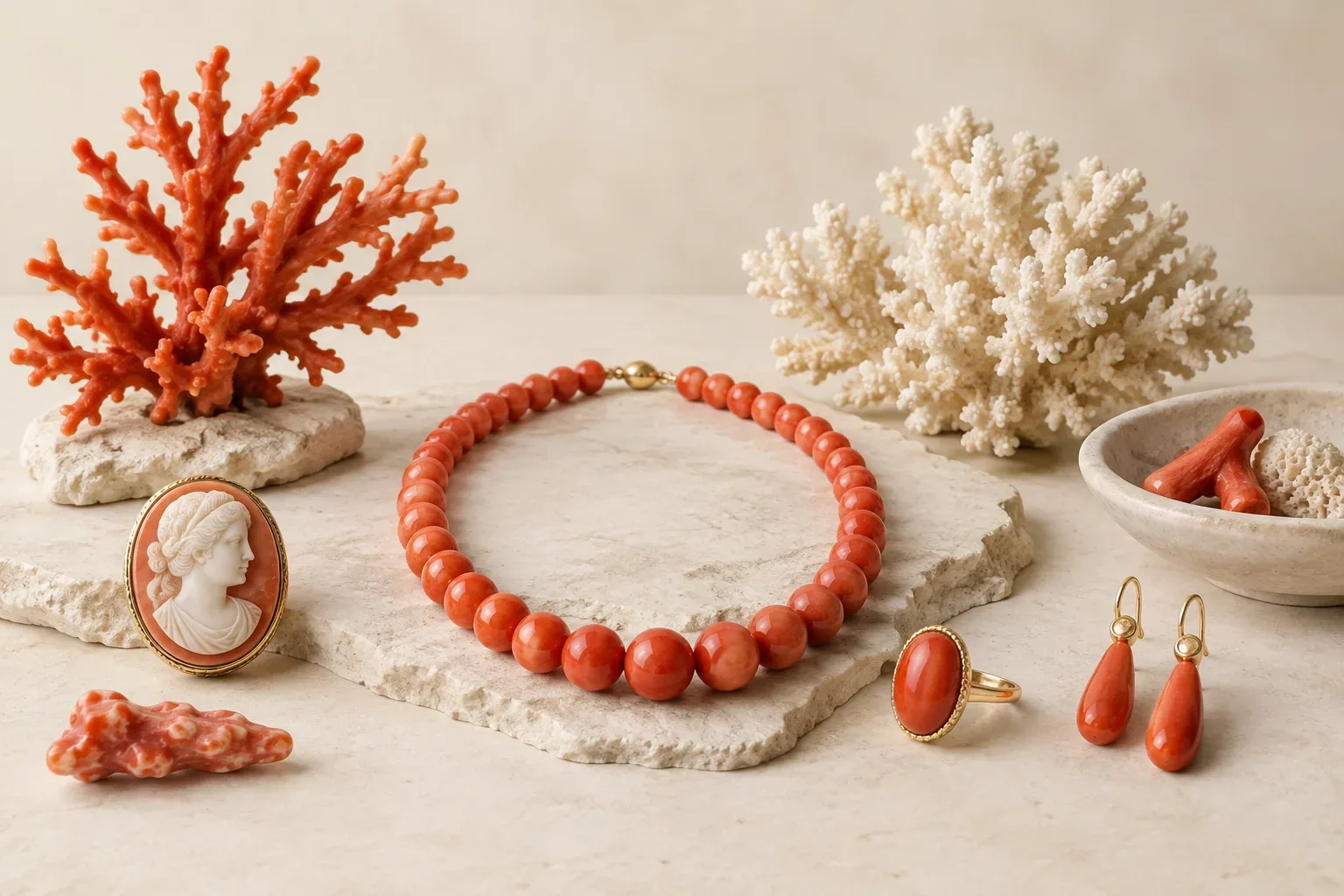
Coral appears in jewelry in several familiar forms: polished beads strung as necklaces or bracelets, cabochons set in rings or pendants, small carved figures or cameos, and inlaid or beadwork components. Jewelry from museum collections and gem-learning resources show coral used both as single striking elements and as part of multi-material pieces alongside metals, pearls, and gemstones (Smithsonian National Museum of Natural History).
Because coral is relatively soft compared with many gemstones, it is commonly cut into rounded shapes, carved for relief, or finished with polishing rather than faceting. Treatments such as dyeing or bleaching are used in the trade to alter or stabilize color; the Federal Trade Commission’s consumer guidance stresses the importance of disclosure whenever materials are treated, enhanced, or imitated (Federal Trade Commission).
Buying coral: species, treatments, imitations, and legal context
When buying coral jewelry, first ask the seller to identify the type of coral, whether any treatments have been applied, and whether the piece contains any imitation material. The Federal Trade Commission emphasizes that sellers should disclose whether a gem is natural, treated, lab-grown, or an imitation, and consumers have the right to clear information about what they are purchasing (Federal Trade Commission).
Because coral is an organic material with many species and color varieties, good sellers will be able to explain whether a piece is made from so-called 'precious' coral species, treated red or pink coral, or synthetic/imitative materials. Provenance and sourcing claims matter for both legal compliance and sustainability; ask for any available documentation and be cautious about absolute claims when they are unsupported by paperwork or reputable lab reports. If you are uncertain, request a return policy or seek an independent appraisal.
Ethics and sustainability considerations
Sustainability, conservation, and local laws affect coral availability and ethical purchasing. Because coral is formed by living organisms and many coral species are ecologically important, buyers who are concerned about environmental impact should ask sellers about sourcing, harvesting practices, and any certifications or legal permits. The general consumer-protection guidance from government and professional bodies recommends clear disclosure rather than assuming a material's origin or status (Federal Trade Commission).
If environmental stewardship is a priority, consider alternatives such as vintage or antique coral pieces, responsibly sourced or recycled materials, or high-quality imitations disclosed as such. These choices reduce pressure on contemporary harvests while preserving the aesthetic and cultural uses of coral in jewelry.
Caring for coral jewelry: practical tips
Because coral is organic and generally softer and more porous than most gemstones, clean it gently and avoid common jewelry cleaners formulated for hard minerals. The Gemological Institute of America recommends mild soap, lukewarm water, and a soft cloth for many organic materials, and advises removing organic-gem jewelry before strenuous activities, exposure to chemicals, or prolonged sunlight that may fade dyes or natural pigments (Gemological Institute of America).
Store coral away from harder stones that could scratch it and keep it in a stable environment where humidity and temperature do not fluctuate drastically. Avoid ultrasonic cleaners, steam treatment, or harsh acids and solvents. If a coral piece is drilled or strung, periodically check threads and settings and have any repairs done by a jeweler experienced with organic materials. For detailed cleaning and repair decisions, rely on qualified jewellers or gemological advice rather than general household remedies (Gemological Institute of America).
Selection and gifting guidance: respectful, practical choices
If you are selecting coral for yourself or as a gift, be explicit about what matters most: color and appearance, species and origin, age (vintage vs new), or ethical sourcing. Ask the seller for written information about species, treatments, and return policies. If the recipient values cultural meaning, ask whether they prefer a piece with a documented historical style, a modern design expressing a personal sentiment, or something chosen for purely aesthetic reasons.
When gifting coral to people from cultures that hold particular traditions around coral, be respectful: ask whether certain colors or motifs have specific meanings for that person, and avoid assuming symbolic significance. If you cannot confirm sourcing or sustainability but want to honor ecological concerns, choose vintage or recycled coral or select a disclosed alternative. Practical steps like including a note about the material and care instructions make a gift both beautiful and responsibly presented.
Conclusion
Coral jewelry carries layered meanings: it is an organic gem material with a long record in human adornment and also a contemporary symbol chosen for personal reasons. Reliable decisions about coral begin with recognizing it as organic, asking clear questions about species and treatment, checking legal and ethical sourcing claims, and using gentle care techniques recommended for organic gems (Smithsonian National Museum of Natural History; Gemological Institute of America; Federal Trade Commission).
Treat historical attributions and symbolic claims as context-specific rather than universal, and rely on specialist research or museum catalogues for precise cultural histories. In practice, careful buying, transparent disclosure, and modest, informed care will help you enjoy coral jewelry while respecting the material’s biological origins and cultural associations.
Frequently asked questions
Is coral considered a real gemstone?
Yes — coral is considered an organic gem material rather than a mineral gemstone. Museums and gem-education resources categorize coral alongside other organic gems such as pearls and amber (Smithsonian National Museum of Natural History).
How should I clean and store coral jewelry?
Clean coral gently with a soft cloth, mild soap, and lukewarm water, and avoid ultrasonic cleaners, steam, or harsh solvents. Store coral pieces separately from harder stones to prevent scratching, and follow care advice for organic gems from professional sources (Gemological Institute of America).
How can I tell if coral jewelry is treated or an imitation?
Ask the seller for written disclosure about treatments, dyes, and whether the material is natural or an imitation. The Federal Trade Commission advises clear disclosure of enhancements and imitation materials; if in doubt, request documentation, a return policy, or an independent appraisal (Federal Trade Commission).
Are there ethical concerns when buying coral jewelry?
Because coral is produced by living organisms and can be ecologically important, buyers should ask about sourcing, harvesting practices, and any legal permits or certifications the seller can provide. If sustainability is a priority, consider vintage, recycled, or clearly disclosed alternatives rather than assuming contemporary pieces are ethically sourced.
Does coral have a single symbolic meaning across cultures?
No. Symbolic meanings for coral vary by culture and period and should be traced to the specific historical or ethnographic sources that document them. Modern attributions of protection, vitality, or luck are often personal or commercial interpretations rather than universally documented historical facts.
Sources and further reading
- Tips on Caring for Jewelry — Gemological Institute of America
- Buying Gemstones, Diamonds, and Pearls — Federal Trade Commission
- Gems and Minerals: Beauties and Building Blocks — Smithsonian National Museum of Natural History