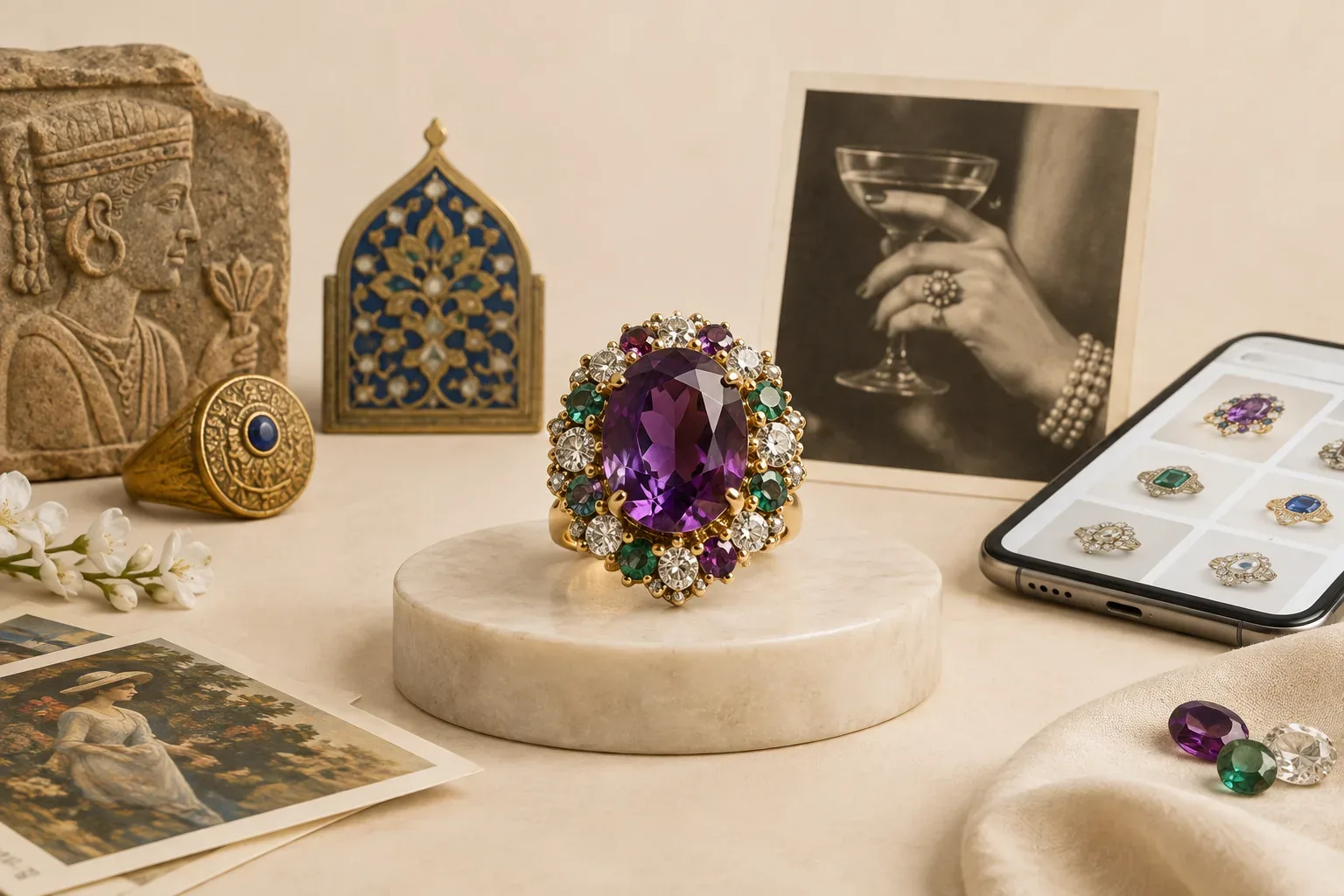
Meaning at a glance
This cocktail ring online shopping guide explains documented history and changing contexts, distinguishes historic meanings from later interpretations, and gives practical advice on photos, seller policies, treatments, and red flags to watch for when buying online.
Historical evidence and cultural contexts
The term and social phenomenon usually called the cocktail ring is most strongly associated with mid-20th-century Western fashion rather than a single ancient cultural tradition. The Victoria and Albert Museum situates changes in jewellery styles and their social meanings in broad historical context, noting how jewellery rose and fell with changes in social life, technology, and display habits. Referencing the V&A helps us place the cocktail ring within modern dress history rather than attributing it to premodern ritual or religion.
In the 20th century, particularly after World War II and into the 1950s and 1960s, large, showy rings worn on evening occasions became common in Western Europe and North America as part of a broader appetite for bold costume jewellery. The V&A's accounts of jewellery history emphasize shifting social contexts—how jewellery that was once a private marker of status or memory could become a fashion statement in an era of increased leisure and public entertainment. These documented social changes are the best-supported historical evidence for the modern cocktail ring phenomenon.
Gemstone use also has a long material history that informs how cocktail rings are made today. The Victoria and Albert Museum's writing on gemstones outlines how certain materials were prized, substituted, or imitated across periods and places, and how technological advances affected availability and appearance. That documented gem history matters when you evaluate an online listing: whether a center stone is a natural sapphire, a lab-grown corundum, or a glass simulant has different historical and market implications.
Documented meanings versus modern personal interpretation
When researching a ring's meaning, keep two categories distinct. First, documented historical meanings are claims supported by museum scholarship or primary sources. For cocktail rings, the documented history is social and fashion-oriented: larger, more visible rings signalled opulence, theatricality, or evening dress codes in the 20th century, not a fixed ritual meaning tied to a single culture. The V&A frames these changes as social and stylistic shifts rather than religious or universal symbolism.
Second, modern personal interpretations are individual or community-based ascriptions added later. People today might call a cocktail ring 'a symbol of independence' or 'an empowerment piece' when gifting it, and that's a legitimate contemporary meaning for the wearer. Those personal meanings are not the same as historic uses documented by museums; they are subjective and culturally variable. This guide recommends always distinguishing historically supported facts from present-day narratives that sellers or buyers may layer onto an object.
How motifs, gemstones, and traditions appear in cocktail-ring jewelry
Motifs: Cocktail rings often favour bold shapes—ovals, clusters, and floral or abstract starburst designs—that create a strong visual impact. Those motifs echo established jewellery forms in museum collections but are typically used for display and fashion rather than to convey a singular symbolic message.
Gemstones: Cocktail rings may feature a single large cabochon or faceted stone, or a cluster of smaller gems. The V&A's A–Z of Gemstones explains how different stones have different histories in jewellery—some were historically valued for rarity, others used for color and effect. In a contemporary cocktail ring, the gemstone choice is usually aesthetic and social rather than ritual; the stone might be natural, treated, lab-grown, or a simulant, and each of those categories has distinct historical and market implications.
Traditions: The practice of wearing large rings to evening events is a relatively recent Western fashion tradition tied to entertainment and nightlife. Museums like the V&A document how jewellery's role shifted as public social life changed, which helps explain why cocktail rings became popular at mid-century gatherings, cocktail parties, and high-society events. Traditional jewellery techniques—setting, filigree, and metalworking—are continuations of craft history but not evidence of a single symbolic tradition for cocktail rings.
Practical guidance for selecting and gifting
Start with clear priorities: decide whether you want a historically accurate vintage piece, a modern high-quality fine-jewellery ring, or an affordable fashion version. If historic authenticity matters, request provenance and condition reports and ask whether any stones or metals have been repaired or replaced. Use the V&A's historical framing as a reminder that many vintage cocktail rings are fashion items rather than ritual objects, so provenance is primarily about date and maker rather than symbolic authority.
Consider size and wearability. Cocktail rings are intentionally large; check the ring's dimensions, weight, and how it sits on photos of a hand. If buying as a gift, discreetly confirm the recipient's ring size and lifestyle. A wearer who uses their hands frequently might prefer a lower-profile setting; someone who enjoys evening wear may appreciate a more theatrical design.
Be respectful about meaning. If you choose a ring because you think it conveys a particular message—independence, celebration, or loyalty—frame that as your personal or cultural interpretation, not as a universally documented meaning. When gifting, explain why you selected the piece without presuming the recipient shares the same symbolic framework.
Photos, seller policies, and red flags when shopping online
Photos: High-quality, multiple-angle photos are essential. Look for sharp close-ups that show the setting, hallmarks, and any inclusions in the gemstone, plus at least one scale reference such as a model hand or a ruler. If a listing uses only studio renderings, generic stock photos, or a single distant shot, ask the seller for additional images and a video of the ring rotating. For vintage pieces, ask for macro photos of the underside and shank where maker's marks or repairs might appear.
Seller policies: A reliable seller will clearly state materials, treatments, return policy, and shipping and insurance options. For gemstone disclosure and treatment information, consult the Federal Trade Commission guidance on buying gemstones, diamonds, and pearls; the FTC requires sellers to disclose treatments and imitations, and that is a practical standard to use when evaluating listings. If a seller refuses to answer questions about treatments, origin, or return terms, consider that a red flag.
Documentation: For high-value purchases, request certification from a reputable lab or an independent appraisal. For vintage pieces, ask for provenance and condition reports. If a listing claims a stone is a rare natural variety without lab documentation, request written confirmation or decline the purchase if the seller cannot provide evidence.
Red flags: Beware of listings with too-good-to-be-true prices for supposedly rare stones, vague material descriptions such as 'stone' without specification, or sellers who pressure you to bypass platform protections or pay off-platform. Avoid purchases where the seller cannot supply additional photos, confirm hallmarks, or provide a standard return policy. Inconsistent or contradictory descriptions between the listing text and photos are another warning sign.
Shopping checklist for a confident purchase
Before you click buy, confirm these essentials: clear multiple photos including hallmarks, a precise material and gemstone description including any treatments or lab-grown status, a written return policy and shipping/insurance terms, and documented provenance or certification for high-value pieces. If you need authenticity documentation, request it up front. Use the FTC guidance on disclosure as your benchmark for what sellers should tell you about treatments and imitations.
If selecting a ring as a meaningful gift, include a note explaining your personal interpretation and, where relevant, whether the design or stone has a historical association you respect. Link personal meanings to the recipient’s story rather than asserting a universal symbolism; that is both respectful and accurate given the documentary evidence about cocktail rings' social origins.
Closing summary
This cocktail ring online shopping guide combines museum-backed history with practical consumer checks. The Victoria and Albert Museum provides the best-documented context for how bold rings became a modern fashion phenomenon, and the Federal Trade Commission's consumer guidance sets expectations for gemstone disclosure and seller transparency. By separating documented history from modern interpretation, scrutinizing photos and policies, and watching for clear red flags, you can choose or gift a cocktail ring responsibly and with confidence.
Frequently asked questions
What exactly is a cocktail ring?
A cocktail ring is typically a large, eye-catching ring worn as a statement piece at social events. Museum scholarship, notably from the Victoria and Albert Museum, places its rise in the mid-20th-century Western fashion scene where bold costume jewellery complemented evening dress.
How can I tell if a ring's gemstone is real or treated?
Ask the seller for a full description of the gemstone including whether it is natural, lab-grown, treated, or a simulant. Sellers should disclose treatments and imitations; the Federal Trade Commission advises that this information be made clear. For expensive stones, request lab certification or an independent appraisal.
What photos should an online listing include?
Look for multiple high-resolution photos: close-ups of the top and underside, images showing any hallmarks on the shank, at least one photo with scale (a hand or ruler), and, if possible, a short rotating video. If these are missing, request them before purchasing.
Are large cocktail rings appropriate for everyday wear?
That depends on the wearer's lifestyle and comfort. Cocktail rings are designed to be bold and are often best for evening occasions. For everyday wear, choose a lower-profile design or a sturdier setting to avoid snagging and damage.
What are common red flags when buying a cocktail ring online?
Red flags include vague material descriptions, no photos of hallmarks or close-ups, refusal to disclose treatments or provenance, pressure to pay off-platform, and prices that seem inconsistent with the claimed materials. Any seller who cannot or will not answer reasonable questions about the ring is a warning sign.
How should I present the ring as a meaningful gift?
Explain your personal reason for choosing the ring and avoid claiming universal symbolism. If you referenced a historical association, be explicit that it is a contemporary interpretation or personal sentiment rather than a documented historical meaning.
Sources and further reading
- Bedazzled: A History of Jewellery — Victoria and Albert Museum
- An A-Z of Gemstones — Victoria and Albert Museum
- Buying Gemstones, Diamonds, and Pearls — Federal Trade Commission