Meaning at a glance
Assess birthstones for engagement rings by prioritizing durability (choose harder gems or protective settings), verifying treatments and disclosures, planning for repair and insurance, and considering alternatives like harder birthstones, diamond accents, or lab-grown options for daily wear.
What historical evidence shows about birthstones
The idea that specific gems are associated with months, places, or personal identity has roots in antiquity and evolved over many cultures. The Gemological Institute of America (GIA) traces the practice of linking gems to months and symbolic lists back through religious, cultural, and commercial changes, noting that what we call "birthstones" today reflects a long series of shifting traditions rather than a single ancient rule.
Different periods and cultures emphasized different stones and meanings. Historical lists were tied to sources such as religious texts, local trade, and regional gemstone availability, and later commercial interests influenced modern standardized lists. The GIA documents how lists were adapted and standardized in the 19th and 20th centuries for retail use, so contemporary birthstone assignments are a mixture of older associations and modern marketing and gemological classification.
Documented historical meanings versus modern personal interpretations
Documented historical meanings are those recorded in museum collections, trade records, and scholarly summaries: for example, certain stones were prized in particular eras for rarity, religious symbolism, or supposed protective powers. The GIA's historical summaries show that these associations varied by time and place and were not universal.
Modern personal interpretations are individual or cultural meanings people attach to a stone today—sentimental value, family tradition, color preference, or personal symbolism. These contemporary meanings are valid as personal or family symbolism but should be distinguished from historically recorded claims. In short, a modern wearer’s reason for choosing a birthstone engagement ring may be emotional and contemporary even if the stone also has a documented cultural or historical role.
How birthstones and motifs appear in jewelry
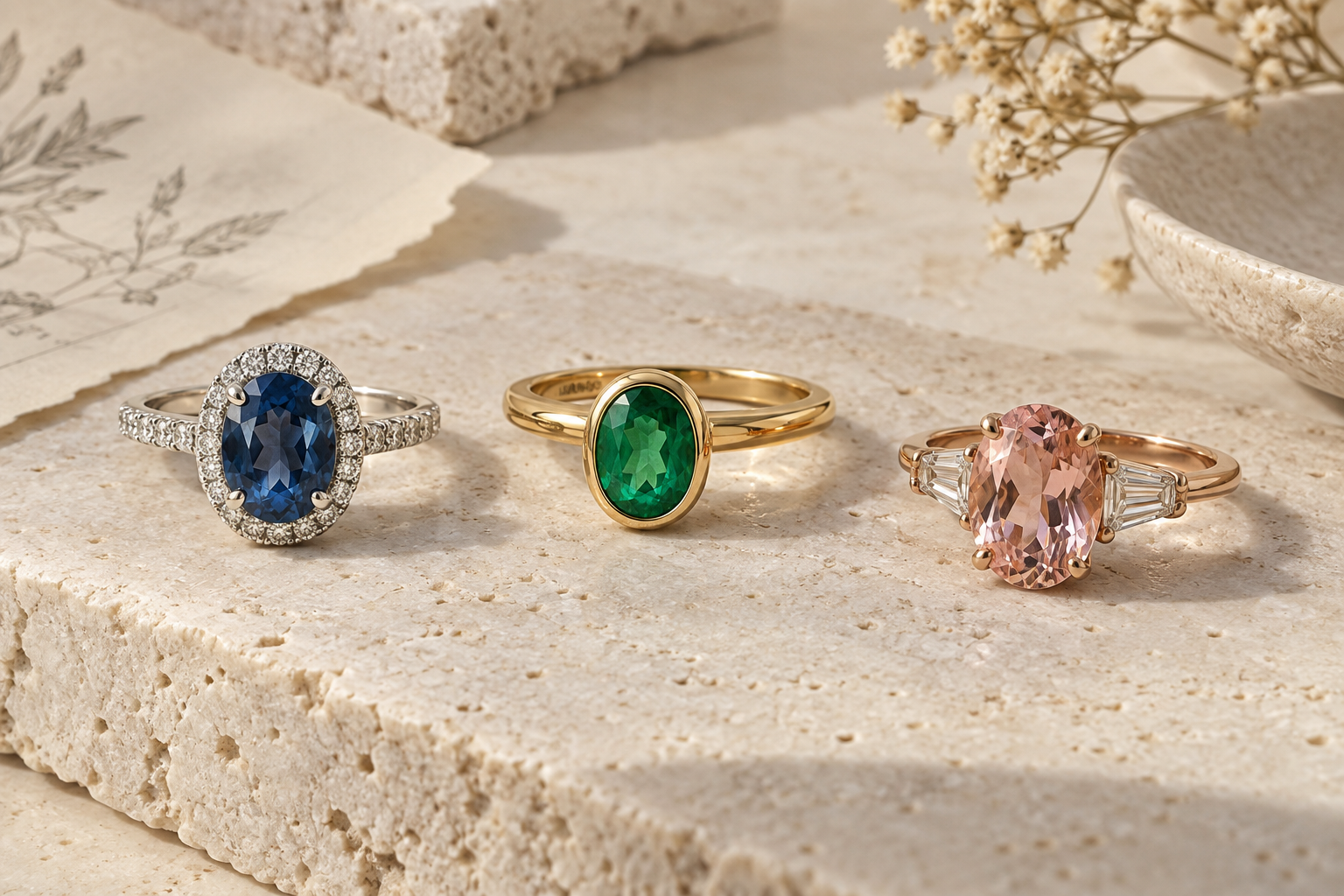
Birthstones appear in engagement jewelry in a few predictable ways: as a single center stone, as an accented center with diamonds or side stones, as a cluster or halo, or set as a meaningful but less exposed element (for instance, a small birthstone set on the band or under the gallery). Jewelers design around a stone’s optical properties—color, transparency, and typical cutting styles—so the same birthstone can be faceted for brilliance, cut as a cabochon for color depth, or set as a rose-cut antique-style gem.
Motifs associated with birth months—such as floral or astrological designs—are incorporated into settings and engraving rather than changing the gem itself. Jewelers of America describes common ring formats and settings that balance protection and visibility, and many professional jewelers tailor mounting style to the gem’s needs: bezel settings and low-profile mounts for delicate stones, prong settings and halos for harder faceted gems, and hidden birthstones placed where they are less exposed to wear.
Durability: what to evaluate
When assessing a birthstone for an engagement ring intended for daily wear, evaluate five practical factors: hardness, toughness, cleavage, surface durability, and treatment stability. Hardness relates to resistance to scratching; toughness relates to resistance to breaking or chipping; cleavage is a mineral’s tendency to split along planes; surface durability concerns how the gem tolerates abrasion and chemicals; and treatment stability concerns whether common enhancements might degrade or require special care.
The GIA provides gemological context and modern birthstone lists useful for identifying which month stones are commonly used and what gem families they belong to. Historically popular birthstones include corundum varieties (ruby and sapphire), beryl varieties (emerald and aquamarine), garnets, and topaz among others—each with differing durability profiles. As a rule for daily wear, corundum-family stones are among the most durable colored options commonly used.
Treatments, disclosure, and what to ask the seller
Many colored gems undergo treatments to improve color or stability, and the Federal Trade Commission (FTC) requires clear disclosure about treatments, lab-grown or synthetic origins, and imitations in jewelry advertising and sales. Before buying, ask whether the stone has been heat treated, fracture-filled, dyed, coated, or otherwise enhanced, and request written disclosure.
Some treatments are stable and commonly accepted; others require more care or may affect long-term durability. The FTC guidance recommends that consumers seek explanation of any treatment and how it affects care, cleaning, and repair. For a daily-wear engagement ring, prioritize stones with stable, well-understood treatments or untreated stones when durability under everyday conditions is important.
Setting choices and protective strategies
Choose a setting that reduces exposure to knocks and abrasion. Bezel settings, low-profile mounts, and protective halos limit direct impacts and reduce the risk of chipping. Jewelers of America notes that setting style, metal choice, and mounting height all influence how a ring wears and how serviceable it is over time. A well-designed prong setting with robust prongs can work for many stones, but thinner or fragile gems benefit from a surrounding bezel or basket.
Consider ring shanks and shoulder designs that shield the stone during everyday tasks, and ask a professional jeweler about reinforced prongs and stress points. A setting that makes routine maintenance—prong inspection, cleaning, and occasional re-tipping—easy will safeguard the ring’s longevity.
Repairability and long-term care
Repairability depends on the stone, the setting, and the degree of damage. Harder gems like sapphire and ruby can often be re-polished or re-cut and generally withstand more aggressive repair work than fragile stones like opal or some varieties of topaz which may fracture or lose color under repair processes. Jewelers can replace a center stone, re-tip prongs, and reset gems, but the availability of similar-quality replacement material and the original gem’s treatment history affect restoration options.
Plan for periodic professional cleaning and inspection. For engagement rings worn daily, schedule at least annual checks to verify prongs and settings, and discuss insurance or appraisal updates with your jeweler. The FTC’s consumer guidance encourages documentation of treatments, origin (natural or lab-grown), and all purchase terms to protect consumers should future repair or resale occur.
Alternatives and compromises
If a true birthstone is unsuitable for daily wear, consider several respectful and practical alternatives. Choose a birthstone that is naturally harder—many people opt for sapphire (including padparadscha and parti-color) or spinel as durable colored centers that still reflect birth-month color. Another approach is to use a smaller, less-exposed birthstone as a sentimental accent on the band while choosing a harder main center stone for durability.
Other valid options include diamond or lab-grown diamond centers accented with the birthstone, lab-grown sapphires or other durable lab-grown gems that match the birthstone’s color, or selecting a different month-associated gem with similar hue but better wearability. These alternatives let you preserve the personal meaning while adapting to the practical needs of daily jewelry.
Practical selection and gifting guidance
Be explicit about daily use. If the wearer cooks, swims, or works with their hands regularly, prioritize durability and low profile settings. When gifting, discuss preferences for visible symbolism versus subtle, private meaning—some recipients prefer an exposed center gem, others a secret birthstone under the gallery or on the inside of the band.
Request written disclosures about treatments and origin, ask the jeweler for care instructions tailored to the chosen gem and setting, and consider appraisal and insurance for valuable pieces. If shopping custom, ask the jeweler to model the ring in wax or CAD so you can confirm how protective the setting will be. Finally, remember the cultural and personal sensitivity: explain the historical and personal reasons for your choice if you are referencing cultural meanings, and respect that the recipient may prefer a different interpretation or presentation.
Conclusion
Birthstone engagement rings can be beautiful and meaningful, but usability for daily wear depends on selecting appropriate stones, protective settings, transparent treatment disclosure, and planning for maintenance. Use the GIA’s gemological context to understand which stones are traditionally associated with months, follow FTC guidance for treatment and origin disclosure, and consult experienced jewelers about setting and repair. Thoughtful choices let you honor birthstone symbolism without compromising the ring’s longevity or the wearer’s lifestyle.
Frequently asked questions
Are birthstones good for daily-wear engagement rings?
Some birthstones are well suited to daily wear, especially harder gems like corundum varieties (ruby and sapphire), while softer or brittle stones such as opal, pearl, or some turquoise varieties are more vulnerable. Prioritize durable stones or choose protective settings and be sure to get treatment and care information from the seller.
What should I ask the jeweler about treatments?
Ask whether the stone has been heat treated, fracture-filled, dyed, coated, or otherwise enhanced, and request written disclosure. The FTC requires sellers to disclose such treatments and whether a gem is lab-grown or an imitation, and disclosure affects care and potential repair options.
How can a setting protect a softer birthstone?
Protective strategies include bezel settings, low-profile mounts, halos that shield edges, and choosing a design with thicker prongs or a guard shank. These choices limit exposure to knocks and abrasion and help preserve the stone's finish and structural integrity.
Is it better to use a birthstone as an accent rather than the center?
Using a birthstone as a subtle accent on the band or under the gallery preserves the personal meaning while protecting the gem. This compromise is common when the traditional birthstone is not ideal for continuous wear as a center stone.
What are practical alternatives if a birthstone isn’t durable enough?
Consider a harder stone with similar color, such as a sapphire or spinel, use lab-grown alternatives that mimic the color with greater durability, or combine a diamond center with birthstone accents. Any alternative should be chosen with written disclosures about treatments and origin.
How often should I have an engagement ring checked?
For rings worn daily, have a professional jeweler inspect the setting and prongs at least annually and after any known impact. Regular checks can catch loose settings early and reduce the risk of losing or damaging the stone.
Sources and further reading
- Birthstones — Gemological Institute of America
- Birthstones: Gems Through the Ages — Gemological Institute of America
- Buying Gemstones, Diamonds, and Pearls — Federal Trade Commission
- Jewelry Guides — Federal Trade Commission
- Jewelry Buying Guides — Jewelers of America