Meaning at a glance
Provide a month-by-month reference that acknowledges competing lists and treats every flower meaning as a documented or modern cultural convention rather than a botanical fact.
Quick answer
This month-by-month birth flowers by month chart lists commonly assigned birth flowers while acknowledging that competing lists exist. Every flower meaning shown here is presented as a cultural convention documented in historical print culture or as a modern assignment and personal interpretation—not as a botanical or universal truth.
How historians and institutions describe floral symbolism
Long-standing human relationships with plants are seasonal, social, and culturally specific. The Smithsonian Libraries and Archives emphasizes that plant meanings and uses shift over time as people change how they plant, cultivate, and talk about flowers, so a single flower can have many different associations across periods and places.
For printed systems of symbolic meaning, the Victorian-era practice of floriography is the best-documented example in English-language sources. The Library of Congress describes how nineteenth-century books, cards, and guides fixed particular associations for blooms and helped ordinary people use flowers as messages; many modern “birth flower” assignments trace to print conventions that grew from that environment.
Botanical seasonality and identification provide context but do not determine symbolic meanings. The Royal Horticultural Society gives reliable guidance on plant identification, flowering seasons, and cultivation, which helps explain why some flowers became affiliated with particular months in temperate garden cultures. That botanical context can explain plausibility (for example, why a spring-flowering plant is linked to a spring month) without establishing symbolic meaning by itself.
A careful birth flowers by month chart (acknowledging variation)
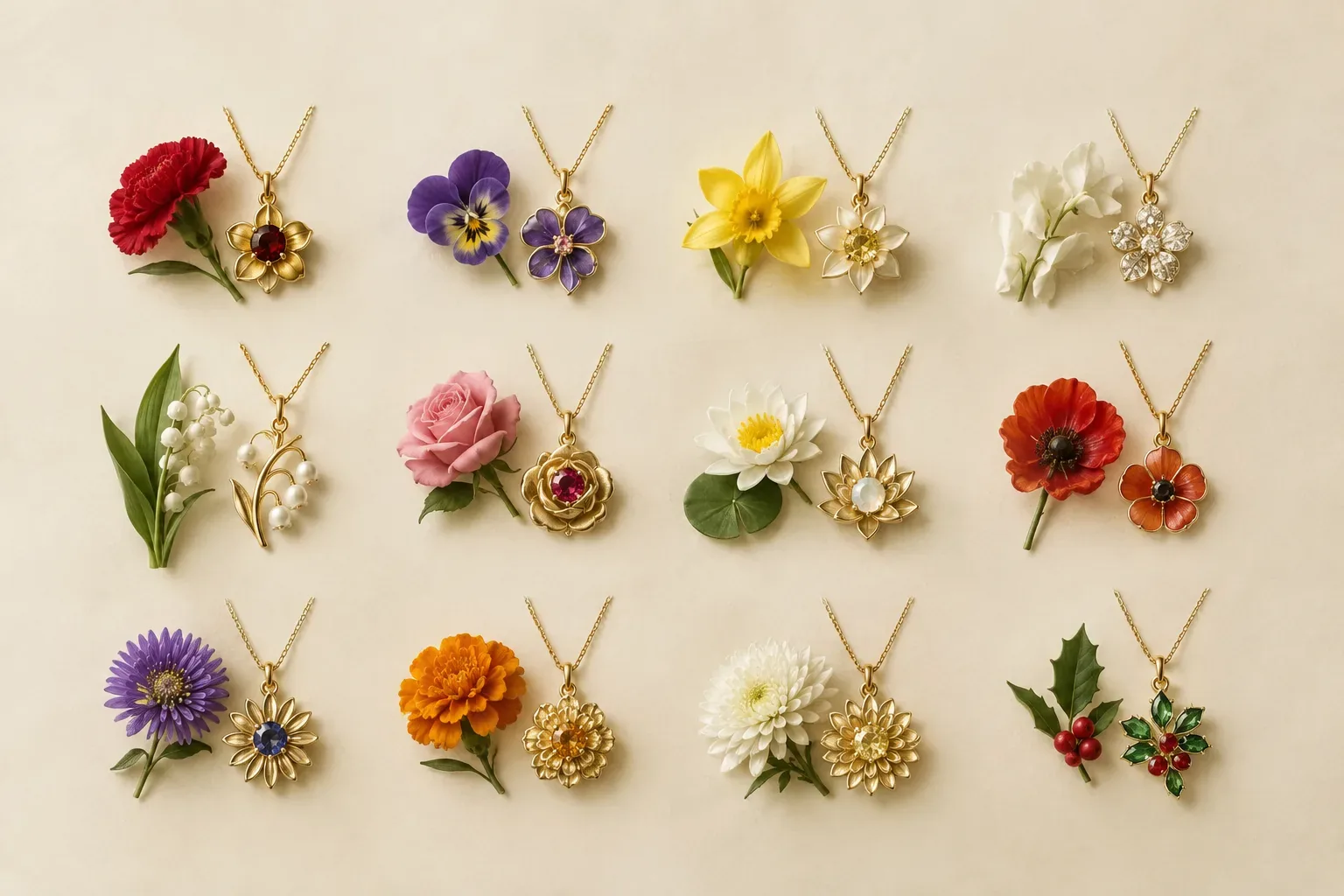
This chart lists commonly encountered birth flowers, notes whether they are traditional or more modern assignments, and flags when alternate flowers commonly appear on other lists. Competing lists and regional practices mean no single entry is definitive; treat every meaning as a cultural convention.
January — Carnation (commonly listed) or Snowdrop (alternative). Carnations appear in many traditional English-language lists and were used symbolically in Victorian floriography according to Library of Congress materials; snowdrops are a seasonal alternative in colder climates and are noted in horticultural records for early bloom (Royal Horticultural Society).
February — Violet or Primrose. Violets feature prominently in nineteenth-century symbolism through printed floriography (Library of Congress); primroses are an alternative tied to early-spring seasonality (Royal Horticultural Society).
March — Daffodil (commonly listed). Daffodils are a widespread assignment for March in modern lists and align with spring bulb seasonality in temperate gardens (Royal Horticultural Society).
April — Daisy or Sweet Pea. Both appear on competing lists; Victorian print culture popularized specific meanings for both flowers (Library of Congress). See our related April article on daisy and sweet pea jewelry for motif examples.
May — Lily of the Valley (commonly listed). This assignment appears in many modern and traditional lists; its spring bloom explains the association in temperate horticultural contexts (Royal Horticultural Society).
June — Rose (commonly listed). Roses are ubiquitous as a floral emblem in many historical periods and appear frequently in Victorian floral symbolism (Library of Congress).
July — Larkspur (commonly listed). Larkspur is a summer-blooming flower used in modern birth-flower lists and matches garden seasonality for July (Royal Horticultural Society).
August — Gladiolus or Poppy. Many lists give gladiolus as August’s birth flower; poppy appears as an alternative on some charts. Both are commonly cited in contemporary lists; gladiolus is discussed specifically in our related August article.
September — Aster (commonly listed). Asters are autumn-blooming flowers often assigned to September in modern lists and fit temperate seasonality patterns (Royal Horticultural Society).
October — Marigold (Calendula) or Cosmos. Marigolds appear on many traditional and modern charts; cosmos is a frequent alternative in North American lists.
November — Chrysanthemum (commonly listed). Chrysanthemums are widely used for late-autumn symbolism and appear across many modern and traditional lists.
December — Narcissus (paperwhite, an alternative) or Holly. December assignments vary widely by region and by whether lists emphasize winter-flowering bulbs or culturally significant evergreens; different lists adopt different emphases, so December is often the most variable month.
Documented historical meanings vs modern personal interpretations
When a source documents a meaning, it usually appears in printed floriography, poetry, or established ceremonial uses. The Library of Congress has curated materials that show how the Victorians and their contemporaries fixed and circulated flower meanings in books and ephemera. Use such sources to attribute a meaning to a historical period or to published print culture rather than to claim it as timeless.
Modern interpretations—how somebody personally uses a flower in jewelry or the meaning they attach when gifting—are shaped by family tradition, personal experience, marketing, and contemporary design trends. The Smithsonian emphasizes that meanings shift as people change how they grow and display plants. Treat contemporary assignments (for example, ‘this shop lists X flower for May’) as conventions that are valid for that cultural context but not universal.
In practice, a historically documented meaning and a modern personal meaning can both be meaningful to a recipient. Distinguish the two when you explain a gift: say whether you are invoking a historical association or a personal sentiment.
How floral motifs, gemstones, and traditions appear in jewelry
Floral motifs have long been a visual language in jewelry—designers translate petals, stems, and seedheads into silhouette, carving, metalwork, and color. Much of the symbolic use of these motifs in the English-speaking world draws on printed floriography and Victorian customs described by the Library of Congress; jewelers and consumers borrowed those associations when commissioning or purchasing pieces.
In contemporary jewelry the idea of a birth flower is expressed in several common ways: a literal floral silhouette or carving on a pendant or ring, a colored gemstone chosen to evoke the bloom’s color, or an engraved inscription that names the flower or its sentiment. Designers may pair a birth flower motif with a recipient’s birthstone, but that pairing is a stylistic choice rather than a historical rule.
Because botanical seasonality matters for plausibility, horticultural guidance from the Royal Horticultural Society helps jewelers and buyers choose accurate floral depictions or seasonal pairings. If a design seeks botanical realism, use RHS resources to match shape and bloom timing; if the design is symbolic, the Library of Congress materials can help artisans select historically resonant motifs.
Practical and respectful selection and gifting guidance
Start by learning which list the recipient or their community prefers. Because many charts compete, ask gently or present choices rather than assuming a single 'correct' birth flower. Saying, 'Some lists say X and others say Y—do you have a favorite?' respects both history and personal taste.
Consider personal associations and cultural context. A flower that is celebratory in one culture might have funerary or other associations in another. If you are unsure about cross-cultural meanings, avoid making symbolic claims on behalf of an entire culture and choose a neutral personal message instead.
Choose materials that suit everyday wear and the recipient’s lifestyle. If you are gifting a floral pendant or ring, prefer durable metals and secure settings for any gem accents. If you know the recipient has metal sensitivities, select hypoallergenic metals. If the design includes delicate enameling or filigree, advise careful handling in the card you include.
Pair symbolism with practicality: a small floral charm that suits daily wear is often more useful than a large, fragile brooch. If you want to signal a documented historical meaning, note the source in a short card (for example: 'Victorian floriography links violets to modesty' with a reference to print-culture histories). If you prefer to make a personal statement, explain what the flower means to you and why you chose it.
When buying commercially produced 'birth flower' jewelry, remember that marketing assignments vary. Use product descriptions to determine whether the maker is following a traditional list, a contemporary convention, or their own design system, and match that to the recipient’s preferences.
Frequently asked questions
Is there a single authoritative birth flowers by month chart?
No. Multiple competing charts exist. The most reliable way to attribute a meaning is to state whether it comes from historical print culture (for example, Victorian floriography documented in Library of Congress collections), horticultural seasonality (recorded by institutions such as the Royal Horticultural Society), or a modern commercial list.
Why do different lists give different flowers for the same month?
Lists differ because floral symbolism developed in print, garden practice, and local custom rather than through a single authoritative source. The Smithsonian documents how plant meanings change with cultivation and social use, and the Library of Congress shows how print culture fixed some but not all assignments.
Can I pair a birth flower with a birthstone in jewelry?
Yes; many designers and gift-givers pair floral motifs with a recipient’s birthstone as a personal stylistic choice. Such pairings are contemporary conventions rather than historical rules, so choose what resonates with the recipient and suits practical wearability.
How should I explain the flower’s meaning when gifting jewelry?
Be explicit about the source: note whether you are invoking a historical meaning from published floriography, a horticultural association, or your own personal sentiment. This clarifies whether the symbolism is a documented cultural convention or a private message.
Are any floral symbols universal?
No single floral symbol is universal. Different cultures and periods assign different meanings to the same flower. Treat meanings as culturally specific conventions and avoid asserting a global interpretation.
How do I care for jewelry that depicts or references flowers?
Care depends on materials. Choose durable metals for everyday wear and protect delicate enamels or filigree. If the piece uses soft gemstones or fragile inlays, advise the recipient to remove it for strenuous activities and to store it separately to avoid abrasion.
Sources and further reading
- Blooming Flowers: A Seasonal History of Plants and People — Smithsonian Libraries and Archives
- Flowers and Their Meanings — Library of Congress
- Plants of the World — Royal Horticultural Society