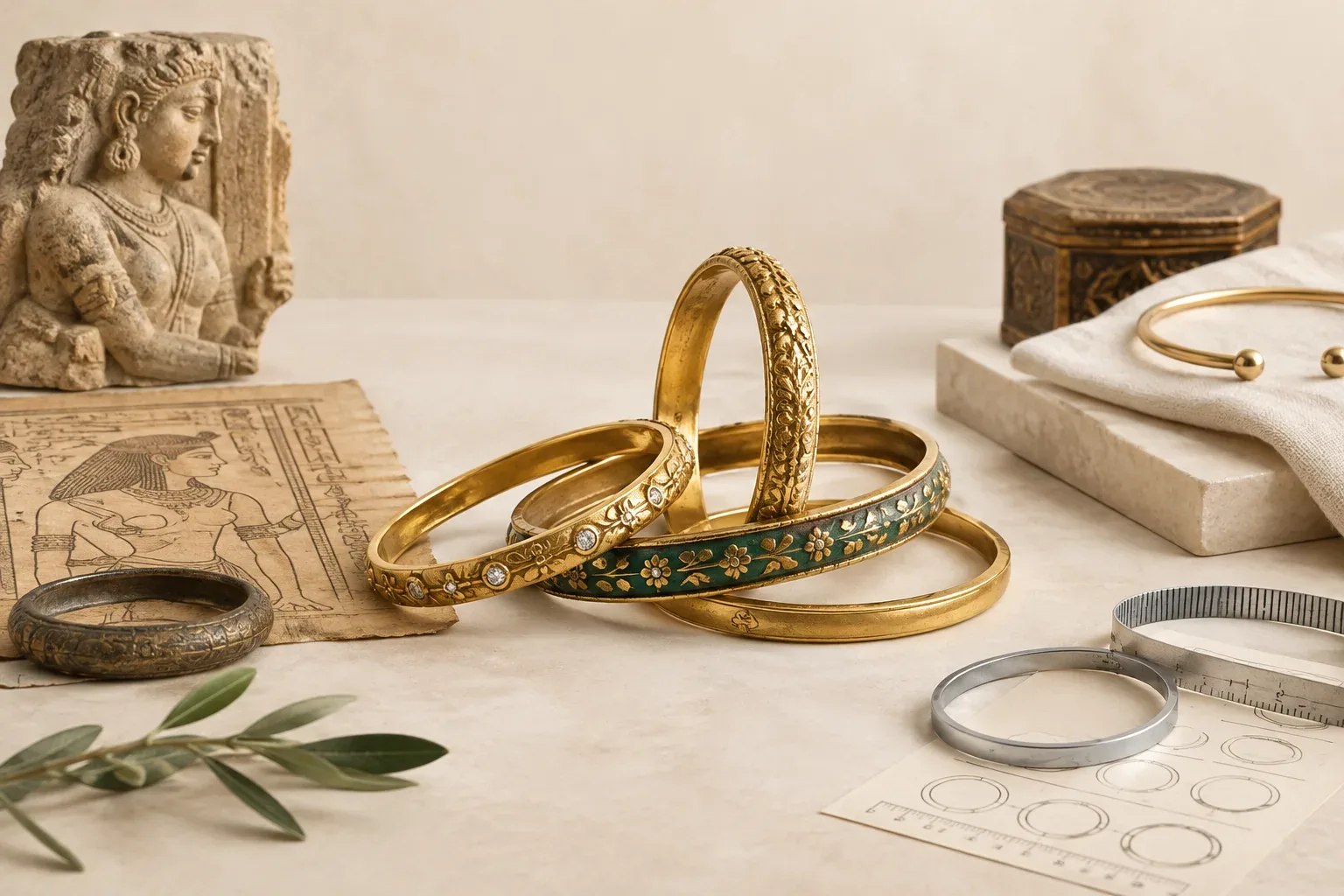
Meaning at a glance
This guide explains documented historical uses of rigid bracelets and bangles, distinguishes museum-evidenced cultural meanings from modern personal interpretations, explains how motifs and gemstones appear on bangles, and gives practical, step-by-step advice for measuring, choosing, and gifting bangles for a correct fit.
What museum evidence shows about bangles and rigid bracelets
Collections and scholarship documented by the Victoria and Albert Museum show that rigid bracelets and bangle-like forms have appeared in many places and periods, and that their social uses and meanings have changed over time. Museum catalogues and displays trace decorative wrist ornaments from ancient burial ensembles to later ceremonial and fashionable dress, demonstrating that the object type — a closed or near-closed circular bracelet — is not unique to a single culture or meaning.
Specifically, curatorial records at the Victoria and Albert Museum record examples of rigid bracelets in South Asian dress traditions, protective and status objects in ancient Egyptian finds, and fashionable rigid bracelets and hinged bracelets in European collections from the 18th and 19th centuries. These museum records show change through time: the same form can serve as personal adornment, a marker of status, a funerary inclusion, or a regional costume element depending on period and place.
Because the V&A traces jewelry across many contexts, its material supports the broader point that meanings attached to bangles were historically variable and tied to particular social practices and moments rather than being universal or timeless.
Documented historical meanings versus modern personal interpretations
Museum documentation gives us evidence for how particular objects were used or acquired, not an unbroken line of single meanings. For example, in some documented contexts rigid bracelets were associated with marital or status indicators, while in others they appear as burial goods or as elements of court fashion. The V&A’s work demonstrates these shifts in social context and function.
Modern personal or commercial interpretations — for instance, advertising a bangle as an unchanging symbol of marital fidelity or a universal talisman — often layer contemporary meanings on top of historically specific practices. That does not make modern interpretations invalid for an individual wearer, but it is important to keep the distinction clear: documented historical meanings come from museum provenance and curatorial research, while modern meanings are personal, cultural, or marketing-driven and can vary widely.
How motifs, gemstones, and traditions appear on bangles
The placement of motifs and the use of gemstones on bangles follow both technical and aesthetic conventions. Motifs may be engraved, chased, enamelled, or applied as filigree around the bangle’s exterior. Gemstones are often set into bezels or collets on the face of the bangle or used as repeating elements around the band, depending on the metalwork technique and the width of the bangle.
The Victoria and Albert Museum’s overview of gemstones explains historical preferences and the visual and cultural value of particular stones across periods, which informs how jewelers chose gems for bracelets. Gemstone choice historically reflected availability, trade networks, and fashion as much as symbolic intent. In modern production, gems on bangles range from small pavé settings to single-set focal stones; placement and setting style affect both appearance and how a bangle sits on the wrist.
Traditional motifs — such as floral patterns, geometric repeats, or culturally specific symbols — are reproduced on rigid bangles in different ways: raised relief, openwork, inlay, and surface finish. The technique used influences the bangle’s thickness, weight, and flexibility, and therefore its fit and comfort.
Practical measurements that matter
Two measurements matter for getting a comfortable bangle fit: the hand’s widest circumference (so the bangle can pass over the knuckles for slip-on styles) and the bangle’s inner diameter or inner circumference (which determines how it sits on the wrist). For slip-on bangles, the hand needs to fit through the bangle while the bangle should sit loosely enough on the wrist to move comfortably but not fall off.
To measure your hand for a slip-on bangle: with your fingers together and palm flat, wrap a flexible tape or a strip of paper around the widest part of your hand (across the knuckles). Mark or note that measurement in millimetres or inches. To estimate a corresponding bangle inner diameter, divide that hand circumference by pi (π ≈ 3.1416). Jewelers commonly work in inner diameters (millimetres) and can convert for you, but the circumference method ensures the bangle will pass over the hand.
To measure an existing bangle that fits well, lay it flat and measure the inside edge straight across through the center to get the inner diameter. If you prefer to work in circumference, multiply that diameter by π. For hinged or clasp bangles that open, measure the wrist circumference where you want the bangle to sit; hinge designs allow a smaller inner diameter because the bangle opens for insertion.
Consider style and width: wider bangles need a slightly larger inner diameter to clear knuckles, and very stiff or thick ornamentation reduces flexibility when the bangle passes over the hand. If between sizes, choose the larger size for comfort or select a hinged or adjustable cuff style.
Types of bangles and fit implications
Slip-on bangles are continuous rings without openings; they must clear the widest part of the hand and tend to sit more loosely on the wrist. Hinged or clasp bangles open and close, allowing a closer fit around the wrist and making them a reliable choice when hand circumference is unknown or when gifting.
Open cuff bracelets are adjustable to an extent and can be widened slightly to pass over the hand, though repeated bending can weaken some metals if over-adjusted. Stiffer materials and heavily gemmed bangles are less forgiving and usually require accurate sizing or a hinged design.
Stacking multiple thin bangles creates a different fit sensation from a single wide piece. When stacking, ensure each bangle is not so tight that multiple pieces restrict wrist movement; small amounts of play are normal and comfortable.
Care, materials and buyer protections
When buying gemstone-set bangles, be aware of material treatments and possible imitations. The Federal Trade Commission advises consumers to ask about gemstone treatments, enhancements, and whether stones are synthetic or assembled. Reputable sellers disclose treatments and provide written information on the stones used.
For long-term care, consider the metal and setting type. Softer metals dent more easily; elaborate settings can catch on clothing and receive knocks. Regular professional inspection of prongs, bezels, and joins helps prevent loss of stones. Clean according to the stone and metal: some gems require gentle, non-abrasive care while others tolerate routine cleaning.
Selecting and gifting respectfully
When buying or giving a bangle as a gift, start with practical considerations: note whether the recipient wears slip-on bangles, hinged bracelets, or cuffs; observe the general scale of their jewelry (delicate, mid-size, or bold); and, when possible, discreetly measure a bangle they already wear or their hand circumference as described above.
Respect cultural and religious contexts. Museum records show that bangles have had specific social and ceremonial meanings in some traditions, and wearing or gifting particular styles can carry significance for some recipients. If the bangle style is associated with a community practice you are not part of, ask sensitively or choose a more neutral design. Avoid assuming that a bangle always signals a particular status for every wearer; meanings are historically and personally variable.
If you cannot measure, choose an adjustable or hinged design and make sure the seller offers exchanges or resizing. Include a note about care and a receipt to make return or resizing easy. When giving an heirloom or historically styled bangle as a sentimental object, explain what the piece means to you and be open to the recipient’s own interpretation.
Final practical checklist
Measure hand circumference across the knuckles for slip-on styles and convert to inner diameter if needed. For hinged styles, measure wrist circumference where the bangle will sit. Allow extra room for wide or heavily ornamented bangles. Choose hinged or adjustable styles when you are unsure of size. Ask sellers about gemstone treatments and disclosure practices and keep receipts in case resizing or exchange is needed. Be mindful of cultural meanings and let documented history inform rather than dictate a gift’s message.
Frequently asked questions
How do I measure my hand for a slip-on bangle?
With your fingers together and palm flat, wrap a flexible tape measure or a strip of paper around the widest part of your hand across the knuckles, mark where it overlaps, and record that length. Divide that number by pi (approximately 3.1416) to estimate the inner diameter a slip-on bangle needs.
What’s the difference between inner diameter and inner circumference?
Inner diameter is the straight-line distance across the inside of a bangle through its center. Inner circumference is the distance around the inside. You can convert between them by using the formula circumference = diameter × π.
What if I can’t measure the recipient’s hand when gifting?
Choose a hinged or clasp bangle, an adjustable cuff with a conservative range, or select a reputable seller who offers easy exchanges or resizing. Include the receipt and a note about potential resizing.
Do gemstones affect how a bangle fits?
Yes. Heavily set or large stones can increase the effective width and stiffness of a bangle and may require a larger inner diameter for comfortable passage over the hand. Discuss setting and profile with the jeweler when ordering.
How can I check whether a gemstone has been treated or is synthetic?
Ask the seller for written disclosure and any available documentation. The Federal Trade Commission recommends that buyers request information about treatments, enhancements, and whether stones are natural, synthetic, or assembled.
Should I assume a bangle has the same meaning across cultures?
No. Museum documentation shows that bangles have had many different functions and meanings in different places and periods. Do not assume a universal meaning; if cultural or religious significance matters for your purchase or gift, ask or research the specific tradition.
Sources and further reading
- Bedazzled: A History of Jewellery — Victoria and Albert Museum
- An A-Z of Gemstones — Victoria and Albert Museum
- Buying Gemstones, Diamonds, and Pearls — Federal Trade Commission