Meaning at a glance
Documented evidence shows amber has been used in personal ornament across many cultures; museums record historical beliefs that ranged from protective amulet to decorative luxury. Modern readings that ascribe universal spiritual or medical powers are personal interpretations rather than established cultural facts. When choosing or gifting amber inclusion jewelry, prioritize provenance, honest disclosure of treatments or imitations, visible condition, and respect for cultural contexts.
What the historical evidence actually says
Institutional collections and reference works treat amber as an established gem material with a multi-period history. The Victoria and Albert Museum’s resources on jewelry and gemstones summarize how materials such as amber were adopted into personal ornament over long timeframes and were understood differently in different places and periods. The V&A presents jewelry history as a changing social practice rather than a single, unbroken symbolism, and lists gemstones in their historical contexts without endorsing modern folklore as universal fact.
Archaeological and museum records show amber in prehistoric, ancient, and historic objects across the Baltic, Mediterranean, and other regions where amber was accessible or traded. Those finds demonstrate the material value placed on amber and its use in necklaces, beads, and inlaid objects. Curatorial overviews at institutions such as the V&A treat amber as both decorative and, in some periods, as a material used in talismans or amulets, but they emphasize that meanings varied by culture and era rather than being uniform.
Separating documented historical meanings from modern interpretations
Documented historical meanings are the beliefs, uses, or rituals that contemporary sources and material culture actually record. Museum treatments and gemstone overviews note that amber has been associated in some historical contexts with protection, warmth, or the sun, or was simply a prized decorative material. These associations are part of recorded history when supported by evidence such as inscriptions, burial contexts, or contemporary writings, and are discussed by institutions like the Victoria and Albert Museum in their accounts of gemstone history.
Modern personal interpretations—such as claims that amber inclusion jewelry will universally restore health, ward off every form of misfortune, or convey a single spiritual identity—are contemporary readings layered onto the material. Such interpretations can be meaningful to individuals, but they are not the same as documented, culture-specific historical practice. When sellers or storytellers present modern metaphysical benefits as if they were historically universal, they are providing a contemporary narrative rather than an evidence-based history.
How the amber inclusion motif appears in jewelry
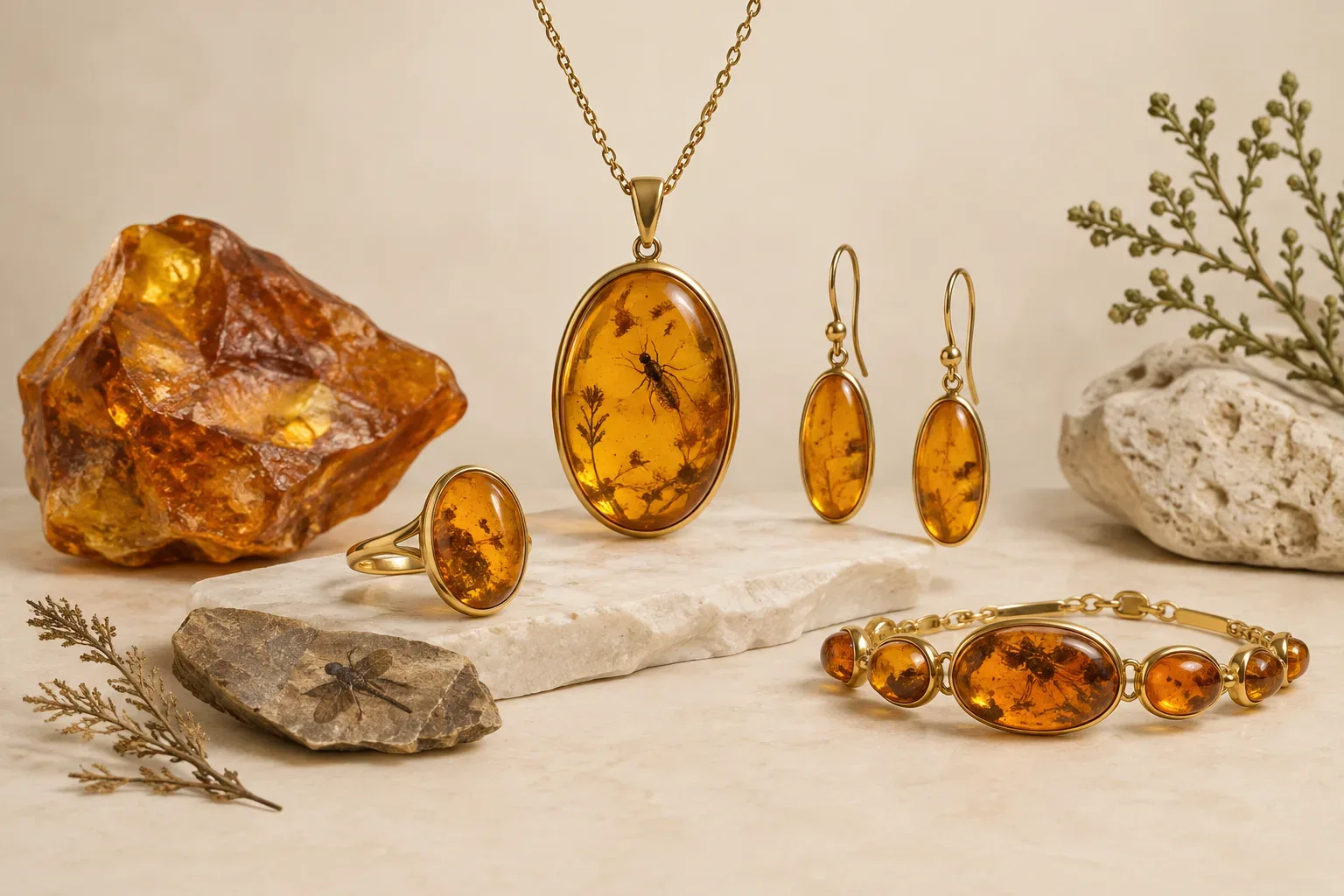
The phrase “amber inclusion” commonly refers to organic material trapped inside amber: plant fragments, air bubbles, or small animals such as insects. These inclusions are naturally occurring and are often the feature that draws attention in a polished piece of amber. Jewelers and designers set amber cabochons, beads, or freeform pieces so that an inclusion sits visibly beneath the surface and becomes the focal point of a pendant, brooch, ring, or pair of earrings.
Historically and today, amber is shaped and polished rather than faceted in the way many crystalline gems are. That means inclusions remain visible and can be displayed behind plain or convex surfaces. Modern jewelers may emphasize a single insect, frame a fragment of plant material, or create matched pairs of inclusion-bearing beads. The motif can also be suggested in metalwork and engraving where a designer evokes the idea of trapped life without using natural amber.
Authenticity, treatments, and buyer protections
Amber can be natural, treated, stabilized, or imitated. The Federal Trade Commission’s consumer guidance on buying gemstones, diamonds, and pearls stresses that sellers should disclose treatments, enhancements, and whether a material is an imitation. That guidance applies to amber: ask whether the piece is natural Baltic or another origin, whether it has been heat-treated, polymer-impregnated, stabilized with plastics, or assembled from multiple pieces.
Visual similarity between amber and plastics or some resins makes disclosure especially important. Reasonable due diligence includes requesting seller documentation, independent testing when value justifies it, and understanding the seller’s return policy. Museums and reputable dealers typically separate descriptive historical information from modern marketing claims; replicate this separation in consumer interactions by asking for verifiable provenance and treatment disclosure.
Practical and respectful selection or gifting guidance
Match the piece to the recipient’s aesthetic and ethical preferences. If the recipient values natural history, choose a clearly natural inclusion with good documentation about origin and treatment. If they value design, prioritize a setting and finish that highlight the inclusion and suit daily wear or occasional use. For symbolic gifting, explain whether the meaning you attach is historical in origin or a personal sentiment so the recipient can accept it on their own terms.
Prioritize transparent provenance and honest labeling. Request written statements about origin, treatments, and whether the inclusion is natural or artificially inserted. If you are buying online, use sellers with clear return policies and documented disclosure. Keep in mind that the presence of an inclusion does not necessarily make a piece rare or valuable—value depends on clarity, size, type of inclusion, overall beauty, and the market for such items.
Be culturally respectful. Some cultures have specific histories or ritual uses for amber; others treat preserved insects differently. Avoid representing a contemporary personal interpretation as a historical or religious truth for a group unless you have clear evidence to support that claim. If you are uncertain whether a symbolic message may be sensitive, choose neutral wording or discuss it with the recipient in advance.
Consider care and wearability. Amber is relatively soft compared with many gem materials and can scratch or fracture. Set pieces so the stone is protected if the wearer intends to use the jewelry daily. Provide the recipient with care instructions and storage advice so light, chemicals, and temperature extremes do not degrade the amber or its inclusion.
Care and conservation notes
Because amber is an organic fossilized resin, it can be sensitive to solvents, strong heat, and some cleaning agents. Clean amber inclusion jewelry with a soft cloth and mild soap and water; avoid ultrasonic cleaners, steam, or solvents that might remove stabilizing treatments. Store amber away from harder gemstones to reduce abrasion and keep pieces in a stable temperature environment.
When buying historically significant pieces or items described as antiques, consider consulting a qualified conservator or reputable museum resources for long-term preservation. The Victoria and Albert Museum and similar institutions treat historical jewelry with specialized conservation approaches; collectors should seek professional advice before attempting any restoration to avoid irreversible damage.
Concluding guidance
Amber inclusion jewelry meaning rests on documented material history plus layers of modern interpretation. Use museum-based sources and transparent seller information to ground any historical claims, and treat modern spiritual or personal readings as individual rather than universal. For selection and gifting, prioritize verified provenance, truthful disclosure of treatments or imitations as recommended by consumer guidance from the Federal Trade Commission, and sensitivity to the recipient’s cultural context and aesthetic preferences.
Frequently asked questions
How can I tell if an amber inclusion is natural?
Natural inclusions are embedded beneath the polished surface and appear integral to the amber mass. Ask the seller for provenance information and disclosure of any alterations. For higher-value pieces, independent gemological testing can confirm whether an inclusion is original or has been artificially inserted.
Are all historical meanings of amber the same across cultures?
No. Historical meanings for amber vary by culture and period. Museum sources such as the Victoria and Albert Museum present amber’s history as context-dependent; some societies treated amber as decorative, others associated it with protective uses, but these are not universal practices.
Can amber be treated or imitated, and will sellers disclose that?
Yes. Amber may be heat-treated, stabilized with polymers, or imitated by modern resins and plastics. The Federal Trade Commission advises that such treatments and imitations should be disclosed to buyers. Ask sellers for written disclosure and documentation before purchase.
Is it appropriate to gift amber jewelry for spiritual reasons?
Gifting for spiritual reasons can be meaningful, but it is respectful to clarify whether the spiritual meaning you attach is a personal interpretation or rooted in a documented cultural practice. Avoid presenting modern metaphysical claims as historical or religious fact without evidence.
How should I care for amber inclusion jewelry?
Clean amber gently with a soft cloth and mild soap and water; avoid solvents, ultrasonic cleaners, and prolonged exposure to heat or direct sunlight. Store amber separately from harder gemstones to prevent scratching.
Does the presence of an inclusion make amber more valuable?
Value depends on multiple factors: clarity, size, type and aesthetic of the inclusion, overall condition, and market demand. An interesting inclusion can increase appeal but is not the sole determinant of value.
Sources and further reading
- Bedazzled: A History of Jewellery — Victoria and Albert Museum
- An A-Z of Gemstones — Victoria and Albert Museum
- Buying Gemstones, Diamonds, and Pearls — Federal Trade Commission