Meaning at a glance
Explain the documented history and changing contexts of the key and lock motif, separate cultural or religious evidence from later popular interpretations, and give practical guidance for choosing and wearing the motif in modern jewelry.
Quick answer
The key and lock jewellery meaning is best understood as a motif with documented functional and symbolic uses that changed over time: historically keys and locks were practical objects that became decorative and sentimental in particular periods, and modern wearers layer personal meaning on top of those documented contexts. This article explains the museum-documented history, distinguishes recorded cultural uses from later popular interpretations, describes how the motif appears in jewellery and gemstones, and offers practical guidance for choosing and gifting key-and-lock pieces today.
Historical evidence and where it appears in the record
Objects that are recognisably keys, locks and lock-shaped fittings appear in archaeological and museum collections from many periods, and scholars at the Victoria and Albert Museum note that jewellery must be read against changing social contexts rather than assumed to carry a single meaning. The V&A's materials on jewellery history emphasise that items moved from strictly functional to ornamental uses as metalwork techniques and social fashions changed, and that museum collections show examples across pre-modern, medieval and post-medieval European contexts.
In post-medieval and especially nineteenth-century Europe, what the V&A describes as the rise of sentimental and personal jewellery made small tokens and charms more common. In that context, padlocks, keys and keyhole motifs were frequently reproduced as decorative elements, often worn on chains or incorporated into lockets and bracelets. Museum interpretation from the V&A demonstrates that the motif's popularity in this period aligned with evolving practices around memory, intimacy and display rather than with a single symbolic programme.
Museum documentation also highlights that the visual language of jewellery depends on local workshops, available materials and fashions: for example, the same key shape could appear on a working lock, on a chatelaine (a practical chain holding household keys), or as a reduced decorative pendant; each use carried different practical and social implications in its own time and place. The V&A's broader history of jewellery is the primary source for these observations about shifting functions and contexts.
Separating documented historical meanings from modern interpretations
Documented historical meanings are best drawn from physical objects, inventories and contemporaneous commentary preserved in museum collections and archives. For many earlier periods the most secure claim is that keys and locks indicated ownership, access and household authority because they were functional items. Later, particularly in the nineteenth century, small lock-and-key motifs became associated with sentimentality and personal attachment in decorative jewellery, as recorded in museum collections and interpretive materials.
Modern interpretations—such as the lock as an absolute sign of emotional exclusivity or the key as a one-size-fits-all symbol of destiny—are largely cultural developments of the twentieth and twenty-first centuries. These newer meanings are real and meaningful to many wearers, but they are not universal historical facts. The V&A material on jewellery history stresses that sentimental meanings intensified in certain times and places, and that contemporary jewellery culture continues to invent and borrow associations.
When discussing religious or cultural symbolism, avoid projecting later popular readings onto older objects without direct evidence. Museum documentation can show when a motif became popular and in what contexts, but it does not support blanket claims that keys or locks always carried a particular spiritual or moral meaning across all cultures or eras.
How the key and lock motif and gemstones appear in jewellery
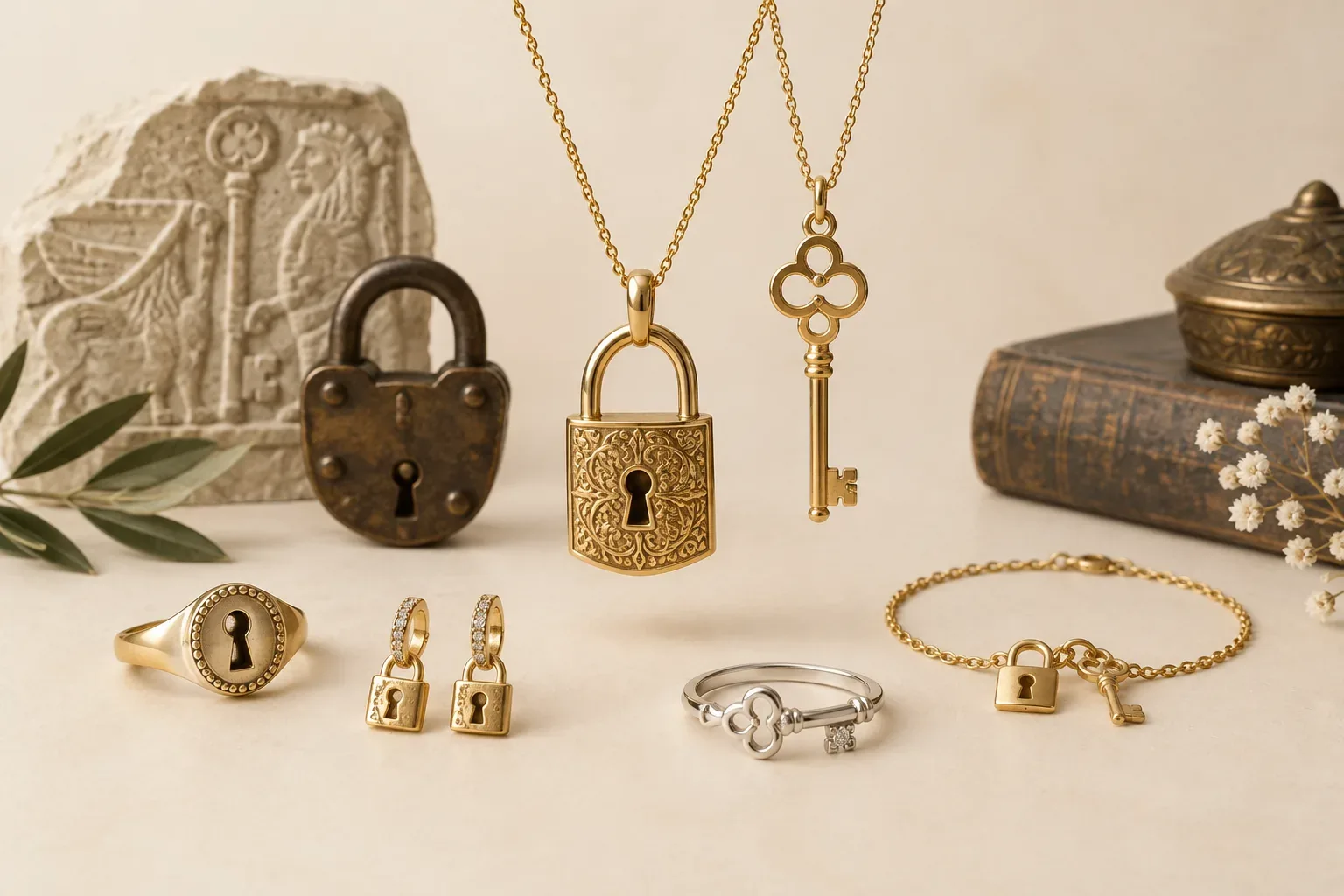
The key-and-lock motif appears in jewellery in three overlapping ways: as a literal miniature of a working key or padlock; as the suggestion of a keyhole or lock shape carved into a pendant, locket or ring; and as paired object sets in which a key pendant is given alongside a lock pendant or locket.
Designs range from restrained, machine-like silhouettes to highly ornate versions with engraving, openwork, enamel and gem settings. The V&A's A–Z of gemstones and its general collections show that jewellers historically combined the motif with the same range of materials used elsewhere in decorative arts: metals such as silver, gold and base alloys; decorative enamels; and stones from seed pearls and garnets in older pieces to diamonds and synthetic gems in later or contemporary jewellery.
Gemstones may serve decorative or symbolic roles. Museum guides explain that particular stones gained associations in different eras, and that gem choice often reflected fashion, availability and purchaser means. In contemporary practice, designers may set diamonds, sapphires, or coloured gems in key-shaped pendants, or use pavé settings to suggest luxury and permanence; the specific stone choices today reflect both aesthetic preference and marketing rather than a single historical meaning.
Practical selection, gifting and wearing guidance
Decide first whether you want historical authenticity, contemporary style, or personal symbolism. If you value documented historical associations, choose designs that reflect a period look—simpler, functional forms for early or utilitarian associations, and ornate Victorian‑style miniatures for sentimental nineteenth‑century associations. The Victoria and Albert Museum's exhibition and collection notes are a useful reference point for period styles and how motifs were used in their historical contexts.
For a meaningful gift, pair the object with an explanation of why you chose that motif and what it represents to you, rather than assuming the recipient will read the same symbolism into it. Matching a key pendant to a locket or lock pendant is an established modern gesture that leans on the motif's long association with access and intimacy, but the emotional meaning depends on the relationship between giver and receiver.
When buying gemstones or branded claims of authenticity, remember the Federal Trade Commission's guidance that sellers should disclose treatments, synthetics and imitations. Ask for transparent information about metal karat, hallmarks and any gem treatments or enhancements. If you are purchasing vintage or antique pieces, request provenance details and a condition report so you understand any repairs or later alterations.
Consider scale and wearability. Small key pendants work well as daily-wear pieces and layer easily; a heavier working-style padlock or a large ornamental lock becomes a statement piece that may be better reserved for occasional wear. Respect personal and cultural boundaries: some recipients may find overtly romantic interpretations inappropriate for certain relationships, while others will welcome visible statements of affection.
Care, authentication and ethical considerations
Care for key-and-lock jewellery in the same way you would similar metal and gem pieces. Clean metals according to their type, avoid harsh chemicals near enamels and pearls, and store items to reduce abrasion. If the piece contains delicate historical components, consult a conservator before attempting restoration.
For authentication and value, seek independent appraisals when purchasing important antique or high-value pieces. The FTC's consumer guidance on gemstones, diamonds and pearls explains why documented disclosures about treatments and synthetic stones are important and why buyers should request written confirmation of what they are purchasing.
Ethical sourcing is an increasing concern. Ask sellers whether metals are recycled, whether gems come with responsible sourcing information, and whether the maker discloses treatment and origin details. These are practical questions that protect both the buyer and the integrity of the piece.
Final thoughts
Key and lock jewellery meaning cannot be reduced to a single explanation. Museum evidence, particularly the Victoria and Albert Museum's work on jewellery history, shows that the motif moved from function to decoration and then to sentiment in particular historical contexts. Contemporary wearers and designers continue to adapt the motif, layering personal symbolism on top of those documented histories.
If you want a piece that resonates historically, consult museum catalogues or period‑inspired designers. If you want to make or give a piece that is personally meaningful, accompany it with your explanation and be transparent about materials and provenance when buying. Keeping the documented history and modern interpretation distinct will help you choose and wear the motif with respect for its complex past.
Frequently asked questions
Does key and lock jewellery always mean romance?
No. Historically keys and locks were often practical indicators of ownership or household authority; only in particular periods—most notably in nineteenth-century sentimental jewellery contexts documented by museum collections—did they gain frequent romantic connotations. Modern wearers may adopt romantic meanings, but those are contemporary interpretations rather than universal historical facts.
Can men wear key and lock jewellery?
Yes. There is no historical or cultural rule that restricts the motif to any single gender. In different times and places keys and lock motifs have been used in practical items such as chatelaines and signet-style pieces as well as in decorative jewellery, and contemporary fashion treats the motif as gender-neutral depending on scale and design.
How should I ask about gemstone treatments or authenticity?
Ask the seller to disclose treatments, enhancements and whether a gem is natural, synthetic or an imitation. The Federal Trade Commission recommends that buyers request written information about treatments and any guarantees, and that they seek independent appraisal for higher-value purchases.
What should I consider when gifting a key or lock piece?
Consider the relationship and the recipient's tastes, choose a design that reflects whether you prefer historical association or contemporary symbolism, and include an explanation of why you selected the motif. If the piece is presented as an antique or high-value item, ensure provenance and condition are disclosed.
Are there conservation issues with antique lock-and-key jewellery?
Yes. Antique pieces may contain fragile enamel, thin wires, or historically applied gemstones that are sensitive to cleaning and handling. For important pieces consult a conservator before cleaning or repair, and request condition reports when buying.
How can I learn more about historical motifs and their meanings?
Consult reputable museum catalogues and exhibition material such as those from the Victoria and Albert Museum, and use specialist resources and academic publications for deeper study. For practical buying guidance, review consumer information from government resources like the Federal Trade Commission.
Sources and further reading
- Bedazzled: A History of Jewellery — Victoria and Albert Museum
- An A-Z of Gemstones — Victoria and Albert Museum
- Buying Gemstones, Diamonds, and Pearls — Federal Trade Commission