Meaning at a glance
Anchor jewelry meaning combines documented maritime and religious uses with later popular and personal interpretations; this article separates historical evidence from modern symbolism, explains how the motif and gemstones appear in jewelry, and gives practical selection and gifting guidance.
What the historical record shows (who, where, and when)
The recorded history of decorative anchor motifs and maritime symbols belongs to the broader history of jewelry and changing social contexts. The Victoria and Albert Museum discusses how jewelry motifs shift meaning as they move between social groups and historical periods, and that approach frames the evidence below rather than claiming a single origin for the anchor motif.
Documented usage of anchors in jewelry and decoration is strongest in communities with seafaring connections and in societies where maritime imagery carried social or occupational significance. The anchor appears in sailors’ badges, naval insignia, and maritime decorative arts, where the object functions as an emblem of profession, connection to the sea, or practical life at sea. The Victoria and Albert Museum’s work on jewelry history notes how occupational and regional identities are expressed through material culture and ornamentation.
Separately, the anchor has been used in Christian symbolism as a figurative image of hope and steadfastness; museums and curators document how religious motifs have been adapted into personal ornament. The V&A similarly frames such motif transfers as part of jewelry’s changing social meaning, showing how symbols with liturgical roots later appear in secular and sentimental jewelry.
Separating documented historical meanings from modern interpretations
Documented historical meanings are those recorded by museum collections, inventories, or contemporary descriptions: anchors as maritime badges or tools of identification among sailors, and anchors used in Christian visual language to convey hope and salvation. Those documented connections are matters of recorded context and are the basis for many later appropriations.
Modern interpretations include broader personal meanings such as stability, resilience, grounding, safe harbor, and memory of a loved one. These meanings are widely used in contemporary marketing and personal narratives but are not universal or inherently tied to the object by historical necessity. Some wearers choose the anchor simply for aesthetic reasons or because it alludes to travel or adventure rather than any specific maritime, occupational, or religious identity.
It is important to distinguish public, recorded meanings from private symbolism. A museum label or a naval badge documents communal or institutional significance; a modern wearer’s statement that an anchor ‘keeps me steady’ is a personal appropriation and not a substitute for historical evidence.
How the anchor motif, gemstones, and related traditions appear in jewelry
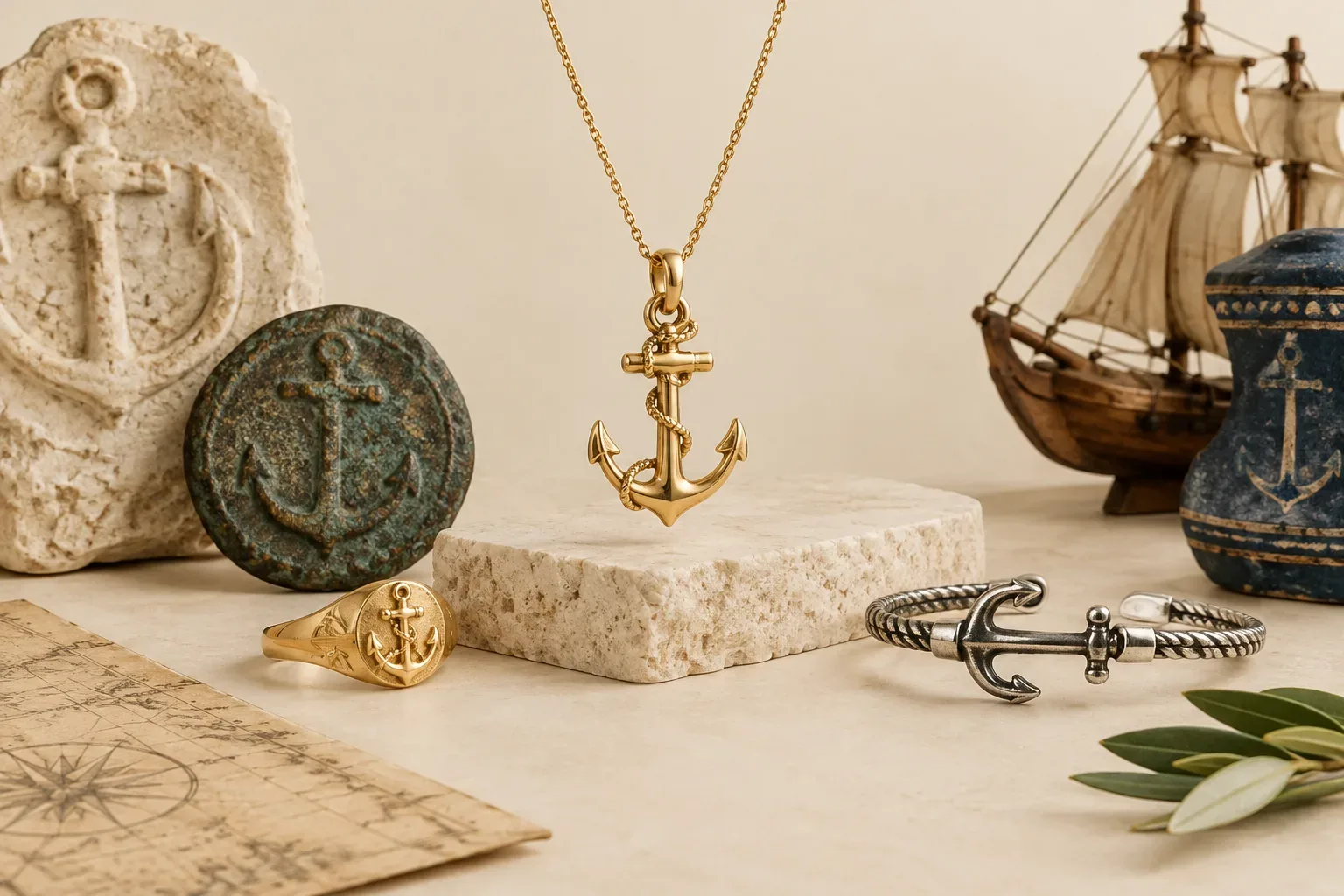
The anchor motif appears across types of jewelry: charms, pendants, brooches, cufflinks, rings, and as decorative motifs on bracelets and lockets. These forms reflect both function and visibility; small anchors work well as charms and pendants, while larger stylistic anchors may appear on brooches or statement necklaces. The motif is rendered in many metals and finishes depending on period and fashion.
Gemstones and materials historically associated with maritime or sentimental jewelry also appear with anchor motifs. The Victoria and Albert Museum’s A–Z of Gemstones explains how different gems and organic materials have been used in jewelry for aesthetic and symbolic reasons over time. Pearls, for example, have longstanding associations with the sea and are historically used in marine-themed pieces, while blue stones such as sapphires or turquoise are often chosen in modern designs to evoke ocean color. These material choices reflect aesthetic association and buyer preference rather than a single fixed meaning.
Manufacturing and decorative techniques vary. In historic pieces, anchors could be engraved, chased, or set with gemstones. In contemporary jewelry, anchors might be laser-cut, cast in precious metal, plated, or combined with other symbols such as rope motifs or compasses. The combination of motif and material influences how a piece reads: a simple silver anchor pendant reads differently from an enamelled, gem-set brooch with Victorian styling.
Choosing an anchor piece: practical guidance
Decide what you want the symbol to express: occupational identity, religious sentiment, nautical aesthetic, or a private meaning such as stability. Your intended meaning should guide size, style, and level of ornamentation. A discreet pendant or charm suits everyday wear and subtle symbolism, while a larger brooch or signet-style anchor makes a bolder statement.
Consider metal and finish for wear and longevity. Solid precious metals are more durable and carry hallmarks; plated or base-metal pieces can be attractive and inexpensive but show wear faster. If durability and long-term value matter, choose pieces hallmarked for sterling silver, gold, or other verified metals.
Assess gemstone choices and treatment disclosures. Use standard guidance about buying gemstones: ask sellers for information about treatments, enhancements, and whether a stone is natural, laboratory-grown, or a simulant. The U.S. Federal Trade Commission advises that consumers should be told about material treatments and imitations, so request clear disclosure before purchase.
Check maker markings and provenance for vintage or historically styled pieces. A documented provenance or maker’s mark can confirm that a piece was intended as a sailor’s badge, a religious token, or a commercial fashion piece. When provenance is important, seek pieces accompanied by reliable documentation or buy from reputable dealers.
Gifting an anchor respectfully and thoughtfully
When giving anchor jewelry as a gift, think about the recipient’s relationship to the symbol. If the recipient has maritime ties, a nautical hobby, or an expressed spiritual connection to the imagery, an anchor piece can be a meaningful and appropriate token. If the symbol has religious resonance for them, choose a design that respects that context and avoid trivializing sacred imagery.
Personalization increases thoughtfulness. Consider engraving a date, initials, or a short message inside a locket, on a ring, or on the reverse of a pendant to tie the symbol to a specific memory or promise. For recipients who want something subtle, choose a small charm or a design that integrates the anchor into a larger motif.
Be mindful of quality and statements of authenticity. If you are spending more because the piece is intended as a keepsake, choose a reputable seller, and ask about hallmarks, materials, and gemstone treatment disclosures. For birthdays, retirements, or farewells, pair the jewelry with a short note explaining why you chose the anchor design to anchor the gift in personal meaning.
Care, verification, and ethical considerations
Care instructions depend on material: precious metals benefit from a gentle polish, pearls and porous stones require careful avoidance of chemical contact, and plated finishes will wear over time. Keep pieces dry and clean them according to the material. For specific guidance about gemstones and materials, the Victoria and Albert Museum’s discussion of gemstones provides historical context about their use and vulnerabilities.
Verify claims about materials and treatments. The Federal Trade Commission recommends seeking disclosure about treatments and imitations; ask sellers for certificates or written statements if a stone’s origin or treatment matters to you. For high-value purchases, consider independent appraisal or laboratory reports.
Respect cultural and religious meanings. If a design clearly functions as a religious emblem or has a known communal significance, wear or gift it with an awareness of that context. Respectful use means avoiding commercialization that could offend, and choosing designs that honor, rather than appropriate, another group’s symbols.
Final thoughts
Anchor jewelry meaning is layered: recorded maritime and religious uses give the motif historical weight, while contemporary wearers add personal and fashionable meanings. Distinguishing documented contexts from modern personal interpretations helps you choose, wear, or gift an anchor piece responsibly and with clarity.
If you want to explore related symbols or choose a piece thoughtfully, see our Symbols category or read our practical gift guide and research tips for jewelry symbolism, which explain how to match a motif to context and recipient.
Frequently asked questions
What does anchor jewelry traditionally symbolize?
Historically, anchors have been recorded as maritime emblems and as figurative images associated with hope within Christian visual language; these documented uses come from institutional records and collections rather than any universal meaning.
Is anchor jewelry a religious symbol?
Anchors have been used in Christian symbolism, but not every anchor piece is religious. Whether it functions as a religious emblem depends on its context, provenance, and the wearer’s intent.
How should I verify gemstones and metal claims when buying an anchor piece?
Ask the seller for written disclosure about treatments and whether gems are natural, lab-grown, or simulants; for substantial purchases, request certificates or independent appraisal, following FTC guidance on disclosure.
Can non-sailors wear anchor jewelry?
Yes. Modern use includes personal, aesthetic, and fashion meanings; wearing an anchor does not require maritime experience, though sensitivity to any religious meaning the recipient might hold is advisable.
What type of anchor jewelry makes a good gift?
Choose a style that matches the recipient’s relationship to the symbol: a simple pendant for everyday wear, a personalized engraved piece for emotional significance, or a higher-quality precious-metal piece when durability and value matter.
How do I care for an anchor pendant with stones or pearls?
Care depends on the materials: clean precious metals gently with appropriate cloths, avoid chemicals and prolonged water exposure for pearls and porous stones, and follow specific care guidance for any gem types used.
Sources and further reading
- Bedazzled: A History of Jewellery — Victoria and Albert Museum
- An A-Z of Gemstones — Victoria and Albert Museum
- Buying Gemstones, Diamonds, and Pearls — Federal Trade Commission