Meaning at a glance
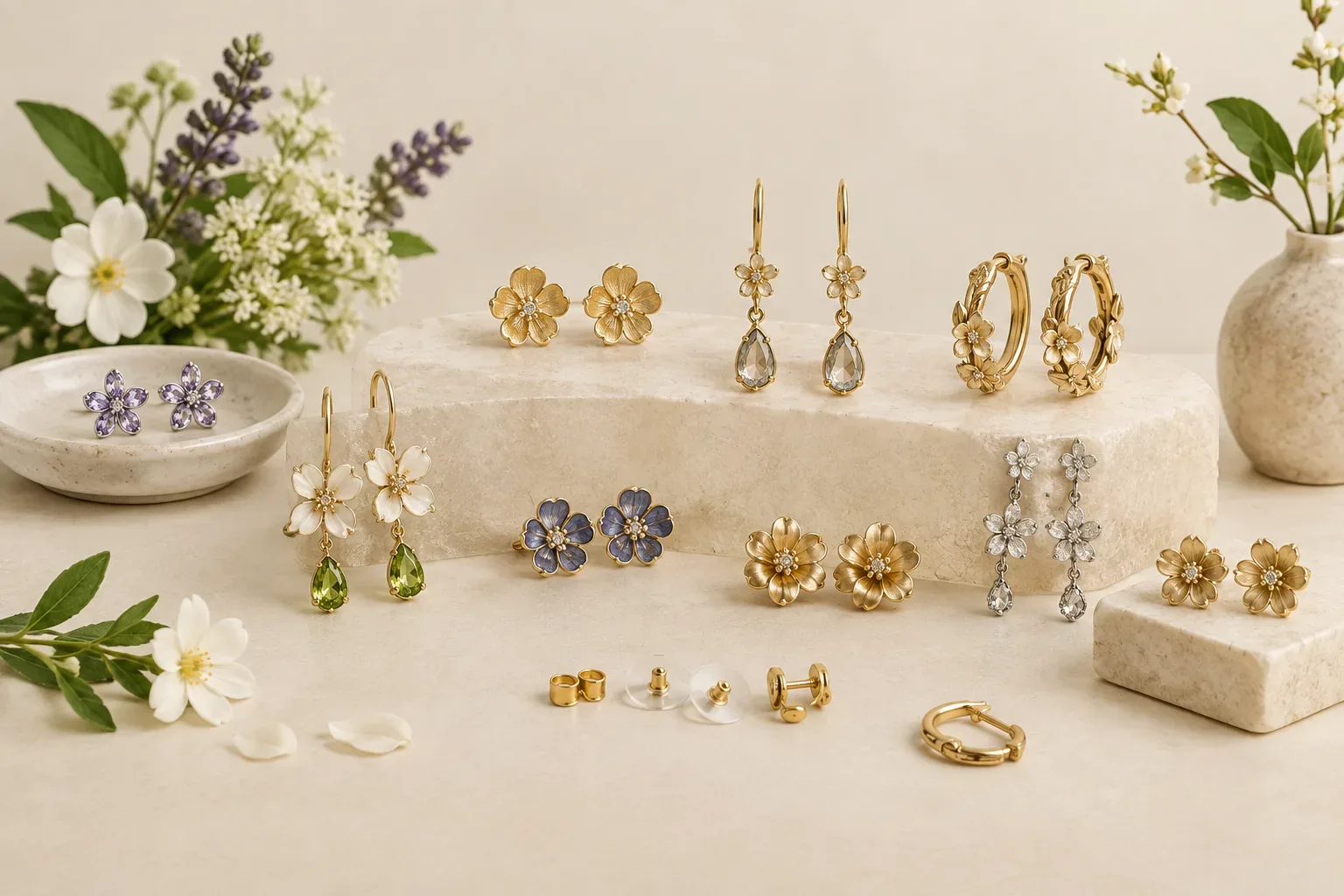
Compare studs, drops, hoops, motif scale, pair matching, weight, closures, metal disclosure, and care when choosing birth flower earrings.
Quick answer
This birth flower earrings guide: choose studs for everyday comfort and minimal motif scale, drops for motion and visual drama, and hoops when you want a floral accent integrated with a circular silhouette; consider motif scale against face and hairstyle, match pairs rather than force symmetry, check weight and closure for comfort and security, insist on clear metal and gemstone disclosure, and follow gentle cleaning and storage care to protect floral details and finishes.
What historical evidence says about flowers in jewelry
Flowers and floral imagery have appeared in personal ornament across many eras and places, but the specific meanings attached to individual flowers shift by period and culture. The Smithsonian’s bibliography and exhibition materials describe how human relationships with plants and seasonal flowers influenced decorative arts in Europe and North America, noting cycles of popularity and botanical interest rather than a single, immutable symbolism (Smithsonian Libraries and Archives).
Print culture in the 18th and 19th centuries promoted floriography, the practice of assigning particular meanings to specific flowers; the Library of Congress’s materials on flower meanings document how those Victorian and later lists circulated through books and popular media, and how different sources sometimes assigned different or even conflicting sentiments to the same bloom (Library of Congress).
Botanical institutions such as the Royal Horticultural Society provide necessary context for identifying plants and their seasonal habits, which in turn affected when certain floral designs were fashionable and what they evoked for wearers and gift-givers. The RHS material demonstrates how plant identification and seasonality shaped horticultural interest and thus the availability and depiction of certain flowers in decorative arts (Royal Horticultural Society).
Documented historical meanings versus modern personal interpretation
Documented historical meanings come from published sources and cultural practices recorded in a given time and place. For example, floristry and Victorian-era guides assigned specific sentiments to flowers, and these assignments are part of the historical record (Library of Congress). Such meanings are useful when you want to reference a period style or an historically informed sentiment.
Modern personal interpretation is different: people today commonly choose a birth flower motif because it connects to a birthday month, family memory, favorite color, or a contemporary aesthetic rather than because of a single historic dictionary of meanings. Contemporary usage often blends historical floriography with personal symbolism and fashion trends, so it is not accurate to present historical meanings as universal or fixed.
How floral motifs, gemstones, and traditions appear in jewelry
Jewelry makers translate flowers into metal, gem, enamel, and carving. Motifs can be literal representations with petal shapes and stamens or stylized suggestions that read as floral at a distance. Gemstones are used to suggest petals and centers, with colored gems or enamel indicating hue, and pale diamonds or pearls suggesting dewdrops or pollen.
Traditions such as birth-month flowers have been adapted by modern jewelers to create month-specific collections. Materials are chosen to reflect the flower’s color and perceived character; for example, a birth flower associated with blush pink may be rendered using rose-cut morganite or pink sapphire, while a white or cream bloom might be paired with pearls or small diamonds. The choice to use natural, lab-grown, or simulant stones is a material and ethical decision that should be disclosed to buyers (Federal Trade Commission).
Design choices also reflect how wearers plan to use the piece. Studs tend to present a compact, gemstone-forward approach, while drops allow longer stems or layered petals to move. Hoops can carry tiny floral charms or have petal-like metalwork along the outer curve, integrating the motif into a circular form favored for repeated wear.
Comparing styles: studs, drops, hoops, and motif scale
Studs work best when the goal is subtlety, durability, and an emphasis on a central stone or small metal flower. Because studs sit close to the earlobe, motif scale should be conservative so the earring reads as a single bloom rather than a dangling composition. Studs usually weigh less and are simpler to wear with many activities and headwear.
Drops (dangles) are the format that most easily communicates complexity and motion. A drop earring can show a flower as a single long-stem bloom, a chandelier of petals, or a staged composition where gemstones take the place of pollen and buds. Because drops swing, consider the weight and the balance between the top fitting and the suspended motif so the earring does not pull on the lobe.
Hoops offer a middle ground. Small or medium hoops with floral embellishment read as energetic but less formal than full drops, while larger hoops can carry multiple small flowers or a repeating petal motif. Hoop designs are good for those who like the circular silhouette but still want floral detailing.
Motif scale is as much about physical proportion as visual language. Larger floral motifs suit people who prefer a statement or who will wear their hair up, while smaller motifs are better for everyday wear and for those whose hair frequently covers the ears. Consider face shape and personal style: a compact motif on a small hoop or stud often looks balanced on smaller faces, while people with longer or larger facial proportions may prefer proportionally larger drops.
Pair matching, asymmetry, weight, and closures
Match pairs carefully. A well-matched pair should be consistent in size, color, and balance; small artisan variations can add charm but avoid clear mismatches in length or weight that will be obvious in wear. Designers sometimes offer intentionally mismatched pairs for a contemporary look, and if you or the recipient prefer that aesthetic, make the intentional asymmetry part of the choice rather than a surprise.
Weight matters for comfort. Heavier earrings, especially drops, can cause lobe stretching if worn often. Ask the seller for approximate weights and try on similar styles to judge comfort. If weight is a concern, lighter metals, hollow construction, or reduced gemstone carat can keep the motif visually strong while minimizing strain.
Closures affect security and ease. Butterfly backs or push backs are common for studs, and screw-backs add security for valuable stones. For drops and hoops, look for reliable lever-backs, latch-backs, or secure hinge systems. A closure that is easy for the owner to operate with their dexterity level will encourage regular wear.
Metal and gemstone disclosure, ethical considerations, and care
Insist on clear metal and gemstone disclosure. The Federal Trade Commission’s guidance explains the importance of distinguishing natural, lab-grown, and imitation gemstones and being transparent about metal karat, plating, or alloys. Request written confirmation when buying, particularly for higher-value pieces or gifts (Federal Trade Commission).
The Jewelers of America’s guidance on buying jewelry recommends asking sellers about construction, return policies, warranties, and resizing or repair services. Certified retailers and trade-association members are often better prepared to offer meaningful information about materials and care (Jewelers of America).
Care instructions will vary by materials. Gold and platinum survive everyday wear well but can show scratches on high-polish finishes; silver tarnishes and may require occasional polishing. Gemstones and delicate enamel require protection from hard knocks and abrasive cleaners. For floral motifs with filigree, open settings, or enamel, store pieces separately in soft pouches and avoid prolonged exposure to chemicals, heat, or direct sunlight that may affect color and adhesives.
Practical selection and gifting guidance
For a gift, start with how the recipient lives and what they already wear. If they regularly wear studs, choose a floral stud that echoes their metal tone and scale. If they favor statement earrings, a drop with deliberate motif scale will likely get more use. When uncertain, choose a mid-sized design in a metal they commonly wear and request a flexible return policy or gift receipt.
Personalize without over-claiming historical meaning. You can reference a documented Victorian or horticultural meaning as context if the recipient appreciates that history, but avoid suggesting a single, definitive symbolic statement. If you want to connect the piece to a birth month specifically, many contemporary collections and references identify birth flowers by month; pair the floral motif with a complementary gemstone or color for a thoughtful touch.
Ask the seller about maintenance and storage recommendations, and consider adding a simple care kit or a note about how to clean and protect the piece. If the recipient has metal allergies or sensitivities, prioritize hypoallergenic metals or plated items over base metals that may cause irritation. Finally, include a print or digital note that explains why you chose that specific floral motif—whether for family association, seasonal meaning, or aesthetic preference.
Summing up
A well-chosen floral earring balances style and practical concerns: studs for low-profile everyday wear, drops for expressive motion, and hoops for a modern floral accent. Consider motif scale against the wearer’s features and habits, prioritize comfort by checking weight and closures, insist on transparency about metals and stones, and follow manufacturer care instructions to keep floral details intact. Use historical meanings as context when useful, but center the choice on the wearer’s tastes and lifestyle.
Frequently asked questions
Are birth flower earrings appropriate for everyday wear?
Yes. Choose studs or small hoops for everyday comfort and lower weight. If the piece includes fragile enamel, large stones, or dangling elements, reserve it for occasions where it won’t be exposed to knocks or chemicals.
How can I ensure the earrings won’t irritate sensitive ears?
Look for hypoallergenic metals such as platinum, palladium, or higher-karat gold, and ask the seller about nickel content or plating layers. Test-wear inexpensive studs first or ask for a return policy if you are unsure.
Should I match the birth flower exactly to a gemstone color?
Matching is a matter of taste. Some people appreciate literal color matches using colored gemstones or enamel, while others prefer complementary tones. Make sure any gemstone is clearly disclosed as natural, lab-grown, or simulated.
How do I know if an earring is too heavy?
Ask the retailer for the earring’s weight and compare it to other pieces you know are comfortable. Heavier drops can pull the lobe over time, so if the wearer prefers light jewelry, choose hollow construction, smaller stones, or lighter metals.
What closures are best for floral drops?
Secure closures such as lever-backs or latch-backs are recommended for drops to prevent accidental loss. For expensive studs, consider screw-backs for additional security.
How should I clean and store floral earrings?
Clean according to the materials: use mild soap and water for most metals and gemstones, avoid ultrasonic cleaners for delicate enamel or unstable stones, and store pieces separately in soft pouches to protect fine details and prevent scratches.
Sources and further reading
- Blooming Flowers: A Seasonal History of Plants and People — Smithsonian Libraries and Archives
- Flowers and Their Meanings — Library of Congress
- Plants of the World — Royal Horticultural Society
- Buying Gemstones, Diamonds, and Pearls — Federal Trade Commission
- Jewelry Buying Guides — Jewelers of America