Meaning at a glance
This guide explains engraved, cast, enameled, and gemstone-accented birth flower rings with practical guidance on fit, surface wear, setting security, resizing limits, and clear material descriptions to help you choose and care for a meaningful floral ring.
What history tells us about flowers in jewelry
Flowers have been used as symbols and decorative motifs for centuries, but meanings have varied widely by time and place. The Smithsonian Libraries and Archives describes how relationships between people and plants changed across seasons and cultures, showing that floral imagery often held local or period-specific significance rather than a single universal meaning. The Library of Congress documents how floriography—the assignment of meanings to flowers—became part of printed culture and social language in specific periods and places, especially in 19th-century Western contexts.
Because symbolism shifted with era and audience, documented historical meanings should be cited to a time and culture when you use them. For example, Victorian-era printed guides gave particular meanings to flowers for letter-writing and personal exchange in Britain and the United States, a practice described by the Library of Congress. These historical associations are distinct from modern personal interpretations: someone today might choose a birth flower ring for family connection, seasonal preference, or aesthetic taste rather than for the precise meaning an older source assigned to that bloom.
How the birth-flower motif and tradition appear in rings
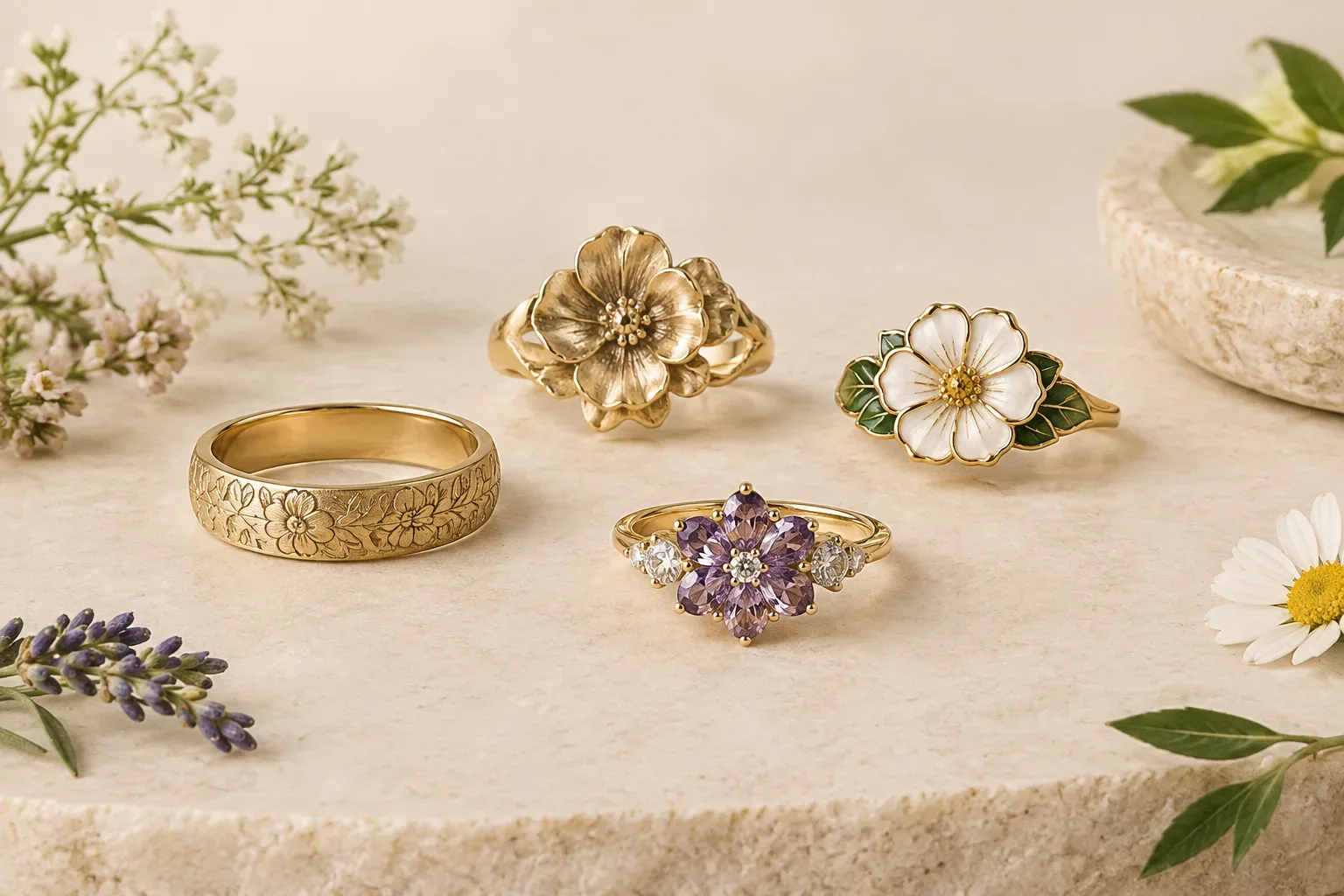
Jewelry makers translate floral motifs into rings in several common ways: engraving, casting, enameling, and by adding gemstones. Engraving is carving or etching a floral pattern into the metal surface; it can be shallow surface work for decoration or deeper relief for durability and shadow. Cast floral rings are produced from a model so the entire motif—petals, stems, and negative spaces—can be three-dimensional and continuous around the shank or concentrated on the head. Enamel adds color by fusing glass powder to the metal surface, creating vivid petals or background fields of color. Gemstone-accented floral rings use stones to form flower centers or petals, or to provide accent sparkle around a metal floral design.
These methods produce distinct looks and maintenance needs. Engraved rings read as subtle, tactile designs and show surface wear slowly; cast pieces allow fine sculptural detail but may make later resizing more complex if the floral pattern crosses the area that would be cut. Enamel produces color that engraving and casting alone cannot, but enamel is a separate material bond that can chip or craze if struck. Gemstones give optical life and symbolic color, but require secure settings—prong, bezel, or flush mounts—to protect the stones from being loosened or lost.
Materials, setting security, and what to ask a seller
When evaluating a birth flower ring, ask for clear material descriptions. The Federal Trade Commission requires sellers to disclose whether gemstones are natural, lab-grown, or imitations and to identify the metal and any plating. Ask about metal purity (for example, karat gold or sterling silver) and whether colored finishes are plating rather than solid color metal.
Setting security is critical for gemstone-accented pieces. Common setting types include prongs, which offer visibility but need periodic retipping; bezels, which surround a stone and offer strong protection; and flush settings, which keep stones level with the metal surface and reduce snagging. A reputable jeweler—one who follows industry repair and inspection best practices described by Jewelers of America—will check prongs and settings before sale and advise on maintenance schedules. For cast and highly detailed floral motifs, check for thin points, openwork, or undercuts where dirt can accumulate; these areas are also where metal can wear thinner over years of daily wear.
Fit, resizing, and design trade-offs
Correct fit matters for comfort and the ring’s structural health. Jewelers of America recommends getting professionally sized rather than guessing, because a ring that is too tight risks bending and a ring that is too loose risks loss. Engraved bands and plain shanks are easiest to resize. Cast rings and rings with continuous floral motifs around the band may be difficult or impossible to resize without disrupting the design. If resizing is likely in future, choose a design with a plain section on the shank where the jeweler can add or remove material.
Enamel and surface treatments affect resizing options. Enamel applied to the exterior of a shank can crack or detach if heat and work are applied during resizing; tell the jeweler about enameling so they can plan minimal heating and protect the work. Likewise, rings with pavé or many small stones across the band will take more careful work to resize without loosening stones. For gemstone-accented designs, ask whether the stones are set in locations that will be affected by any resizing or whether the jeweler can remove and reset stones as needed.
Surface wear and long-term care
Every ring surface wears with use; how quickly depends on metal, finish, and motif. High-polish areas and raised edges on engraved or cast flowers show wear first because they contact surfaces during daily tasks. Enamel retains color but is vulnerable at raised edges and in areas that take impact. Jewelers of America recommends regular inspection and cleaning; have prongs and settings checked annually or sooner if you notice movement or chips. For metal finishes, ask about maintenance: some finishes can be reapplied or gently re-polished, while heavier repair may require professional restoration.
For gemstone care, follow guidance on handling and cleaning appropriate to the stone type. Because the FTC requires accurate disclosure of treatments, ask whether stones have been stabilized or treated, and get cleaning instructions from the seller. For everyday wear, consider the ring’s wearer and activities: if they do manual labor, sports, or frequent handwashing, choose lower-profile settings, bezels, or engravings rather than high, fragile enamels or tall prongs.
Design and gifting guidance—practical and respectful
When selecting a birth flower ring as a gift, start by learning whether the recipient values historical symbolism, botanical accuracy, or simply likes the imagery. Recall that historical meanings are context-specific—an association from a Victorian printed floriography guide does not automatically apply across cultures. If the recipient treasures botanical correctness, use resources such as the Royal Horticultural Society to verify the flower’s appearance and seasonality before choosing a design that claims to represent a particular birth flower.
Be clear about personalization choices. If you want engraving of a name, date, or short message, check available space and whether the band’s profile supports legible engraving without compromising structural integrity. Consider sizing carefully: if you are unsure of exact size, choose a maker or seller who offers resizing or exchange within a stated policy. For heirloom intentions, select durable construction—solid precious metals, secure bezel or low-set stones, and minimal fragile enameling—so the piece survives regular use and future resizing if needed.
Buying checklist and red flags
Before purchase, confirm these points with the seller: a clear description of materials (metal type and gemstone origin or treatments), the setting type and any recommended maintenance, the seller’s resizing policy, and whether the piece has enamel or surface treatments needing special care. Prefer sellers who provide written information and offer inspection or repair services following trade best practices described by Jewelers of America.
Watch for these red flags: vague material descriptions, no policy on resizing or repairs, overly high-profile settings that are impractical for the recipient’s lifestyle, and enamel or surface treatments not described in writing. The FTC requires transparency about gemstones and treatments, so lack of disclosure is a reasonable cause to pause and request clarifying documentation.
Final notes on meaning versus modern interpretation
Historical sources show flowers carried meaning in specific contexts, but those meanings were never global constants. The Smithsonian and the Library of Congress document changing human-plant relationships and period-specific floriography. Today, people bring personal stories, family traditions, and contemporary aesthetics to a ring’s symbolism. Whether you select a birth flower ring for botanical accuracy, historical resonance, or purely for beauty, be explicit about which kind of meaning matters to you and the recipient so the piece communicates what you intend.
Frequently asked questions
Will an engraved birth flower ring shrink or expand with resizing?
Engraved bands are generally easier to resize than rings with continuous cast motifs; shallow or surface engraving can be preserved with careful work, but deep or continuous patterns around the shank may be disrupted. Always tell the jeweler about the engraving so they can plan minimal alteration or relocate the design.
Is enameled floral jewelry durable for everyday wear?
Enamel gives bright, long-lasting color but is a glass-like material that can chip or crack if struck. For everyday wear choose low-profile enameling, avoid high-impact activities, and have the piece checked if you notice hairline cracks or loss of color.
How often should I have gemstone settings inspected?
Follow industry best practices and have settings inspected at least annually or sooner if you feel movement, hear rattling, or notice exposed stone girdles; reputable jewelers can re-tip prongs or tighten bezels as needed.
What should I ask the seller about materials?
Request written disclosure of metal type and purity, whether gemstones are natural, lab-grown, or simulated, and any treatments the stones have undergone. The FTC requires such disclosure, and clear answers help with long-term care and valuation.
Can a cast floral ring be resized without changing the design?
Cast rings with a decorative motif that runs uninterrupted around the band are often difficult to resize without altering the design. If future resizing is likely, choose a design with a plain shank section or confirm whether the maker offers resizing or remaking services.
Sources and further reading
- Blooming Flowers: A Seasonal History of Plants and People — Smithsonian Libraries and Archives
- Flowers and Their Meanings — Library of Congress
- Plants of the World — Royal Horticultural Society
- Jewelry Buying Guides — Jewelers of America
- Jewelry Repair — Jewelers of America
- Buying Gemstones, Diamonds, and Pearls — Federal Trade Commission