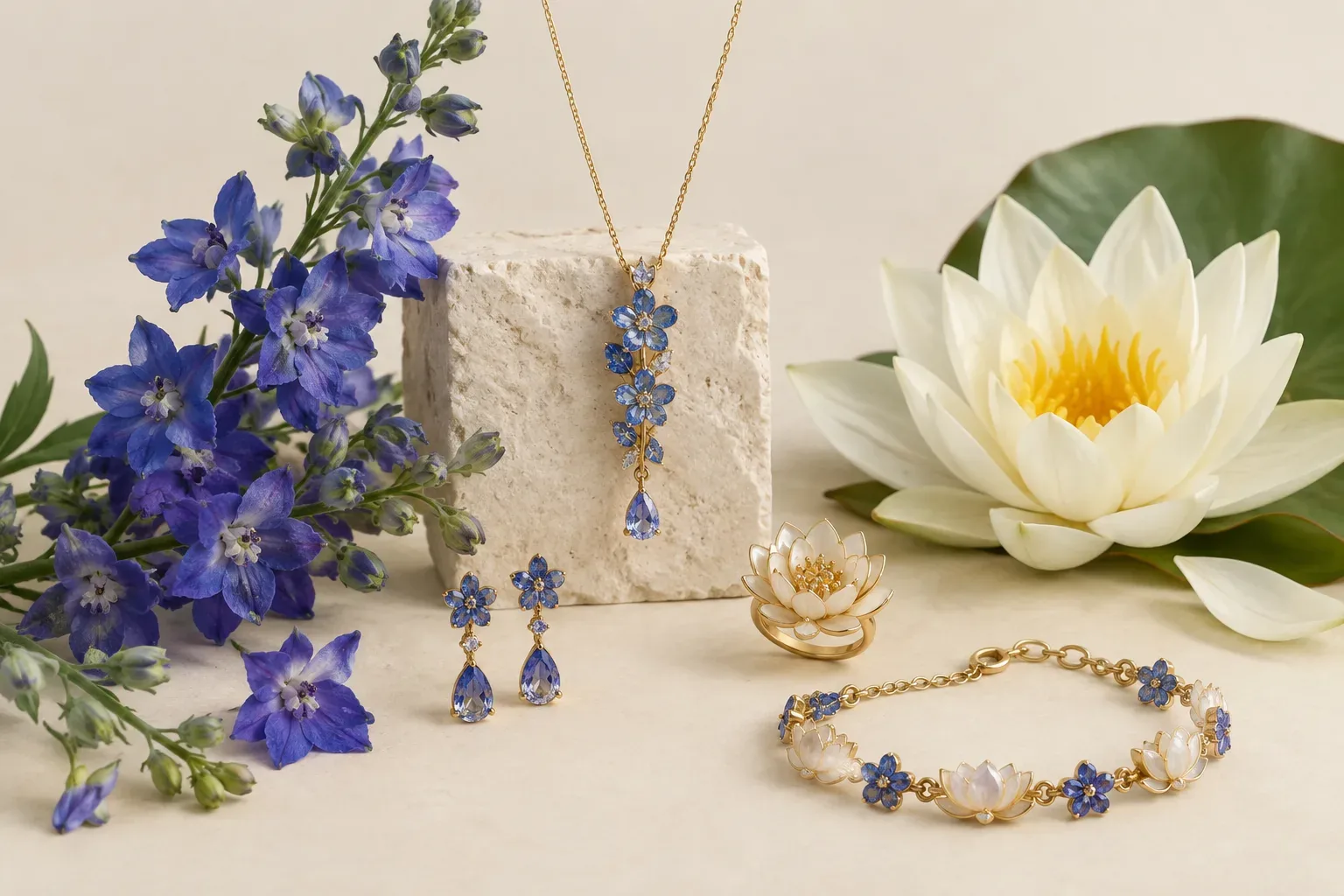
Meaning at a glance
The contemporary July pairing of larkspur and water lily pairs two botanically and culturally distinct plants; documented historical meanings for these flowers vary by time and place, and modern jewelry draws on their shapes, colors, and seasonal associations to create personal symbolism and wearable design choices.
Historical evidence and precise cultural contexts
Evidence for how societies have treated and written about flowers across seasons is best approached through specialized collections and horticultural literature. The Smithsonian Libraries and Archives frames floral histories within seasonal and cultural shifts in plant use and appreciation, which helps explain why certain flowers become attached to months or social meanings in different eras. The Smithsonian materials situate many floral associations within changing domestic gardens, trade, and print culture rather than as timeless, universal symbols.
The Library of Congress documents the emergence of floriography—an explicit language of flowers used in nineteenth-century print culture and social exchange—and shows how meanings could be assigned, published, and circulated. That body of evidence makes clear that some symbolic attributions, especially those widely quoted today, are products of particular periods and publishing contexts rather than ancient or worldwide beliefs.
Botanical and horticultural detail that matters for jewelry design—seasonality, species differences, and form—comes from horticultural authorities such as the Royal Horticultural Society. The RHS provides botanical identification and notes on the seasons when larkspurs and water lilies bloom, which is useful when choosing which species or visual traits a piece of jewelry should reflect. Taken together, these sources ground the July pairing in modern horticultural practice and nineteenth-century print culture rather than in a single continuous ancient tradition.
Documented historical meanings versus modern personal interpretations
Documented historical meanings are often specific to a time and a publication. The Library of Congress materials show that many floral 'meanings' became codified in nineteenth-century floriography manuals and popular print, which assigned virtues and sentiments to individual flowers in ways that were meant to be read in social contexts. When you trace a meaning for larkspur or water lily to nineteenth-century sources, attribute it to that print culture rather than to a universal botanical truth.
The Smithsonian's seasonal history materials emphasize that flower-month associations often reflect horticultural calendars and social fashion. For example, lists pairing particular flowers with months can change across countries and eras because gardeners and publishers reinvent seasonal symbolism for new audiences. The Royal Horticultural Society's botanical notes remind us that species differences matter: 'larkspur' is commonly used for Delphinium species with tall spires, and 'water lily' refers to water-loving Nymphaea species with very different forms and growing conditions.
Modern personal interpretations—what you feel when you see a water lily or a tower of larkspur—are valid and useful for selecting jewelry, but they are not the same thing as documented historical meanings. Contemporary designers and wearers often blend botanical accuracy, personal memory, and current design trends to form new symbolic associations. Make a clear distinction between historical claims you can cite to a source and the personal meanings you want the jewelry to carry.
How the motifs and traditions appear in jewelry
Larkspur in jewelry: The larkspur's defining characteristics—an upward spike of blossoms, slender stems, and lobed petals—translate well into vertical and linear jewelry motifs. Designers may render larkspur as a delicate vertical pendant with a graduated arrangement of small stones to suggest individual florets, or as repeated elements along a bracelet to evoke a row of stems. Enameling is commonly used to capture the often intense blues, purples, pinks, and whites of Delphinium flowers, and textured metalwork can suggest the feathery leaves and serrated edges that accompany the blooms. Where botanical accuracy matters, jewelers may reference Delphinium petal shapes; where a general 'spiky-summer' impression is sufficient, they simplify the form into stylized stalks.
Water lily in jewelry: Water lilies offer a contrasting set of visual cues: broad, rounded petals radiating from a central point and floating pads that read as calm and horizontal. Jewelry inspired by water lilies often emphasizes radial symmetry—a central gem set within petal-shaped metalwork or repeated petal outlines around a cabochon. Materials that suggest water and reflection—pearls, moonstone, aquamarine, and reflective metal finishes—are common choices. Enamel can reproduce the subtle gradations found in real water-lily petals, while openwork designs can allude to the airy, floating quality of the plant.
Combined motifs and mixed-media approaches: When larkspur and water lily appear together in a design—an unusual but modern pairing reflecting July's dual assignment—designers typically keep them visually distinct to preserve each plant's character. A necklace could pair a vertical larkspur drop with a separate, horizontally oriented water-lily charm so each reading remains clear. Alternatively, designers may create two-part sets (earrings and a pendant, for instance) where one piece takes its cue from the larkspur and the other from the water lily, allowing wearers to emphasize one meaning or the other.
Practical and respectful selection or gifting guidance
Make your choice with botanical and cultural clarity. If you want to honor a specific documented meaning from nineteenth-century floriography, check print-source attributions in historic collections such as the Library of Congress and state that provenance when gifting. If your intent is horticultural—celebrating a plant that blooms in July—verify bloom season and species with horticultural references like the Royal Horticultural Society so the floral claim is botanically accurate.
Be mindful of personal and cultural differences. Not every community recognizes the same flower meanings, and many widely circulated interpretations are products of Western print culture. When gifting across cultures or to someone whose background you do not know well, favor neutral language about seasonal beauty or personal feelings rather than asserting a single symbolic meaning as universal.
Choose materials with sustainability and wearability in mind. Water-lily motifs pair naturally with gems and metals that suggest water and light; choose durable settings and consider the recipient’s metal sensitivities. For larkspur pieces, vertical designs are elegant on long chains and can get caught on fabric, so consider how the recipient dresses and whether a lower-profile design or studied clasp would be preferable.
Respect living plants as well. If you pair jewelry with cut blooms or potted plants as part of a gift, be aware that some plant species may be toxic to pets or sensitive people. Using a durable, well-designed piece of jewelry to evoke a flower often communicates long-lasting regard more reliably than giving a fragile bouquet.
Putting meaning into practice
If you want a historically grounded gift, describe which source inspired the piece: for Victorian-era floriography meanings cite the Library of Congress context, and for seasonal garden associations cite horticultural calendars like those from the Royal Horticultural Society. If you prefer a contemporary, personal meaning, explain that the symbolism is your own and why it matters to you or the recipient.
Consider commissioning a two-piece set if the recipient likes choice: a larkspur pendant for vertical elegance and a water-lily brooch or ring for a reflective, aquatic counterpoint. When possible, support jewelers who work transparently about materials and who can show sketches that preserve botanical distinctions—this ensures the finished piece respects both plant form and the story you want it to tell.
Frequently asked questions
Why does July have two birth flowers?
July’s dual listing reflects modern practice rather than a single historical origin. Some contemporary lists pair a garden flower (larkspur/Delphinium) with an aquatic bloom (water lily/Nymphaea) to reflect different seasonal gardens and aesthetic traditions; the Library of Congress and the Smithsonian show that month-to-flower assignments have changed over time and across publishers.
Are the larkspur and the water lily associated with specific historic meanings?
Yes, but attributions vary by era and source. Many widely quoted 'meanings' for flowers come from nineteenth-century floriography and print culture, as documented by the Library of Congress. Horticultural authorities such as the Royal Horticultural Society provide botanical context but do not assign a single symbolic meaning to either plant.
What materials best evoke water lilies in jewelry?
Materials that suggest water and reflection—pearls, moonstone, aquamarine, and high-polish metals—are commonly used in contemporary water-lily designs. Enamel work can reproduce petal coloration and gradation; openwork can suggest floating pads.
How can I ensure a larkspur design is botanically respectful?
Ask the maker which Delphinium forms or petal shapes they used as references and request sketches. Designers who consult horticultural resources such as the Royal Horticultural Society are more likely to render distinctive vertical stems, lobed leaves, and floret clusters accurately.
Is it appropriate to gift flower-meaning jewelry across cultures?
Gifting is appropriate, but be cautious about ascribing universal meanings. Many floral meanings are products of specific historical print cultures. When in doubt, frame the gift as expressing your personal sentiment or as celebrating the recipient’s birth month rather than claiming a universal symbolic message.
Sources and further reading
- Blooming Flowers: A Seasonal History of Plants and People — Smithsonian Libraries and Archives
- Flowers and Their Meanings — Library of Congress
- Plants of the World — Royal Horticultural Society