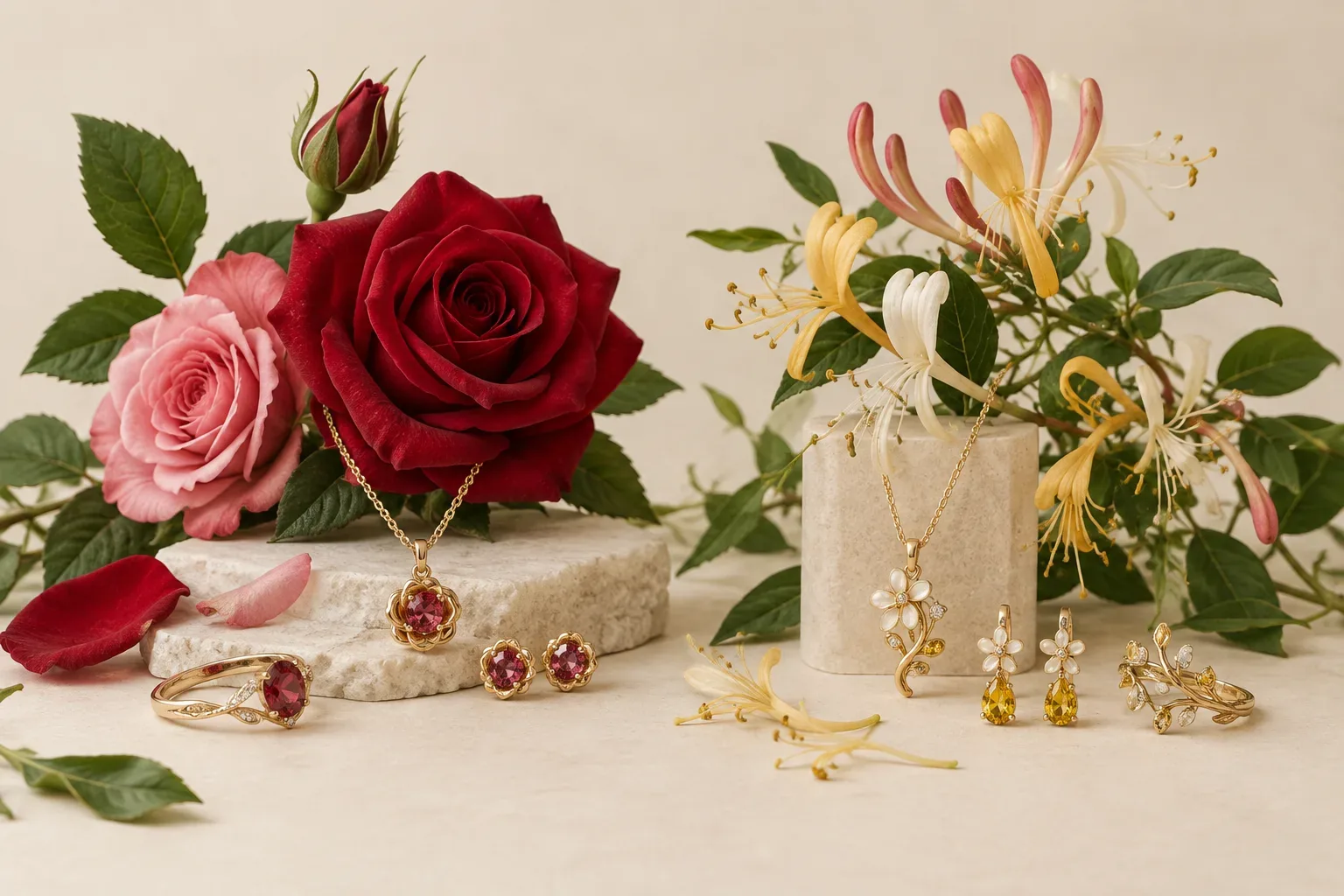
Meaning at a glance
The June birth-flower meaning recognizes two modern choices: the rose, whose symbolism is highly color-dependent and shaped by print-era floriography, and the honeysuckle, valued for its scent and associations of attachment; both appear widely as motifs in rings, pendants, and enamel or carved pieces, and choosing between them is best guided by the recipient’s tastes and cultural context.
How historians and cultural sources frame both flowers
Two different kinds of evidence shape our understanding of birth-flower meanings: long-standing seasonal and horticultural ties, and the print-era practice of assigning messages to flowers. The Smithsonian Libraries and Archives discusses how human relationships to plants change across seasons and cultures, which helps explain why multiple flowers have been paired with a single month at different times and places.
The Library of Congress documents the development of floriography in print and popular culture and notes that nineteenth- and early twentieth-century publications often assigned specific meanings to flowers and even to particular colors. Those print-era meanings were widely circulated and reused in jewelry and gifts, but the Library of Congress also emphasizes that meanings vary by period, place, and the author of a given “flower dictionary.”
Botanical context: what these plants are and when they bloom
Botanically the rose and the honeysuckle are unrelated plant groups with different growth habits and flowering patterns. The Royal Horticultural Society provides identification and seasonality context that helps explain why both plants are associated with late spring and early summer blooms in many temperate regions. Roses belong to the genus Rosa and include species and cultivated varieties that bloom in spring and through summer; their wide range of forms and colors made them obvious cultural symbols across many landscapes.
Honeysuckles belong to the genus Lonicera and encompass climbing vines as well as shrubs. Many honeysuckles flower in late spring and early summer and are notable for strong perfume-like scents that attract pollinators. That scent and their habit of twining toward other plants contributed to long-standing cultural associations of devotion and attachment.
Documented historical meanings versus modern personal interpretations
Documented historical meanings for flowers most often come from printed floriographies and horticultural writings. According to the Library of Congress, such printed sources gave readers an alphabetized shorthand for emotions and messages that could be conveyed with a bouquet or a single bloom. In this tradition, roses frequently carried messages tied to love, admiration, or purity depending on color, while honeysuckle entries commonly noted attachment or bonds of affection.
Modern personal interpretations, however, often depart from or expand these printed meanings. Contemporary wearers and gift-givers may select a rose simply because they favor its appearance or because a family member has roses in their garden. Honeysuckle jewelry might be chosen for its connotations of home, childhood summers, or scent memories rather than adherence to any single historical definition. It is important not to treat the printed flower language as universal; the Smithsonian and the Library of Congress both show that human-plant relationships and symbolic assignments shift over time and by culture.
How rose and honeysuckle motifs appear in jewelry
Roses are one of the most versatile floral motifs in jewelry. Designers render them as detailed metalwork roses in rings and brooches, stylized rose outlines in pendants, carved cameos, and micro-mosaic panels. Color plays a strong role: red roses are often echoed with red gemstones such as rubies or garnets, white roses with pearls or white opal, and pink roses with rose quartz or pink tourmaline. Many contemporary makers use enamel to capture petal colors and gradations, and rose forms appear in everything from minimalist charms to highly detailed statement pieces.
Honeysuckle appears differently because its character is rooted in scent and in the twining, elongated shape of its flowers. In jewelry this translates to graceful, sinuous lines: vine-like necklaces and pendants with narrow tubular blossoms, openwork rings that suggest twining stems, and small cluster earrings that mimic the flared ends of individual honeysuckle flowers. Designers also use yellow or creamy gemstones, or warm-toned enamel, to hint at common honeysuckle colors, and some pieces emphasize movement or scent-holding elements such as lockets that can carry tiny fragrance inserts.
Contemporary design choices tied to meaning and aesthetics
Because the rose’s symbolism is especially color-dependent, modern jewelry makers often encourage intentional color choices as part of the message. A red-stone rose pendant is commonly marketed with romantic connotations, while a white pearl rose might be framed as a gesture of admiration or purity. The Library of Congress’ materials on floriography help explain why color remains a legible shorthand for many buyers and designers, even when users interpret meanings personally.
Honeysuckle pieces tend toward themes of attachment, homesickness, or familial bonds in contemporary descriptions, and designers favor elongated forms and warm tones to evoke scent and embrace. The Royal Horticultural Society’s botanical descriptions of honeysuckle growth inform how jewelers translate those physical traits into wearable shapes—twining lines, clustered blossoms, and elements that suggest movement across the skin.
Practical and respectful selection and gifting guidance
Start by asking what the recipient values: color, scent memories, botanical accuracy, or simply appearance. If the recipient has expressed a favorite flower or color, honor that preference rather than assuming a single symbolic meaning. The Smithsonian’s overview of changing plant-human relationships encourages attention to personal and seasonal contexts, which means a June gift may be most meaningful if it reflects the recipient’s lived experiences of the month rather than a strict symbol list.
When a giver wants to emphasize a message, match the motif and materials to that message thoughtfully. Use color to reinforce intended meaning with the rose, remembering that printed floriographies provide one historical layer of meaning but not the only one. For a subtle message of dedication or closeness, honeysuckle motifs or vine-like designs can be appropriate without claiming universal symbolism.
Respect cultural differences and personal boundaries. Avoid asserting that a flower must mean the same thing across cultures or families; the Library of Congress stresses that printed dictionaries are only one source of meaning. For durability and daily wear choose metals and settings appropriate to the recipient’s lifestyle, check for allergies to metals, and consider low-profile settings for active wearers. For heirloom intentions, favor classic metals and stones and keep documentation about the piece’s symbolism and provenance for future recipients.
Final thoughts
June birth-flower meaning is usefully framed as a choice between two complementary traditions rather than a single answer. The rose offers a richly layered, color-sensitive vocabulary that has been shaped by print-era floriography and ongoing horticultural popularity, while the honeysuckle brings botanical clarity, fragrance-based associations, and graceful form.
Selecting rose or honeysuckle jewelry should balance historical references with personal significance. Use the rose when color and layered symbolism matter, and choose honeysuckle when you want to evoke connection, scent memories, or a subtler botanical motif. Either choice can be crafted into meaningful, wearable jewelry when chosen with attention to the recipient’s tastes and the cultural context of the gift.
Frequently asked questions
Why are there two June birth flowers?
Multiple cultural and commercial traditions have paired different flowers with months, and plant-human relationships change with region and time. The Smithsonian notes that seasonal histories and horticultural practices vary, which is why modern lists sometimes include both rose and honeysuckle for June.
What does a rose mean for June birthdays?
Historically, printed floriographies assigned meanings to roses that depended strongly on color; the Library of Congress documents this print-era practice. In modern use, a rose can signify romantic love, admiration, purity, or personal sentiment depending on color choice and cultural context.
What does honeysuckle symbolize?
Honeysuckle is commonly associated with attachment, devotion, and nostalgic scent memories. The Royal Horticultural Society’s botanical descriptions of honeysuckle growth and fragrance help explain why jewelers and givers link it to bonds and closeness rather than a wide spectrum of color-driven meanings.
Which should I choose for jewelry: rose or honeysuckle?
Choose the motif that best matches the recipient’s taste and the message you intend. Select a rose if color-specific symbolism matters, and choose honeysuckle if you want a motif that suggests closeness or fragrance memories. Always consider the recipient’s style, allergies, and the piece’s practicality for daily wear.
Can flower meanings be taken as universal?
No. The Library of Congress emphasizes that meanings in printed floriographies vary by period and source, and the Smithsonian shows that plant-people relationships shift across cultures. Treat flower meanings as historically informed options rather than universal facts.
Sources and further reading
- Blooming Flowers: A Seasonal History of Plants and People — Smithsonian Libraries and Archives
- Flowers and Their Meanings — Library of Congress
- Plants of the World — Royal Horticultural Society