Meaning at a glance
Assess vintage birthstone jewelry by inspecting condition, documented repairs, replacement stones and treatments, hallmarks and metal tests, setting integrity, seller descriptions and disclosures, and by obtaining professional appraisals when value, insurance, or repair decisions require it—avoid assigning age based on style alone and use written disclosures to establish provenance and treatment history.
What the historical record shows (and what it does not)
The idea of linking gems to months and personal milestones exists in many traditions, but documented, consistent lists and commercial practice are modern. The Gemological Institute of America provides the modern birthstone list and gemological context used by the jewelry trade today (Gemological Institute of America). That means when you see a 'birthstone' piece, the connection to historical belief is often a modern commercial or sentimental adoption rather than a single, continuous meaning across cultures.
Because documented meanings vary by place and time, it is incorrect to assume that a particular motif or stone always carried the same symbolic meaning historically. Treat historical associations as specific claims that require citation; in the context of buying, rely on what is documented for the piece (hallmarks, receipts, appraisals) rather than broad cultural assumptions.
Documented historical meanings versus modern personal interpretation
Documented meanings are those you can verify in paperwork, scientific reports, or authoritative lists. For example, the Gemological Institute of America publishes the modern list of birthstones and explains gemological properties that influence how they are used in jewelry (Gemological Institute of America). Modern attributions—such as a seller saying a gemstone was 'worn for protection by sailors'—may be true for a specific culture or story, but should be treated as interpretive unless the seller provides historical provenance.
Personal interpretation is common and legitimate for gifting and everyday wear: many people today choose a birthstone because of family tradition, color preference, or personal symbolism. Those modern meanings enrich the jewelry’s value for the wearer but are separate from historically documented uses.
How the motif, gemstone, or tradition typically appears in jewelry
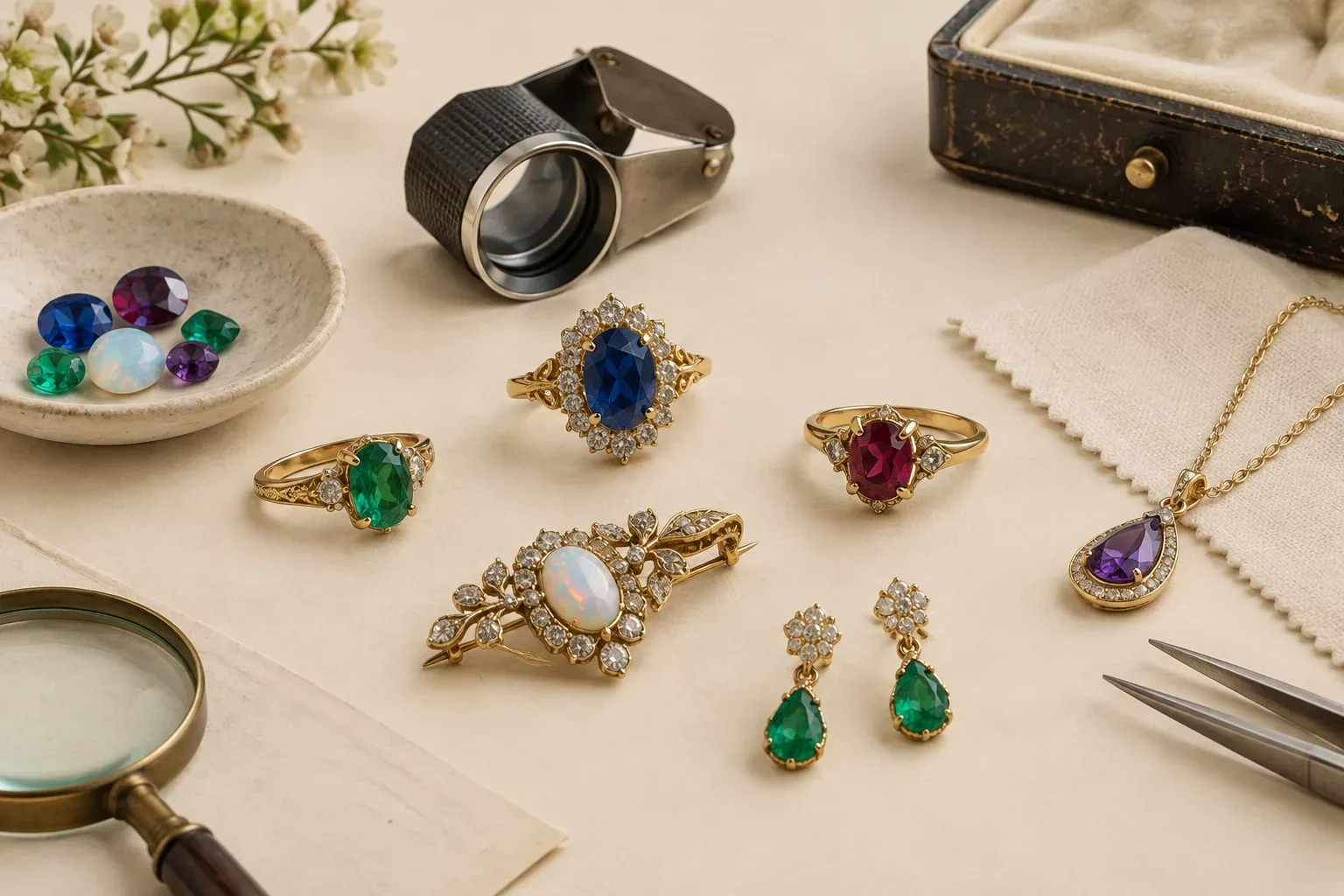
Birthstones appear across formats: single-stone solitaires in rings and pendants, small accent gems in cluster or halo settings, stones set into charm bracelets and lockets, and in mixed-metal pieces combining multiple month stones. The format affects condition risks: prong-set solitaires are susceptible to stone loss if prongs are worn, bezel settings provide good protection but can conceal chips, and pave or micro-pave settings require close inspection for loose accents.
Motifs—like hearts, flowers, initials, or birth-month labels—are applied to frame a birthstone in a piece. These motifs are design choices and do not reliably indicate a piece’s age. A modern maker can produce a piece in a historical style, and older pieces can be reshaped or repaired to follow current tastes, which is why physical evidence and documentation are primary dating tools.
Assessing condition: what to look for
Start with the stone: examine for chips, abrasions, surface wear, and signs of re-cutting under magnification. Look for movement in the setting and missing or replaced accent stones. Secure settings, intact prongs, and a clean girdle without fissures are positive signs for continued wearability.
Then inspect the metal: check for hallmarks or stamps that indicate metal type and maker, test for softness or distortion that suggests resizing, and look for solder lines or color differences that reveal repairs. The Jewelers of America’s repair guidance can help you assess whether a repair is reversible, stable, or requires further work (Jewelers of America).
Repairs and replacement stones: how they affect value and use
Repairs themselves are not automatically negative, but undisclosed or poor repairs can reduce value and increase risk. Ask for written descriptions of any work, and look for professional soldering, consistent metal color, and secure settings. Repaired prongs that retain heavy tool marks or inconsistent solder blobs indicate amateur work that may need correction.
Replacement stones are common. A replacement may be identical and of equal quality, or it may be a different material or quality. Obtain confirmation of origin and treatment status for replacement stones. If a stone has been replaced and the seller cannot document whether the new gem is natural, lab-grown, or an imitative material, treat the lack of disclosure as a negotiation point or a reason to seek a lab report.
Treatments, natural vs. lab-grown, and seller disclosures
Treatments (heat, fracture filling, diffusion, dyeing) are widely used in the jewelry trade and materially affect value and care. The Federal Trade Commission requires that sellers disclose treatments and whether a gem is natural, lab-grown, or an imitation in written form; you should ask sellers to put these details into the listing or a sale document (Federal Trade Commission).
If a seller lists a gemstone as a certain type without disclosure about treatments or origin, ask for a gemological report or a specific written statement. For valuable or rare stones, request lab reports from reputable labs. For less expensive pieces, clear written disclosure and a return policy reduce risk.
Hallmarks, settings, and why style alone cannot date a piece
Hallmarks, maker’s marks, assay marks, and documented receipts are solid clues to provenance and metal content. A clear hallmark with a recognizable maker or assay office can often be used as evidence for dating and metal verification, whereas the absence of a hallmark is not proof of age or inauthenticity; many makers did not hallmark consistently.
Settings and stylistic elements help form hypotheses but are unreliable as sole dating evidence. A contemporary jeweler may reproduce an antique setting, and older jewels are frequently re-set. Use hallmarks, documented provenance, and scientific testing rather than style alone to establish a piece’s age.
Seller descriptions and questions to ask before buying
Request written answers to these points: has the piece been repaired or resized; have any stones been replaced and, if so, what are their origins and treatments; is there any paperwork (receipts, prior appraisals, lab reports); are the metals hallmarked and can the seller provide photos of marks; and what is the return policy and warranty period.
Use the seller’s answers and documentation to make an objective judgment. Reputable sellers will disclose repairs, treatments, and replacement stones and will supply or allow independent testing. If a seller cannot or will not provide clear answers, treat the sale as higher risk.
When to get an appraisal and what type you need
Get a written appraisal when you need an insured value, a replacement value, or a professional opinion for resale. The Jewelers of America explains that appraisals should state purpose, market assumptions, and the credentials of the appraiser, and that an appraisal for insurance differs from a fair market valuation (Jewelers of America).
Choose an appraiser with recognized credentials and independence from the seller. For high-value stones or disputed origins, ask for a gemological laboratory report in addition to the appraisal. Keep in mind appraisals are opinions based on inspection and available documentation; pair them with disclosure and condition reports for the most reliable picture.
Practical and respectful selection and gifting guidance
Consider the recipient’s priorities: sentiment, durability, or investment potential. For everyday wearers, select durable settings such as bezels or low-profile prongs and choose stones with appropriate hardness and known treatment stability (Gemological Institute of America). For heirloom gifts, prioritize documented provenance and clear disclosure so future owners understand the piece’s history.
When gifting vintage pieces, be transparent about condition and any known repairs or replacements. Present any paperwork you have and explain care needs. If you commission work to refresh a vintage piece, discuss reversible options with a reputable jeweler, and obtain written confirmation of the planned changes so future owners can understand what is original.
Final checklist for buyers
Before you buy, verify metal content and hallmarks, inspect setting security and stone condition, confirm disclosure of treatments and replacement stones in writing, ask for any paperwork or lab reports, and obtain an independent appraisal when you need insured or market value. Avoid assigning an approximate age based solely on style; use marks and documentation instead.
If you follow this evidence-led approach, you can buy vintage birthstone jewelry with confidence—either as a sentimental gift or an addition to a collection—while respecting the distinction between documented history and personal meaning.
Frequently asked questions
How can I tell if a birthstone has been replaced?
Look for mismatched color or wear between the main stone and surrounding accents, different mounting styles, and signs of fresh solder near the setting. Request written confirmation from the seller and, for valuable stones, a lab report that identifies origin and treatments.
Are treatments like heat or dye always disclosed?
Sellers are required by the Federal Trade Commission to disclose material treatments and whether a stone is natural, lab-grown, or an imitation. Ask for written disclosure and consider independent testing if the information is missing or unclear.
Can I date a piece by its design or motif?
No. Style and motif alone are unreliable dating tools because styles are reproduced and pieces are often altered. Use hallmarks, maker’s marks, paperwork, and professional testing to establish age.
When should I get an independent appraisal?
Obtain an appraisal when you need insurance replacement value, plan to insure a gift, or are considering resale. Choose an independent appraiser with clear credentials and understand that appraisal purposes (insurance vs. market value) differ.
Is a repaired piece less wearable?
Not necessarily. Professional repairs can restore functionality and durability. Poorly done repairs or weak solder joints reduce wearability; ask about who performed the repair and inspect the work or have a jeweler examine it before purchase.
Should I avoid vintage birthstone jewelry because of treatments?
No. Many vintage and modern stones receive treatments that are stable and disclosed. Prioritize clear disclosure and a condition report; if treatments affect value or care, make sure you understand their implications before buying.
Sources and further reading
- Birthstones for Each Month — Gemological Institute of America
- Buying Gemstones, Diamonds, and Pearls — Federal Trade Commission
- Jewelry Buying Guides — Jewelers of America
- Guide to Jewelry Appraisals — Jewelers of America
- Jewelry Repair — Jewelers of America