Meaning at a glance
Jewelry in Viking-period graves provides evidence for dress, craft, contact, and burial practice, but grave goods do not offer a direct biography or simple map of belief.
What the archaeological record actually shows
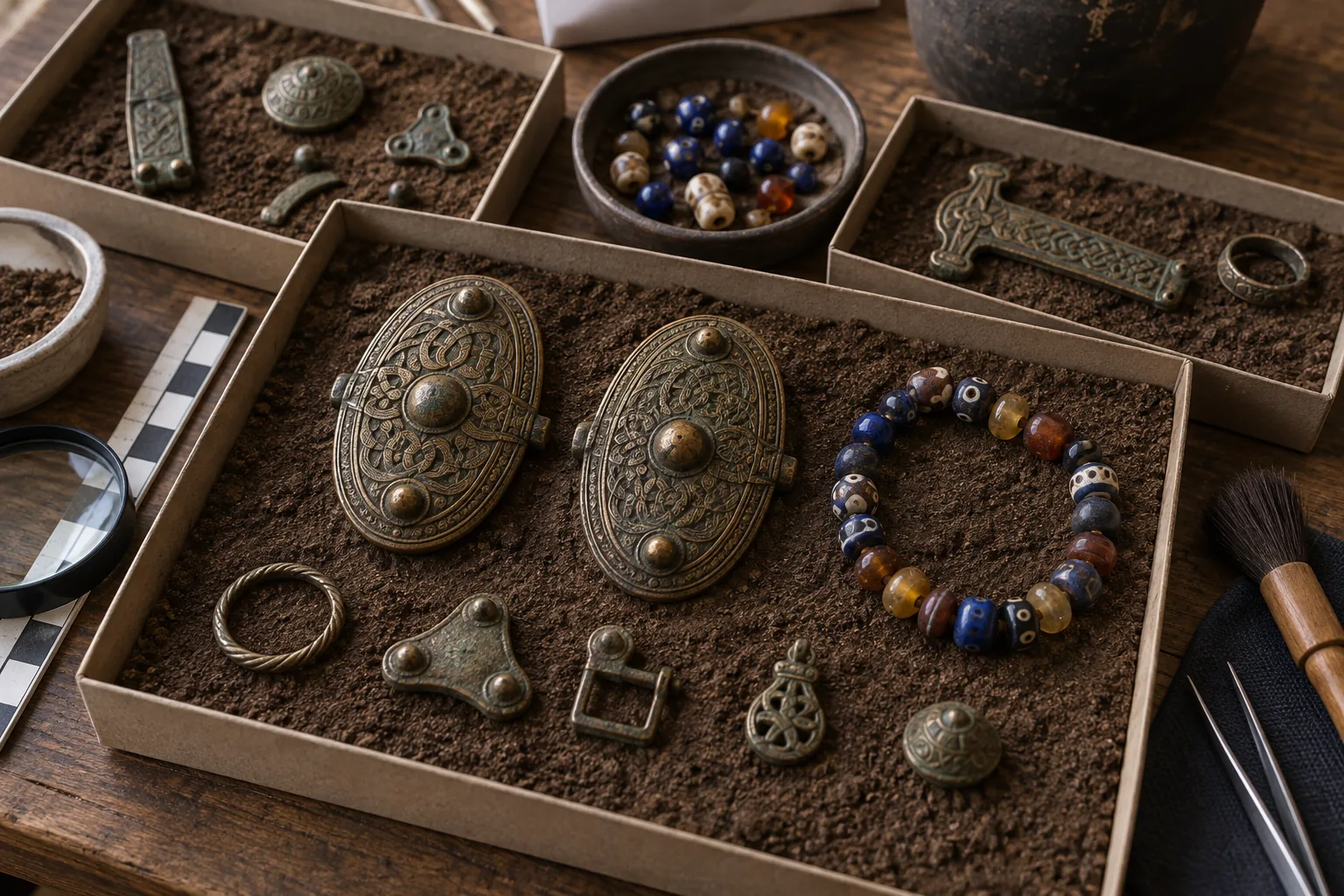
Archaeological finds from the Viking Age consistently provide tangible information about clothing, craft, and contact. For example, the British Museum’s collection and object records, including descriptions of oval brooches, document functional and decorative items placed in female burials that indicate how garments were fastened and arranged. The objects themselves—metal types, manufacturing marks, and wear patterns—are concrete evidence that lets researchers reconstruct dress practices and workshop skills.
Museums also use burial assemblages to map regional and long-distance contacts. The presence of foreign alloys, beads, or stylistic influences in grave jewelry points to exchange networks and cultural interaction. The British Museum’s interpretive materials and exhibits explain how typology and materials connect objects to broader trade and craft patterns rather than to a single interpretive story about the deceased.
At the same time, institutions such as the National Museum of Denmark emphasize caution when moving from objects to beliefs. The museum’s overview of religion, magic, death, and rituals in the Viking Age highlights the diversity of funerary practice across Scandinavia and warns against assuming that every grave with certain kinds of objects straightforwardly reflects a specific religious creed or a universally shared meaning.
What Viking grave jewelry can reliably tell us
Dress and gendered clothing practices: Certain jewelry types replicate fasteners and dress elements. Oval brooches, for instance, consistently appear in graves associated with specific female dress configurations in Scandinavian contexts, which allows curators and archaeologists to reconstruct aspects of how women dressed and wore their clothing in different regions. The physical placement of brooches and associated textile remains yield strong, material evidence about clothing systems.
Craft and technology: Jewelry in graves is primary evidence for techniques such as casting, filigree, and inlay, and for the use of materials like silver, bronze, glass, and various stones. The condition of manufacturing marks and the presence of unfinished pieces can reveal workshop practices and skill levels.
Trade and contact: Foreign materials or stylistic elements in grave jewelry are reliable indicators of exchange and contact. Beads, metal alloys, and motifs that trace to non-local sources show networks of commerce, gift exchange, or mobility.
Funerary practice and social display: The inclusion, arrangement, and quantity of jewelry in burials provide evidence for ritual choices about display and the social signals conveyed at death. Museums use these assemblages to discuss variations in burial treatment—such as richly furnished graves versus sparsely furnished ones—and what those differences may indicate about status or local custom.
What grave jewelry cannot tell us without caution
Inner belief and personal religion: Although some graves include objects that may have ritual associations, the presence of a particular pendant or symbol in a grave does not automatically reveal the deceased’s private beliefs. The National Museum of Denmark specifically notes the difficulty of equating grave goods with a single, uniform set of religious beliefs in the Viking Age. Interpretations that read objects as fixed statements of faith risk oversimplifying how people used symbols in different contexts.
Complete biography or identity: Jewelry does not provide a full life history. Age, social role, mobility, or personal tastes cannot be read from grave goods alone. Objects may reflect family traditions, social expectations, or the choices of the living who organized the burial rather than the preferences of the deceased.
Clear-cut symbolic meaning: Motifs that appear repeatedly do not necessarily bear the same meaning in every place or period. The same motif might be decorative in one context, a status marker in another, and a religious or protective sign in a third. Archaeological context, not just the motif itself, is decisive.
How motifs, gemstones, and traditions appear in Viking jewelry
Motifs: Viking-age motifs include animal interlace, geometric knotwork, and stylized zoomorphic designs. These appear on brooches, arm rings, and pendants as punched, cast, or chased decoration. Museums describe these stylistic elements as diagnostic of production centres, workshops, and periods when particular styles were popular, which helps archaeologists date finds and trace stylistic influence.
Gemstones and glass: Gemstones and glass beads commonly appear in grave assemblages as strings, insets, or settings. The material itself—whether amber, glass, or imported stone—speaks to resource access and exchange rather than conveying a single symbolic message. The presence of certain materials can indicate long-distance trade or the social value placed on a conspicuous material.
Traditions and production marks: Repeated technical features—such as soldering methods, thread patterns on wire, or the use of particular alloy recipes—make it possible to link objects to workshops or regions. Museums use these manufacturing signatures to explain craft traditions across the Viking world and to show how forms were adapted in different contexts.
How to select or gift Viking-inspired jewelry respectfully and well informed
When choosing jewelry inspired by Viking grave finds, start with an awareness of the difference between historical documentation and modern interpretation. If you value historical accuracy, seek designs that are based on archaeological types as presented by museums and specialist catalogues rather than mass-market inventions that mix unrelated motifs indiscriminately. The British Museum’s object records, for instance, can be a useful visual and descriptive reference for authentic forms such as oval brooches.
Consider material honesty: prefer pieces that clearly disclose materials and manufacturing methods. Reproductions crafted honestly in silver or bronze with traditional techniques are more respectful to the archaeological source than items made from cheap alloys that imitate a look without acknowledging craft.
Think about context and intention: if you are gifting Viking-inspired jewelry to commemorate heritage or interest in history, make that intention explicit. A respectful gift is presented with an explanation of what the object type actually represents archaeologically and what modern meanings you attach to it, rather than claiming a direct spiritual continuity where none is proven.
Avoid appropriating contemporary religious or cultural practices by assuming objects carry the same ritual power now as they might once have had. Museums such as the National Museum of Denmark remind readers that beliefs and rituals in the Viking Age were diverse and regionally specific; modern wearers should avoid asserting a single 'authentic' spiritual meaning for an item.
Finally, consider provenance and ethics: choose sellers who can document where a replica’s design comes from and who do not trade in illicitly obtained antiquities. Supporting ethically made reproductions and knowledgeable craftspersons helps sustain respectful engagement with the material past.
Closing perspective
Viking grave goods, including jewelry, are prime sources for reconstructing how people dressed, what materials they valued, and how burial customs varied across regions. The British Museum’s collections and interpretive work and the National Museum of Denmark’s writings on religion and ritual both stress the strengths and the limits of what graves can tell us. Respectful use of these objects in modern jewelry and gifting should recognize archaeological evidence as evidence—powerful but partial—and should avoid converting that evidence into simplistic claims about personal belief or identity.
Frequently asked questions
Do Viking grave goods prove Norse pagan religious beliefs?
No—grave goods provide material evidence about funerary practice and possible ritual elements, but they do not by themselves prove a uniform set of religious beliefs. The National Museum of Denmark cautions that funerary objects reflect diverse practices and that interpreting belief requires careful contextual and comparative study.
Can we tell a person's gender or status from the jewelry found in their grave?
Sometimes graves contain jewelry types that correlate with likely gendered dress practices or with indicators of wealth, but these are not definitive. The British Museum’s object records show patterns such as particular brooch types often appearing with certain clothing arrangements, yet social roles and burial choices could vary by region and over time.
Are modern Viking-style jewelry pieces historically accurate?
Some modern pieces are faithful reproductions based on museum documentation and archaeological types, while others are modern reinterpretations that mix motifs and materials. If historical accuracy matters to you, compare a piece to museum catalogues or object records such as those from the British Museum.
Do gemstones in Viking graves have symbolic meanings?
Gemstones and glass beads in graves indicate material value and contact networks, but assigning a single symbolic meaning to any stone across the Viking world is speculative. Materials like amber or imported stones more reliably signal trade and social value than a uniform symbolic code.
How can I respectfully gift Viking-inspired jewelry?
Choose ethically made or well-documented reproductions, disclose your reasons for the gift, and avoid asserting unproven spiritual claims. Prefer sellers who are transparent about design sources and materials and who do not traffic in looted antiquities.
Where can I learn more about the archaeological context of Viking jewelry?
Museum collections and interpretive resources are good starting points. The British Museum and the National Museum of Denmark both provide object records and explanatory material that distinguish material evidence from interpretive hypotheses.
Sources and further reading
- Viking oval brooch — The British Museum
- Vikings gallery activities — The British Museum
- The old religion — National Museum of Denmark