Meaning at a glance
Birthstone lists vary because they developed over centuries across cultures and were later standardized by trade groups and gemological bodies; use historical context, gem durability, and honest vendor disclosure to choose or gift thoughtfully.
Direct answer — why traditional vs modern birthstones lists differ
Birthstone lists differ because they grew in different places and times for different reasons. Some lists preserve older regional or religious customs; others are modern trade or gemological conventions created to serve markets and clarity. No single list is the one original, universal birthstone standard; as the Gemological Institute of America (GIA) explains, lists and associations changed over the ages and between regions, and modern month-by-month lists reflect later standardization rather than ancient unanimity.
Historical evidence and where it comes from
Documented evidence for birthstone traditions comes from varied sources and must be read in context. The Gemological Institute of America (GIA) presents examples showing that what people considered “birthstones” has shifted over time and across cultures. Some ancient and medieval sources linked specific gems to religious stones, talismans, or calendar systems in particular communities, while other periods emphasized different gems because of trade availability, religious symbolism, or court fashions. These were not single global edicts but local practices tied to place, language, and belief.
When historians and museums trace this background, they point out changes rather than continuity. The GIA museum materials illustrate that lists used in Europe, South Asia, and the Near East have differed and that modern monthly lists—now familiar in many Western contexts—are the result of later standardizing choices made by jewelers, trade groups, and consumer organizations. Because the underlying records are fragmentary and region-specific, scholars prefer to describe where a tradition was practiced and when, rather than assume it applied everywhere.
Documented historical meanings versus modern personal interpretations
What is documented historically is the existence of different lists, specific community usages, and recorded beliefs tied to certain gemstones. The GIA's historical work documents those changing associations and emphasizes that earlier lists were not identical to the modern monthly charts many buyers know today.
By contrast, modern personal interpretations—that a stone will bring luck, health, or personality traits—are contemporary meanings individuals or communities assign. These modern meanings are valid as personal or cultural expression, but they are not the same as documented historical fact unless explicitly tied to an identified source. In practice, you can respect both kinds of meaning: keep historical claims attributed and precise, and treat personal or family symbolism as subjective and meaningful for the wearer.
How birthstones and motifs appear in jewelry today
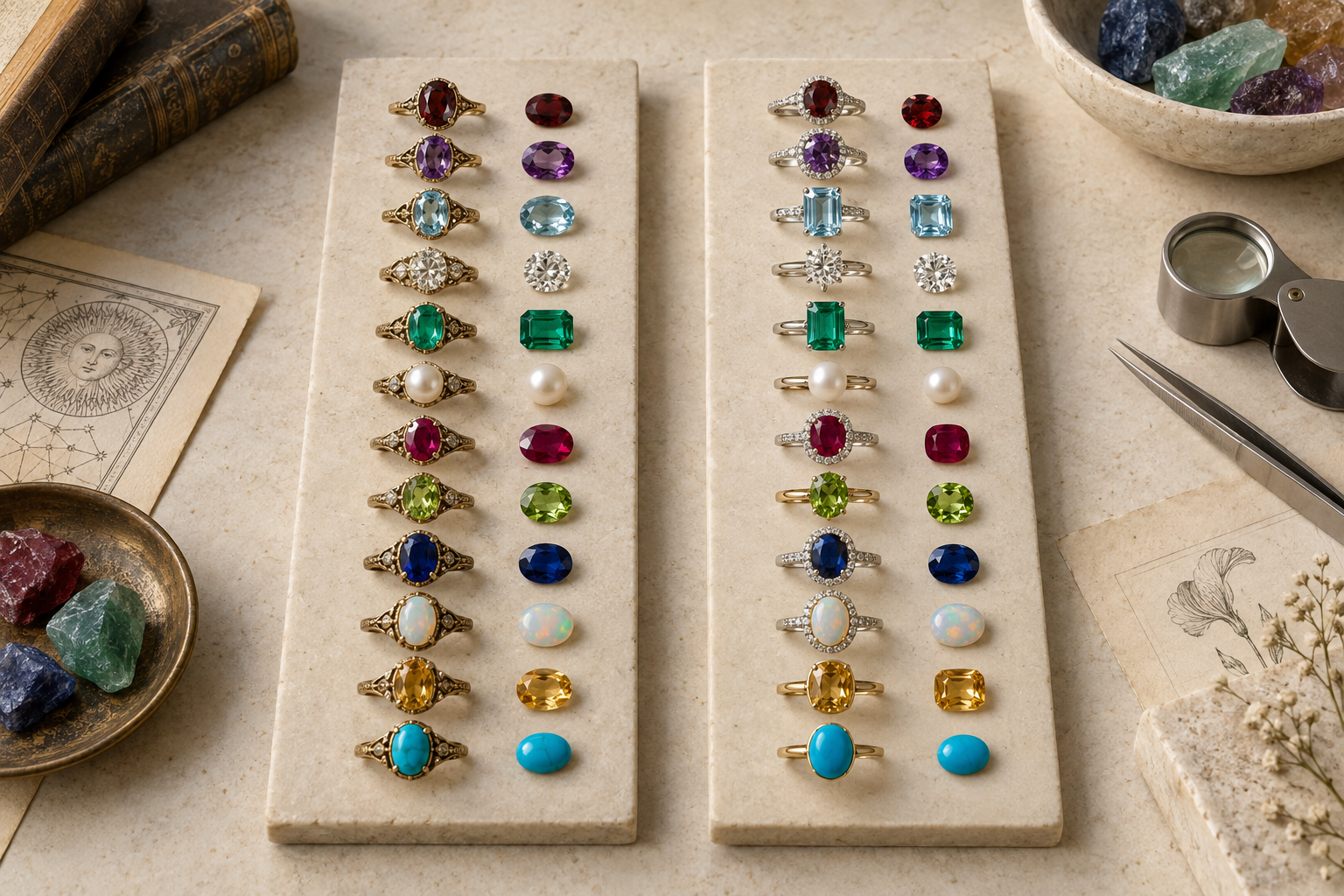
In contemporary jewelry, birthstones appear in a wide range of formats and motifs. Jewelers commonly set a single marked stone in rings, pendants, bracelets, and stud or drop earrings; cluster settings and multi-stone pieces that show several months together are also popular for family or commemorative pieces. The Jewelers of America notes the importance of format and setting when choosing a gemstone because the metal, setting type, and design affect durability and everyday wear.
Design motifs often reflect the sentiment attached to a birthstone. For example, a single stone in a bezel or prong setting is a clear, minimalist statement; engraved or enamel accents can add a personalized emblem; and multi-stone pieces—such as a bar pendant with several small stones—make it easy to show multiple family birthdays. Practical considerations from a jewelry-making and buying perspective matter: harder stones like sapphires and diamonds withstand daily wear in rings better than softer stones, and settings such as bezels protect edges and corners more than exposed prongs.
Practical, respectful guidance for selecting or gifting a birthstone
Start with the purpose: is the gift meant to follow a particular list, honor a heritage, match a favorite color, or carry a personal meaning? Any of these are fine; clarity about intent helps you choose. If you want to reference a “traditional” list, check a reputable source such as the Gemological Institute of America to understand which tradition you are following and where it originates. If your intent is sentimental rather than historical, choose the stone that best represents the recipient’s story.
Consider durability and lifestyle. The Jewelers of America highlights how gem hardness, toughness, and setting type affect long-term wear. For everyday rings, prefer harder stones or protective settings. For occasional-wear pendants and earrings, you can select more delicate gems with appropriate care.
Ask questions about treatments, origin, and certification. The Federal Trade Commission (FTC) warns consumers to look for truthful disclosure about treatments, whether gems are lab-grown or natural, and about trade names and imitations. Reputable sellers should disclose whether a stone has been heat-treated, dyed, fracture-filled, or is lab-grown, and should not misrepresent simulants as real gemstones. If provenance or untreated status matters to you, request written details or a laboratory report.
Set a realistic budget and be explicit about it. Jewelers of America suggests discussing ring size, metal choice, and setting complexity early with the seller to avoid surprises. If you are replacing or adding multiple stones for a family piece, plan for matching cut, color, and size so the finished piece feels cohesive.
Respect cultural context. If the birthstone tradition you wish to follow is tied to a specific culture, learn about its origins and whether certain stones or colors carry other meanings in that context. A respectful approach is to ask family members or the recipient whether they prefer a particular tradition or aesthetic.
Personalize thoughtfully. Engraving a name, date, or brief message can make a birthstone gift more meaningful than strictly following a list. Personalization often matters more to recipients than strict adherence to one list.
Choosing between traditional lists and modern lists: a quick checklist
Decide whether historical authenticity, modern conventions, or personal symbolism is most important for this gift or purchase. Use the GIA’s resources to verify which tradition corresponds to the “traditional” list you have in mind. Balance the desired stone against durability and budget, and use the FTC’s guidance to confirm full disclosure regarding treatments and lab-grown status. When in doubt, ask a reputable jeweler for written information on the stone and setting.
Conclusion — open questions and a respectful approach
Different lists exist because birthstone traditions were never a single global system: they evolved in particular places, for particular communities, and later were adapted by trade groups and gemological authorities to create the modern lists familiar to many buyers today. The best approach when choosing or gifting is to be intentional—decide whether the choice is historical, conventional, aesthetic, or sentimental—and then use reliable sources and transparent vendors to match that intent.
Frequently asked questions
Why are there different “traditional” and “modern” birthstone lists?
Different lists reflect different origins: historical or regional practices, religious uses, and later trade or gemological standardization. The Gemological Institute of America documents that associations changed over time and by place, while modern lists were compiled later for trade clarity.
Is one list the correct or original list?
No single list is universally original. Historical evidence shows multiple, region-specific traditions, and modern month-by-month lists are standardizations produced for convenience and commerce rather than a single ancient decree.
Should I worry about gemstone treatments or lab-grown gems when buying a birthstone?
Yes. The Federal Trade Commission advises buyers to ask sellers about treatments, whether a gem is lab-grown, and whether any simulants are being used. Reputable sellers should disclose this information in writing if requested.
Which setting is best for a birthstone ring worn every day?
For everyday wear choose durable stones or protective settings. The Jewelers of America notes that harder gems and protective settings—such as bezels—reduce damage risk. Softer stones can be used in pendants or earrings where they are less exposed.
How can I honor cultural traditions respectfully when selecting a birthstone?
Learn which tradition you are referencing and check reputable sources to understand its origin. Ask family or community members about preferred practices, and be transparent about whether you follow a historical list or a modern convention.
Sources and further reading
- Birthstones — Gemological Institute of America
- Birthstones: Gems Through the Ages — Gemological Institute of America
- Buying Gemstones, Diamonds, and Pearls — Federal Trade Commission
- Jewelry Guides — Federal Trade Commission
- Jewelry Buying Guides — Jewelers of America