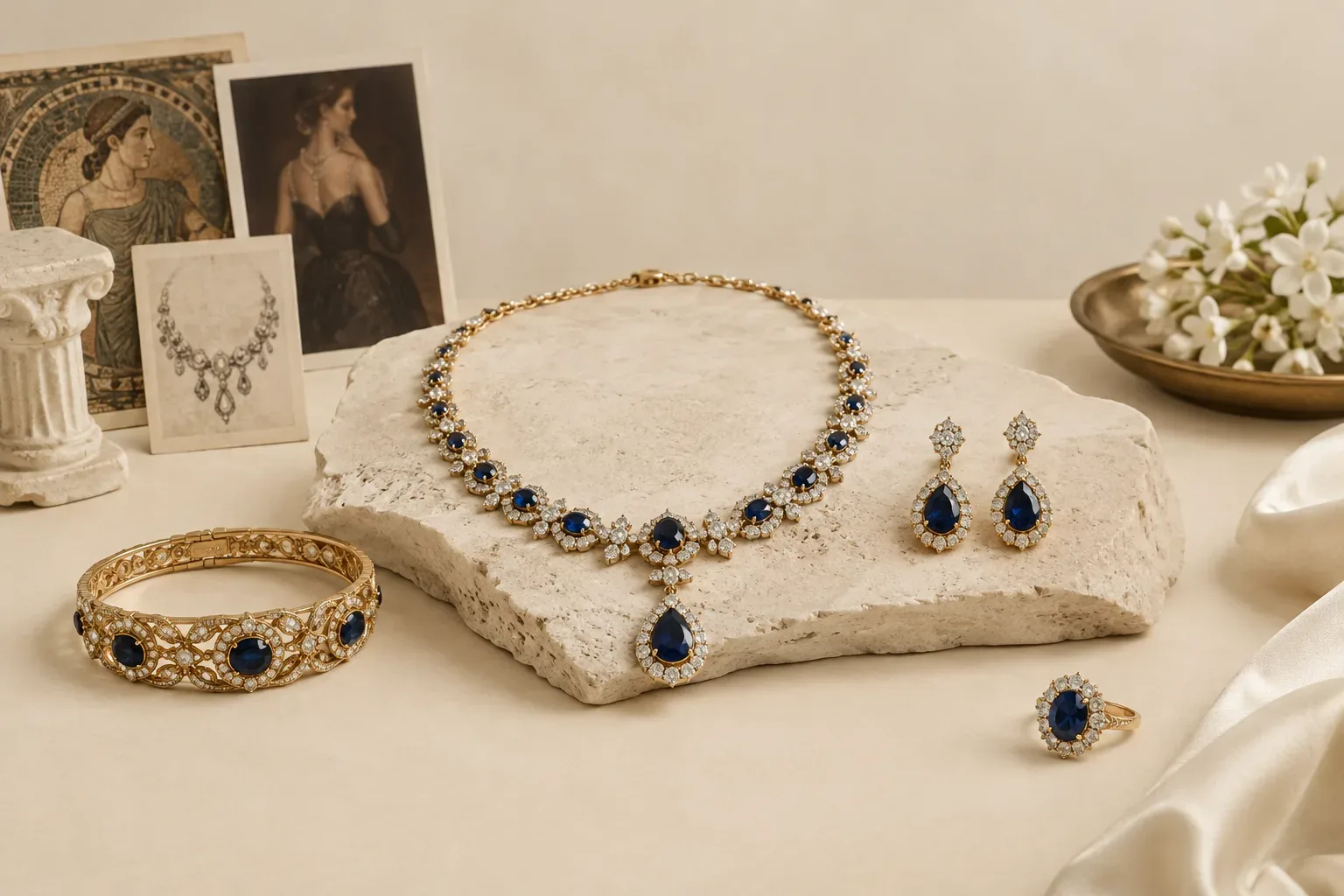
Meaning at a glance
Explain the documented history and changing contexts of jewelry for evening outfits, separate cultural or religious evidence from later popular interpretations, and give practical guidance for choosing proportion, color, and focal pieces in modern jewelry.
What the historical record shows
Museums and curatorial research describe how jewellery has changed in form and social meaning as dress and occasions evolved. The Victoria and Albert Museum (V&A) notes that jewellery’s role and styles shifted with changing social contexts, from display of social rank and family ties to fashion statements and evening dressing conventions. The V&A’s historical overview shows that different periods and cultures used jewellery in distinct ways—Victorian sentimental pieces contrasted with the pared geometry of 1920s Art Deco, for example—reflecting each era’s tastes rather than a single universal code.
Gemstones and techniques have their own historical trajectories. The V&A’s A–Z of Gemstones discusses how particular stones, such as pearls, diamonds, sapphires and colored gems, appear repeatedly in dress and ceremonial jewellery but acquire different meanings and uses in different places and times. That museum material is useful for understanding documented practice: which stones were prized by which cultures, and how gem cutting, setting and metalwork evolved alongside fashions for evening dress.
Documented meanings versus modern personal interpretation
Documented historical meaning: museum records and object catalogues show what jewellery was used for and how it was presented. For example, curators at the V&A record changes in function—mourning jewellery, court dress pieces, and theatrical costume jewellery each served specific social purposes. These are historical facts about how objects were used and displayed.
Modern personal interpretation: today many people wear jewellery for emotional or stylistic reasons that differ from historical uses. A gemstone worn as a “lucky” stone, a family heirloom used to complete an evening look, or a pendant chosen for a fashion trend are contemporary meanings that may not match an object’s original cultural significance. Treat such personal meanings as subjective and context-dependent rather than universal.
How motifs, gemstones, and traditions appear in evening jewellery
Motifs: Evening jewellery often favors motifs that read clearly at a distance and under artificial light. Geometric shapes, stylized florals, and line-based motifs (for example, fringe or graduated drops) are common because they create movement and silhouette. Museums like the V&A document how different motifs were fashionable in specific periods—lace-like filigree in one era, stark geometry in another—and these motifs still appear in modern evening pieces.
Gemstones: Gemstone use in evening jewellery follows both optical and cultural patterns. Pearls and diamonds have long been associated with formal wear because of their reflective qualities and historic status; colored gemstones such as sapphires, emeralds, and rubies are chosen for saturated color and contrast. The V&A’s A–Z of Gemstones explains how cut, polish and mounting affect a stone’s appearance and therefore its suitability for different settings, including evening lighting.
Traditions and techniques: Traditions such as wearing a single statement necklace, coordinated earring-and-necklace sets, or multiple bracelets at formal events trace back to historic practices of coordinated dress. Curatorial sources show these traditions changed with social customs and technological advances in gem cutting and metalwork, which in turn shaped what was practical and stylish for evening wear.
Choosing proportion for evening outfits
Consider the garment’s neckline and silhouette first. A high neckline or heavily embellished bodice usually pairs best with earrings and a bracelet or a small pendant; an open or simple neckline can sustain a larger necklace. Aim for balance: large necklaces need simpler earrings, and dramatic drop earrings require a calmer neckline treatment. Think in relative terms rather than fixed rules—‘proportion’ means the jewellery should complement the wearer’s body and the dress, not overwhelm them.
Scale earrings and bracelets to the wearer’s frame. Long, sculptural earrings can lengthen the neck and suit updos common at evening events. For wristwear, a single broad cuff reads as more evening-appropriate than multiple heavy bangles that can clash with formal sleeves. Keep movement in mind: dangling elements catch light and animate an outfit under evening lighting.
Using color effectively
Decide whether you want contrast or harmony. A jewel-tone stone like sapphire or emerald can contrast with a black or neutral dress to create a focal point, while monochrome metals and lighter gemstones can harmonize with pastel or metallic fabrics. Colour choices should also account for skin tone and makeup; evening lighting flattens some colors, so pick stones and metals that retain presence under artificial light.
Match metal to the outfit’s trim and to other jewellery. Gold tends to warm an outfit; white metals (platinum, white gold, silver) read cooler. Mixed-metal looks are acceptable if executed deliberately—anchor the look with a dominant metal and let smaller pieces echo it for cohesion.
Creating a clear focal point
Select one focal piece—typically a necklace, pair of statement earrings, or a brooch—and let other pieces play a supporting role. A single focal point prevents a busy or cluttered look and draws attention where you want it. If a gown has dramatic detail near the shoulder or waist, place the focal jewellery in balance with that detail rather than directly on top of it.
For groupings and layering, choose repetition and rhythm rather than contrast. If layering necklaces, keep the lengths graduated and the widths complementary so the ensemble reads as intentional layers rather than clutter.
Practical buying and gifting guidance
When buying gemstones or finished jewellery, ask about treatments and disclosures. The Federal Trade Commission advises that sellers disclose common treatments, synthetics and imitations. For expensive purchases, request written information about care and any certifications. This is especially important for stones that may appear visually similar but differ widely in price and durability.
Consider the recipient’s lifestyle and sensitivities when gifting. Ask about metal allergies, daily activities that could damage delicate pieces, and personal style preferences. For evening-oriented pieces, choose items that can be worn for multiple kinds of events rather than hyper-specific costume pieces unless you know the recipient favors that style.
Include care guidance with the gift. Evening jewellery often requires specific storage and occasional professional cleaning. A note about safe cleaning and recommended maintenance helps the recipient keep the piece in good condition and preserves any historical or sentimental value it may acquire.
Respectful cultural considerations
Do not assume a symbol, gemstone or motif has the same meaning across cultures. Museums like the V&A record cultural specificity: the same object form can carry distinct meanings in different societies and periods. If you choose jewellery with cultural or religious symbols, research or ask about their contemporary significance to avoid unintentional offense.
If you are unsure, opt for design elements that are broadly aesthetic rather than explicitly symbolic, or ask the recipient if they welcome a piece with cultural resonance. When in doubt, a well-made, classic piece that emphasizes proportion, color and focus will usually be an appropriate evening choice.
Care and presentation for evening wear
Prepare jewellery before the event: check clasps and settings, polish metals, and store pieces to avoid tangles. Under evening lighting, small surface smudges and loose stones are more noticeable; a quick pre-event inspection reduces risk.
Transport and pack evening jewellery safely. Use individual pouches or compartments to avoid abrasion between pieces. For travel, keep an inventory and any certification documents separate from the jewellery itself in case of loss or insurance needs.
Final note
Choosing jewellery for evening outfits is a craft of balance: respect the garment’s lines and embellishments, use color to support the wearer’s look, and create a single clear focal point. Historical records, as summarized by museum collections and gemstone guides, show that these concerns are longstanding, even as styles and meanings shift over time. Apply historical understanding respectfully, prioritize the wearer’s preferences, and follow disclosure and care guidance when buying or gifting high-value pieces.
Frequently asked questions
How do I choose the right necklace length for an evening dress?
Match the necklace to the dress neckline and the desired focal area: short collars and chokers suit high necklines and strapless styles, while longer pendants work with deep V or scoop necklines. Keep scale in mind so the necklace does not compete with dress embellishments.
Are pearls appropriate for evening wear?
Yes; pearls have a long history in formal and evening jewellery and read well under evening lighting. Consider the pearl’s size and luster relative to the outfit and choose simple settings if the dress is heavily detailed.
Can I mix different metal colors in an evening look?
You can mix metals if done intentionally. Anchor the ensemble with one dominant metal and use small accents of the other to create cohesion. Avoid too many contrasting pieces that could make the look feel disjointed.
How do I check if a gemstone has been treated or is synthetic?
Ask the seller for written disclosure and any certification. The Federal Trade Commission recommends consumers request information about treatments, enhancements, or synthetic stones when making a purchase. For high-value items, seek an independent appraisal.
What should I consider when gifting evening jewellery?
Consider the recipient’s style, any metal allergies, and their typical wardrobe. Choose versatile pieces that can be worn to multiple events unless you know the recipient prefers bold, unique costume pieces. Include care instructions and purchase documentation.
How should I care for delicate evening pieces before and after an event?
Inspect clasps and settings before wearing, polish gently, and store pieces individually to prevent abrasion. For pearls and softer gemstones, avoid harsh chemicals and seek professional cleaning when needed.
Sources and further reading
- Bedazzled: A History of Jewellery — Victoria and Albert Museum
- An A-Z of Gemstones — Victoria and Albert Museum
- Buying Gemstones, Diamonds, and Pearls — Federal Trade Commission