Meaning at a glance
This guide explains documented historical uses and changing social contexts of jewelry, separates museum-documented meanings from modern personal interpretations, shows how common motifs and gemstones appear in wedding-appropriate pieces, and gives practical, respectful advice on choosing or gifting jewelry for wedding guests.
Why a historically informed approach matters
Jewelry choices at weddings carry both aesthetic and social signals. The Victoria and Albert Museum frames jewellery as an object whose meanings and uses change over time and across cultures: dress and adornment have been used to show status, commemorate relationships, mark rites of passage, and express fashion since ancient times. Understanding these shifting contexts helps a guest make choices that look intentional rather than accidental.
Documented historical evidence: cultures and periods
The Victoria and Albert Museum documents jewelry from a broad sweep of times and places, including ancient Egypt, classical Greece and Rome, medieval and Renaissance Europe, and later periods such as Georgian and Victorian Britain into the twentieth century. Museum collections and cataloguing show repeated themes—use of precious metals and gems for social display, lockets and portrait jewelry for memory, and floral or religious motifs tied to local beliefs—while the exact meanings and rules around wearing them vary by time and culture. Referencing museum documentation clarifies that many associations people assume today are the result of later fashion trends rather than immutable symbolism.
What the record shows about gemstones and materials
The Victoria and Albert Museum's overview of gemstones notes that different stones have been valued for color, rarity, durability and the practicalities of cutting and setting. Pearls, for example, appear repeatedly in museum collections as markers of status and luxury in many cultures because they were rare and required specific acquisition methods. Colored gemstones have been prized for visual effect and for the meanings later communities have attached to them, but museum catalogues emphasize physical provenance and craftsmanship more than one single, universal symbolic reading. For practical shopping and honesty about treatments or imitations, the U.S. Federal Trade Commission recommends asking sellers about treatments, synthetics and disclosure practices so you know what you are buying.
Separating documented historical meanings from modern interpretation
Documented historical meanings are those that appear in museum records and contemporaneous sources: for example, jewellery used as memento in the nineteenth century is recorded in museum collections and writings, and certain gemstones were handled as status materials in many documented contexts. Modern personal interpretations—such as reading a specific flower motif on a brooch as a universal symbol of love or assigning a single, fixed meaning to a colored stone—are largely contemporary constructions. They can be meaningful to the wearer, but they are not necessarily supported as universal or historical facts. Good practice is to distinguish when you are invoking a historically recorded use (and cite the museum or archival evidence) and when you are choosing something because it has personal resonance.
How motifs, gemstones and traditions appear in contemporary wedding guest jewelry
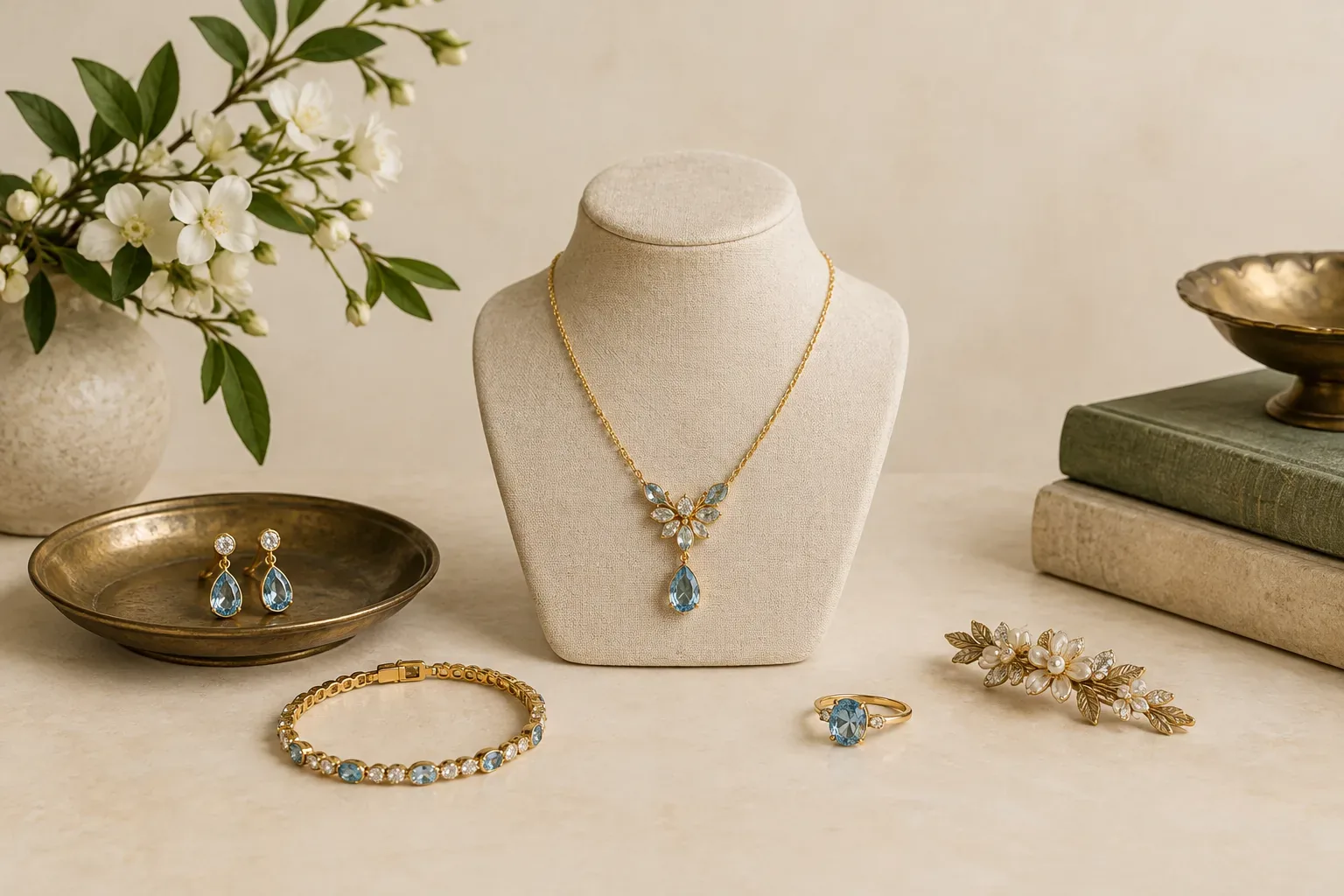
Motifs and traditions show up in modern jewellery through design language and the types of pieces people wear. Lockets and pendant keepsakes echo the nineteenth-century sentimental pieces documented by museums, translated into lightweight modern styles that hold small photos or charms. Pearls and simple gemstone studs appear as subdued, classic choices that reference long-standing use for formal occasions. Floral motifs, leaves and wreath shapes appear in brooches, hairpins and necklaces and derive from both nature-inspired fashion trends and historical decorative motifs recorded in museum collections. Religious or ethnic symbols also appear in contemporary pieces, but the historic use and significance of those symbols can be specific to particular communities and periods; a museum source helps show that such symbols carried different weight in different places and times.
Practical guidance on proportion: scale and placement
Think of proportion as how a piece relates to your body, your outfit’s silhouette, and the event’s formality. For high necklines, favor drop earrings or a cuff; for low or strapless necklines, a statement necklace can be the focal point. If you choose a large necklace, keep earrings small to avoid competing focal points. For a long-sleeved formal gown, a noticeable bracelet or a brooch near the shoulder can add interest without overwhelming the look. The key is to create a single or clearly prioritized visual focus so your accessories complement rather than compete with both your outfit and the occasion.
Practical guidance on color: complement, contrast, and context
Color decisions should consider both your outfit and the wedding’s tone. If the wedding palette or the bridal party uses a dominant color, you can either complement it with harmonizing gemstones or provide a tasteful contrast to avoid a matchy-matchy look. Metallics are versatile: warm golds suit rich, warm fabrics while cool silvers or white gold look crisp with pastels and cool tones. If the bridal dress is traditionally white or ivory, many guests choose to avoid wearing an all-white head-to-toe ensemble; instead, use jewelry color to add contrast or subtle echo. Remember that color also carries cultural associations in some traditions, so when in doubt ask or observe what the hosts are wearing.
Practical guidance on focus: what to make the statement piece
Decide whether your statement will be a necklace, earrings, a brooch, a hairpiece, or a ring. For photos and movement, earrings are highly visible; necklaces define the décolletage area in portrait shots; and hair jewelry catches light in motion. For evening weddings, a single statement piece—such as a pair of chandelier earrings or a bold cuff—can read as intentional and elegant. If you are attending a religious or culturally specific ceremony, prioritize discretion and respect: avoid pieces that mimic ritual objects unless you have permission or personal connection to the practice.
Respectful selection and gifting guidance
If you plan to gift jewelry to the couple or bridal party, consider preferences, traditions and practicalities. Ask about metal allergies, typical dress codes and whether the recipient prefers subtle or standout pieces. For culturally significant symbols, ask a close family member if a particular motif is appropriate to gift. When buying gemstones or pearls, request written information about treatments, synthetics, or imitations; the Federal Trade Commission advises consumers to ask sellers for disclosure about treatments and for receipts that accurately describe materials. For budget-conscious gifting, choose well-made, timeless pieces rather than overtly trendy items so the gift has longevity and can be adapted to different outfits.
Final checklist before you leave home
Before you walk out the door, check proportion against your outfit in a mirror from head to waist to ensure balance, confirm that your chosen piece complements the wedding’s formality and color scheme, and make sure no item has a loud brand or slogan that could distract. If the ceremony or venue has cultural or religious expectations, err on the side of modesty and ask quietly if you are unsure. Keep back-up fasteners and a small repair kit for minor emergencies, and carry a small jewelry polishing cloth to remove fingerprints before photos.
Frequently asked questions
Can wedding guests wear pearls?
Yes. Pearls are a long-documented choice for formal events and appear throughout museum collections as status and formal-wear items, but wearing pearls as a guest is primarily a style decision. Consider the dress code and the bride’s preferences; avoid matching the bridal silhouette too closely if that would upstage the bride.
How do I choose the right scale of necklace for my dress?
Match the necklace to the neckline: for high necklines choose long or pendant styles, for plunging or strapless necklines choose a statement necklace that follows the shape of the décolletage, and if you choose a bold necklace keep earrings minimal so the overall look has one clear focal point.
Are there symbols I should avoid wearing to be respectful?
Avoid wearing religious or culturally significant ritual objects unless you know they are appropriate for you to wear. If you are unsure, ask a close family member or the hosts. Museum documentation shows such symbols often have specific ceremonial uses and meanings that vary by community.
What should I ask the seller when buying gemstone jewelry for a wedding?
Ask whether the stone has undergone any treatments, whether it is synthetic or an imitation, and for written confirmation of the materials. The Federal Trade Commission advises consumers to request clear disclosure about treatments and to keep receipts that accurately describe the piece.
Is it acceptable for a guest to wear a strong statement piece?
Yes, if it is tasteful and appropriate for the dress code. Aim for one strong statement piece rather than multiple competing ones, and choose colors and styles that complement rather than mimic the bridal look.
Sources and further reading
- Bedazzled: A History of Jewellery — Victoria and Albert Museum
- An A-Z of Gemstones — Victoria and Albert Museum
- Buying Gemstones, Diamonds, and Pearls — Federal Trade Commission