Meaning at a glance
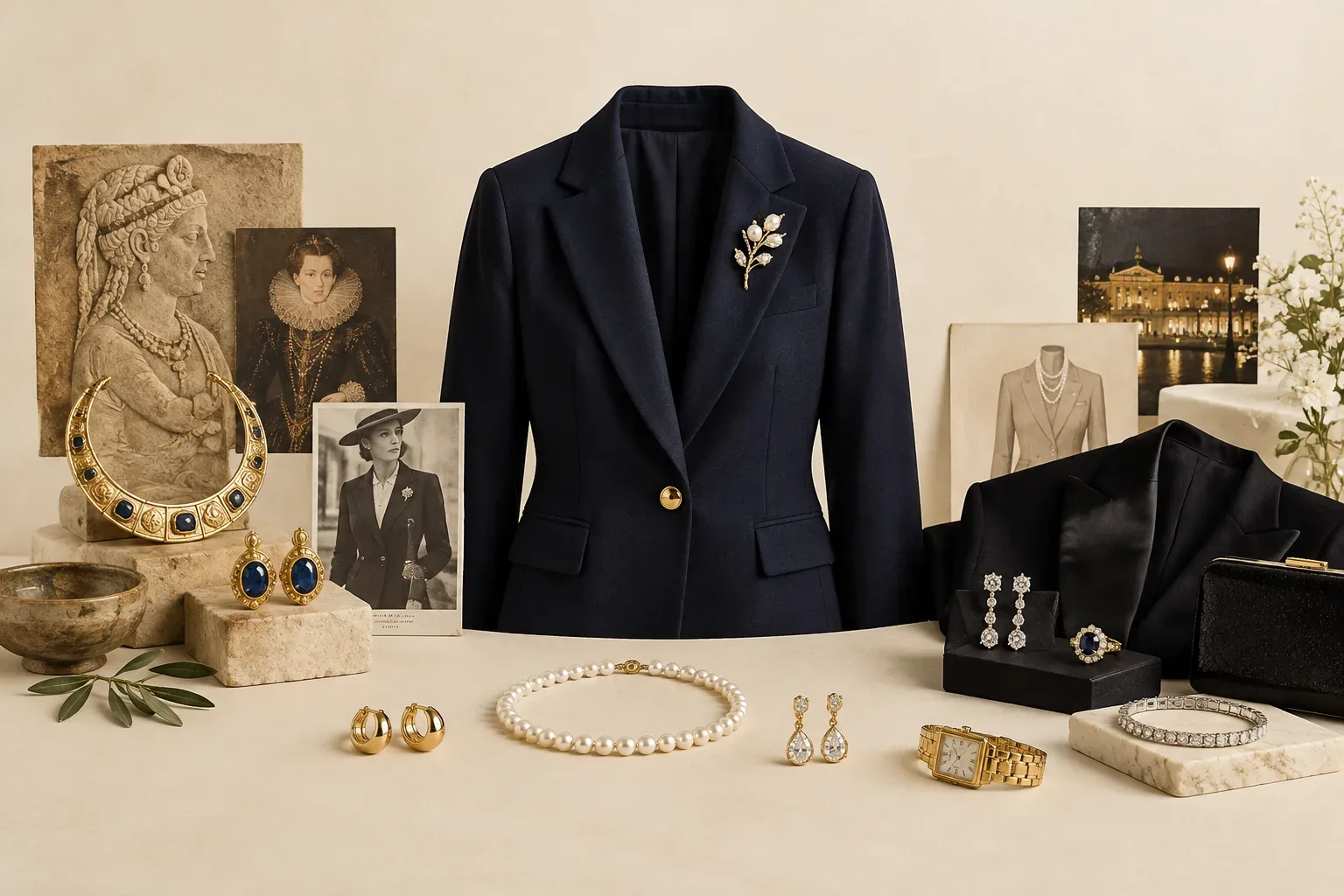
Start with restrained pieces that complement your blazer by day and add one or two bolder elements for evening: a statement brooch or longer necklace, change studs to drops, and consider detachable charms or lapel pins. This article explains the documented history of wearable fasteners and decorative jewelry, distinguishes historic meanings from modern personal interpretations, describes how motifs and gemstones appear in contemporary blazer jewelry, and gives selection and gifting guidance grounded in museum and consumer-protection sources.
What history tells us about wearing decorative fastenings and ornaments on jackets
The idea of decorating or fastening outer garments with jewelry has a long, documented history. Museums such as the Victoria and Albert Museum (V&A) trace how jewelry forms evolved in response to clothing technology and social custom. For example, brooches and pins were functional as well as decorative in Roman and Medieval Europe, used to fasten cloaks and garments; later they became also symbols of status and identity as textile construction changed, according to the V&A’s overview of jewellery history.
In the 18th and 19th centuries, as tailored jackets and tailored outerwear became part of civilian dress in Europe, small decorative items—such as buttons, cufflinks and stickpins—shifted between practical hardware and personal ornamentation. The V&A’s historical surveys show these changes were linked to broader shifts in manufacturing, trade, and social expectations about dress, not to a single universal meaning.
Separating documented historical meanings from modern interpretations
Documented historical meanings are what contemporary records or museum studies show people used a piece for or associated it with at the time. For instance, in several periods a brooch’s primary function was to fasten garments, and its value or decoration reflected wealth or rank; the V&A places these uses in specific social and technological contexts. That documented evidence does not automatically extend to modern uses.
Modern personal interpretations—such as wearing a lapel pin to signal a political stance, or choosing a gemstone for personal healing—are contemporary practices that may draw inspiration from history but are not the same as historical meaning. When styling a blazer for day to night, treat historic symbolism as background context rather than an authoritative guide to personal expression. Be especially careful when adopting motifs that have clear cultural or religious significance in defined communities; those meanings belong to those communities and should be respected.
How motifs, gemstones, and traditions appear in blazer jewelry today
The historical forms—pins, brooches, cufflinks, chains and studs—have direct descendants in contemporary blazer jewelry. Lapel pins and brooches are the modern equivalents of earlier fastening tools, now designed primarily for decoration. Cufflinks descend from historic shirt fasteners and are often used to add a polished touch when a blazer exposes the shirt cuff.
Gemstones and materials continue to signal different aesthetics. The V&A’s A–Z of gemstones offers context for how particular stones have been valued and used across periods: pearls are classically associated with refined formality, while garnet, onyx and opaque stones have been used for contrast and silhouette definition. Contemporary designers also use mixed metals and simulated stones; when evaluating materials remember the Federal Trade Commission’s guidance that sellers must disclose treatments and imitations so consumers can make informed choices.
Practical day-to-night styling changes that work
Start with a daytime baseline: small stud earrings or minimal hoops, a simple short necklace or none at all if the blazer’s collar is high, a modest brooch or none, and neutral cufflinks or watch. Keep scale and shine moderate so jewelry complements the blazer’s tailoring and professional context.
For evening, introduce one focal point rather than several competing accents. Change stud earrings to medium-length drops to add movement and draw attention upward; swap a short chain for a longer pendant that sits against an evening top; or add a statement brooch to the lapel or the blazer’s shoulder. A visible brooch close to the collar transforms the blazer into a styled outerwear piece without needing a full outfit change.
If you prefer subtlety, use detachable elements: convert an everyday stud into a drop with an enhancer, add a removable lapel chain that hooks into a buttonhole, or use a detachable charm on a bracelet. Detachable options keep daytime looks understated while allowing quick evening updates.
Consider proportions. A narrow lapel suits a small brooch or pin; a wider peak lapel can carry a larger, more sculptural brooch. Fabric matters: delicate silks or lightweight blazers favor lighter jewelry to avoid distortion, while heavy wool can take a denser piece without sagging.
Selection and respectful gifting guidance
Choose jewelry that respects the recipient’s style, cultural background and professional context. Ask about metal allergies and preferred metal tones, and keep in mind that not everyone wears religious or culturally specific motifs. If you are unsure whether a motif has specific cultural or religious significance, research first or choose a neutral decorative form such as geometric pins, simple pearl studs, or classic cufflinks.
When selecting gemstones, rely on reliable information about material quality and treatment. The Federal Trade Commission advises consumers to expect clear disclosure about gemstone treatments, synthetics and imitations. For a gift, include a note about care and any known treatments if provided by the seller, so the recipient understands the piece’s materials.
Size and fastening are important for blazers. Choose brooches and pins with a secure clasp that will not damage fine fabrics, or select a style designed for structured garments. For lighter fabrics, look for clips or pins with protective backings. For cufflinks, ensure the recipient wears shirts with French cuffs and prefers that accessory.
Think about versatility. A reversible or detachable brooch, studs that convert to drops, or a classic pair of pearls can all work for both office and evening. If you’re gifting across cultures, avoid assuming meanings and consider a card that explains your intention without asserting cultural authority.
Care and buyer protections
Treat blazer jewelry like any fine object: remove pieces before laundering or heavy movement, and store pins with protective backs to avoid catching. For gemstones and pearls, follow the material-specific care guidance summarized by museum sources such as the V&A, which emphasizes that different stones and organic materials require different handling.
When buying, confirm whether gemstones are natural, treated or lab-created, and whether metals are plated or solid. The Federal Trade Commission requires sellers to disclose treatments and imitations, which helps you assess value and expected longevity. Ask the seller about return policies and repair services, especially for pieces intended to be worn regularly on structured garments.
Final note
Jewelry for blazers is a practical lineage that runs from ancient functional fasteners to modern decorative pins and cufflinks. Use historical context to inform your choices but rely on contemporary fit, proportion and respect for cultural meanings when styling or gifting. A few thoughtful swaps—scale, length, or a single added statement—will reliably take a blazer from day to night without compromising the garment’s tailored line.
Frequently asked questions
What are the easiest jewelry swaps to take a blazer from day to night?
The least disruptive swaps are: change studs to medium drop earrings for movement, swap a short necklace for a longer pendant, and add a single statement brooch or lapel pin. Detachable or convertible pieces make these changes quick and reversible.
Can wearing certain jewelry on a blazer be culturally insensitive?
Yes. Some symbols and motifs have religious or community-specific meanings. If a motif might be culturally significant, research before wearing or gifting it. When in doubt, choose neutral decorative options or ask the wearer about their comfort and preferences.
How do I avoid damaging a delicate blazer when adding a brooch or pin?
Choose pins with secure clasps and protective backs, or use clips designed for lightweight fabrics. Alternatively, fasten a brooch to an accessory such as a scarf or a removable lapel pad rather than directly through fragile weave.
What should I ask a seller about gemstones or materials when buying jewelry for a blazer?
Ask whether stones are natural, treated, synthetic or simulated, whether metals are plated or solid, and about any care instructions. The Federal Trade Commission advises that sellers disclose treatments and imitations so you can make an informed purchase.
Are mixed metal looks acceptable with blazers?
Yes. Mixing metals is a contemporary styling approach that can add visual interest. To keep the look cohesive, repeat one accent metal in two places (for example, a gold brooch and gold-trimmed watch) and use a secondary metal in a smaller role.
Sources and further reading
- Bedazzled: A History of Jewellery — Victoria and Albert Museum
- An A-Z of Gemstones — Victoria and Albert Museum
- Buying Gemstones, Diamonds, and Pearls — Federal Trade Commission