Meaning at a glance
Documented histories show that wooden elements in jewelry have changed meaning and use across periods; this guide separates museum-documented context from later personal interpretations, explains how wood appears in jewelry, lists warning signs of damage, and gives practical guidance for choosing, maintaining, and when to seek professional repair.
Direct answer — what this guide explains
Wood jewelry repair and maintenance requires both respect for historical materials and attention to simple physical warning signs. This guide explains what museums document about wooden elements in jewelry, separates historical uses from later personal meanings, describes how wood appears with motifs and gemstones, and gives practical advice on selecting, caring for, and when to take wooden pieces to a professional conservator or jeweller.
Historical evidence and cultural contexts
The use of wood in personal ornament is ancient and varied; museum research catalogs these changing contexts rather than presenting a single, universal meaning. Collections and curatorial writing at the Victoria and Albert Museum discuss jewellery as a changing social practice across periods and places, noting that materials and motifs shift in social significance as fashions, technology, and trade routes change. Use of organic materials, including wood, appears in different regions and eras according to availability and technique rather than one symbolic meaning alone.
Because interpretations change over time, it is important to attribute what is documented to the relevant culture or period. For example, a carved wooden bead found in a specific archaeological context might indicate local craft traditions or trade in a particular historical period; in other cases, wooden components in Victorian-era sentimental jewellery reflect different tastes and technologies than preindustrial examples. The Victoria and Albert Museum frames such changes as part of ‘a history of jewellery’ where social context and manufacture determine meaning and use.
Documented historical meanings versus modern personal interpretations
Museum documentation tends to record how objects were made and used in their original contexts and how fashions and meanings changed afterward. The V&A emphasizes shifting social contexts rather than fixed symbolic readings. When a wooden motif or object has a recorded religious or cultural function, that link should be attributed to the specific place and time recorded in provenance or curatorial notes.
Modern wearers and makers often attach new, personal meanings to wooden jewelry—environmental symbolism, statements about sustainability, or aesthetic nostalgia—that are contemporary interpretations rather than continuations of historical belief. Those modern meanings are valid for the wearer but should not be presented as the original historical meaning unless evidence ties them together. Separate the documented, source-attributed history from later personal symbolism when describing any piece.
How wood appears in jewelry: motifs, settings, and combinations
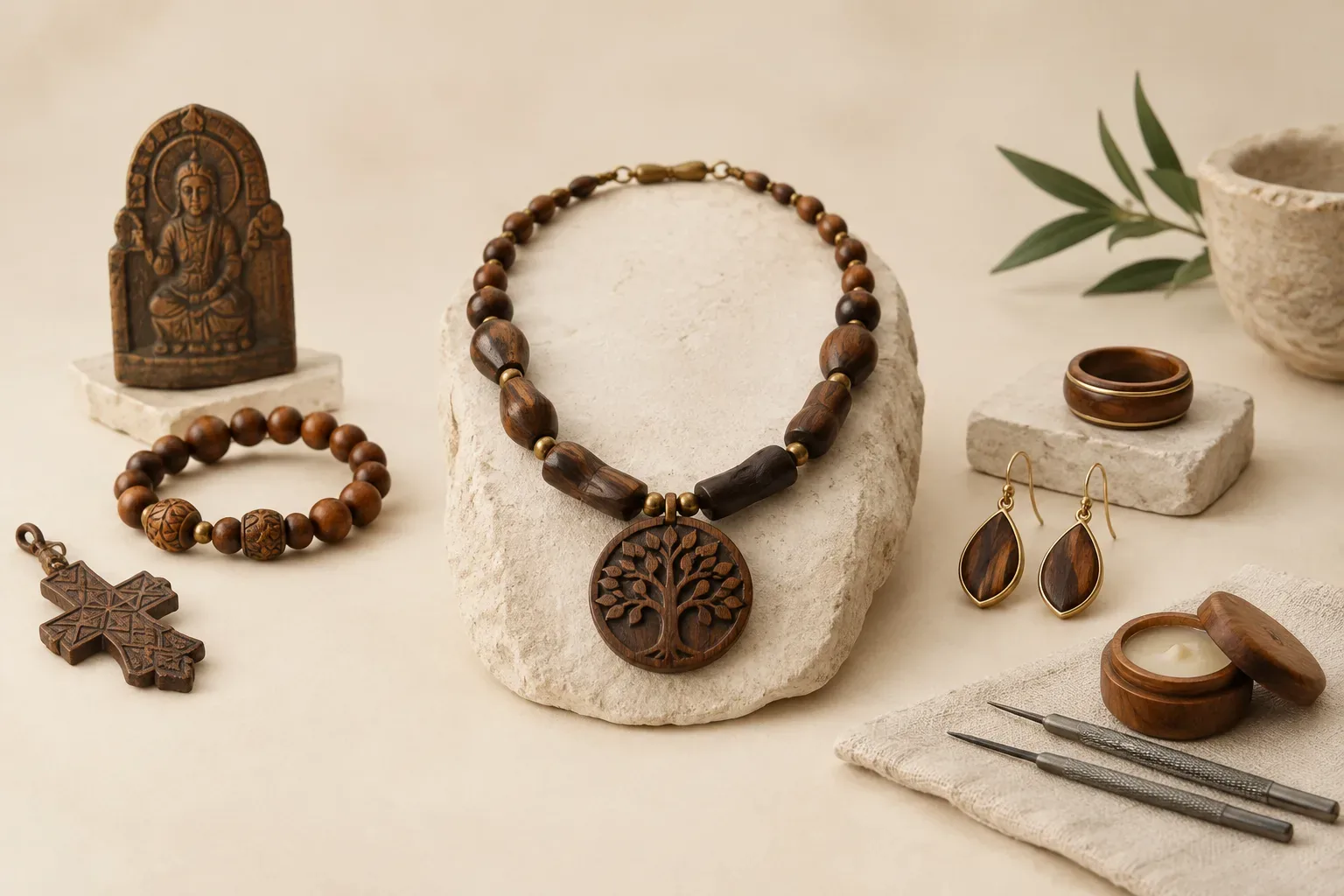
Wood enters jewelry in several technical and stylistic ways: as carved beads or pendants, as inlaid panels set into metal, as frames for miniature paintings or photographs, and as components treated with varnish, resin, or stabilizing materials to increase durability. Museums catalogue these variations to show how makers integrated available materials with prevailing fashions.
Wood is also combined with gemstones, glass, metal, and organic accents to produce contrast in color, texture, and weight. Curatorial treatments (noted in museum collections) highlight that wooden elements are often chosen for their tonal warmth and carved detail; they may be mounted in metal settings or paired with gemstones to create a mixed-material effect rather than to convey a single symbolic message.
Warning signs that a wooden jewelry piece needs attention
Look for physical signs before wearing a treasured wooden piece. Visible splitting or surface cracks that run along the grain, loose or missing inlays, and joints loosening where wood meets metal are clear indicators of structural issues. Significant change in shape, warping, or edges that feel soft or crumbly suggests moisture damage or material breakdown.
Other warning signs include flaking or peeling of finishes, unusual odors that could indicate mold or previous pest activity, and discoloration that appears suddenly or unevenly. If a wooden component is glued into a setting and feels loose or rattles, the bond may have failed and the piece requires repair. For pieces that include a resin glaze or stabilizer, look for yellowing, cloudiness, or separation between layers.
Basic maintenance principles (safe and conservative)
Conservative, minimal-intervention care is the safest approach for wooden jewelry. Keep pieces away from prolonged humidity, direct sunlight, and extreme temperature changes to reduce warping and finish degradation. Store wooden pieces separately from hard metals and stones to prevent knocks and abrasions; a soft pouch or lined compartment protects surfaces.
Clean gently with a soft, dry cloth. Avoid soaking wooden components or using household solvents and abrasive cleaners. If a finish appears dull, do not apply oils or polishes without understanding the original surface treatment; some finishes and stabilizers can react poorly to household products. When in doubt, consult a professional conservator or jeweller with experience in organic materials.
When to seek professional repair and how to choose help
Seek professional help if structural integrity is compromised, if pieces include valuable gemstones or metal mountings at risk from amateur repair, or if the surface finish requires treatment beyond gentle cleaning. A conservator with experience in wood and mixed-media objects is preferable for historically important pieces; a skilled jeweller may be appropriate for contemporary wearable items that need secure re-setting or simple stabilization.
Ask any prospective repairer about their experience with wooden jewelry and mixed materials. If a piece is of historical provenance, mention this up front and ask whether the repair will be reversible and documented. For consumer protection regarding disclosure of treatments and imitations, guidance from the U.S. Federal Trade Commission underscores that sellers and professionals should disclose material treatments, so request written information about any adhesives, stabilizers, or surface treatments used during repair.
Practical selection and gifting guidance
When choosing wooden jewelry as a gift, consider the recipient’s lifestyle and whether they will value and care for a delicate organic material. For daily wearers who wash their hands frequently or work in variable conditions, opt for pieces that are explicitly described as stabilized or sealed for wear rather than untreated carved wood. If the item is historic or potentially collectible, verify provenance and condition before gifting.
Respect cultural specificity when selecting motifs. If a wooden motif or form is tied to a particular cultural or religious tradition in museum records, learn and acknowledge that context when presenting the gift. For a personal symbolic gift, explain your contemporary interpretation while clarifying it is a modern view rather than a claim about historical meaning. For guidance on selecting meaningful jewelry more broadly, see our related gift guide and resources on researching jewelry symbols.
Record-keeping and long-term care
Keep documentation about provenance, previous repairs, and any treatment materials used. Written records are valuable for future conservators and add to the object’s value and history. Photograph the piece clearly before and after any repair and retain receipts and written descriptions of materials used in restoration.
For long-term storage, control humidity where possible and avoid plastic containers that trap moisture. If pest activity is suspected, isolate the piece and consult a professional rather than attempting home fumigation methods.
Final considerations
Wooden jewelry sits at the intersection of craft, material vulnerability, and personal meaning. Museums such as the Victoria and Albert Museum contextualize these objects within changing social histories rather than fixed symbolic systems. Treat wooden pieces conservatively, separate documented historical meanings from modern personal interpretations, and consult qualified professionals for structural or material repairs.
Frequently asked questions
How can I tell if my wooden jewelry needs professional repair?
If you see splitting, loose inlays, warping, a rattling component, flaking finishes, sudden discoloration, or suspect pest or mold activity, stop wearing the item and seek professional advice. These signs indicate structural or material failure that may worsen with continued wear.
Can I clean wooden jewelry with water or household cleaners?
Avoid soaking wooden jewelry or using household solvents and abrasives. Gently wipe with a soft, dry cloth. If cleaning beyond that seems necessary, consult a conservator or experienced jeweller to avoid damaging finishes or treatments.
Is it okay to oil wooden jewelry to restore shine?
Do not apply oils or polishes without knowing the original finish; some finishes react badly to oils. For contemporary pieces explicitly marketed as oiled, follow the maker’s instructions. For historic or uncertain items, ask a conservator.
Who should I contact to repair a valuable or historic wooden piece?
For historically significant pieces, seek a conservator with experience in wood and mixed-media objects. For contemporary wearables that need secure resetting or simple stabilization, a reputable jeweller experienced with organic materials may be appropriate. Always ask about reversibility and documentation of the repair.
Do repairers have to disclose treatments or materials they use?
Yes. For consumer protection and informed provenance, request written disclosure of any adhesives, stabilizers, or surface treatments used. Guidance from the Federal Trade Commission emphasizes disclosure of treatments and material modifications.
Sources and further reading
- Bedazzled: A History of Jewellery — Victoria and Albert Museum
- An A-Z of Gemstones — Victoria and Albert Museum
- Buying Gemstones, Diamonds, and Pearls — Federal Trade Commission