Meaning at a glance
This guide explains the documented history and changing contexts of leather in jewelry, separates historical evidence from modern personal meanings, describes how leather and associated motifs appear in jewelry, and provides practical maintenance, warning signs, and advice on when to seek professional repair.
What the historical record shows
Museum research shows that jewellery materials and their meanings have changed over time and across societies, and that organic materials — including leather, textile, and plant fibres — have long been part of personal adornment. The Victoria and Albert Museum frames jewelry as a changing set of social practices and materials rather than fixed universal meanings, noting that materials are chosen for practical, economic and symbolic reasons in different periods.
Evidence cited by the Victoria and Albert Museum indicates that corded and strung elements — where leather or other organic threads have been used to carry beads, pendants, and amulets — appear in multiple historical contexts as a practical solution for assembling ornaments and as part of worn ensembles. The museum’s general treatments of jewellery history and gemstones emphasize shifting styles and techniques rather than a single, consistent meaning for a material such as leather.
Documented historical meanings versus modern interpretations
Documented meanings in museum scholarship tend to be context-specific: a material may be recorded as practical, prestigious, functional, or symbolic in a particular culture and period. The Victoria and Albert Museum’s overview of jewellery history stresses that a material’s social meaning changes with context, so leather may have been valued in one society for durability or available local resources and in another for humility or craft traditions.
Modern interpretations that attribute a single universal symbolism to leather jewellery — for example, that leather always signifies ruggedness, rebellion, or spirituality — are personal or popular readings rather than consistent historical facts. Those contemporary meanings are valid as personal expression but should be distinguished from documented cultural or religious practices in any specific place or era. When discussing a piece’s history or symbolism, rely on provenance and documented sources rather than generalizations.
How leather appears in jewellery: motifs, settings, and combinations
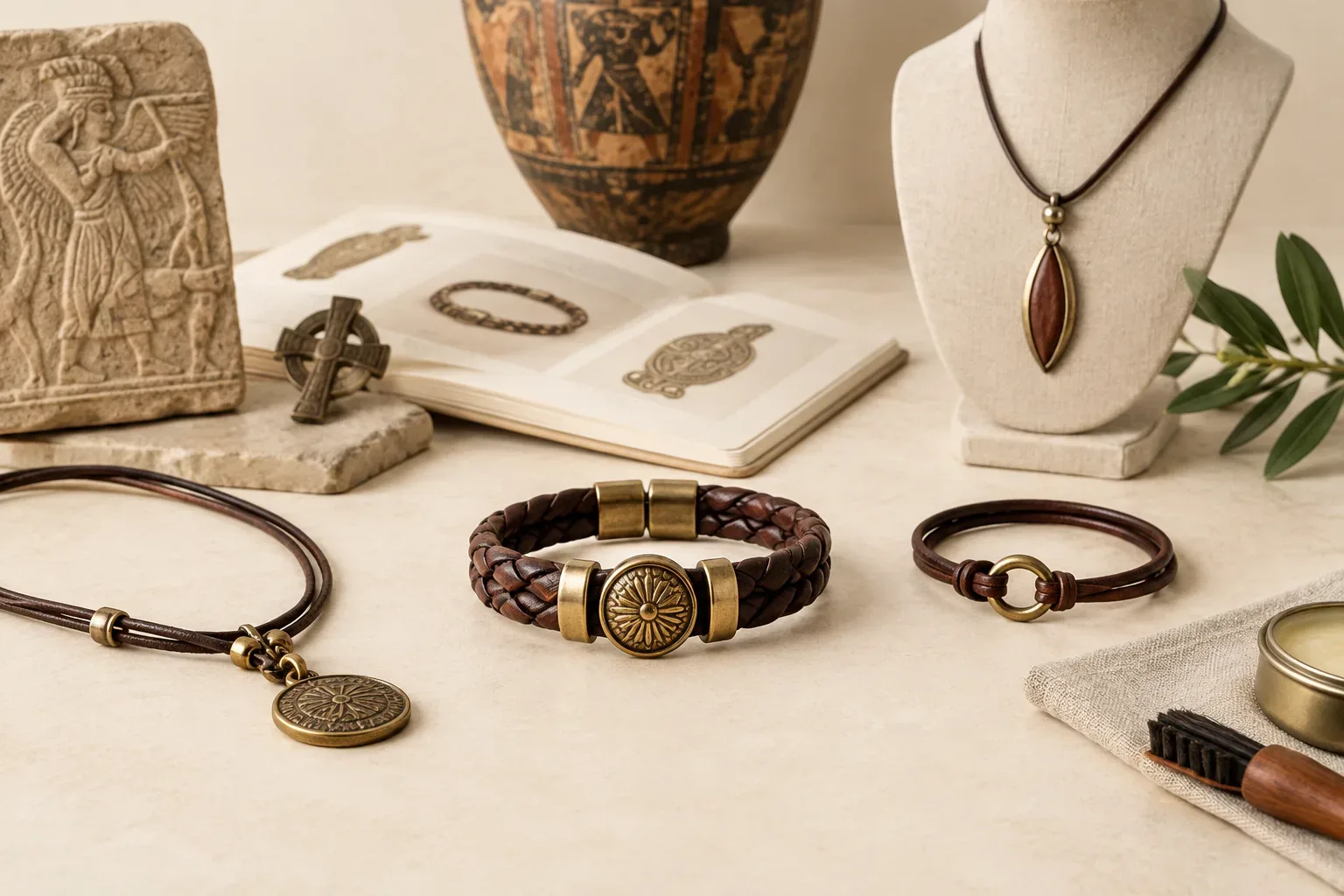
Leather shows up in jewellery in several practical and aesthetic roles: as cording for beads, straps for cuffs and bracelets, braids and knots as visible motifs, and as the backing or bezel for pendants and watch straps. Leather jewellery often integrates metal fastenings, clasps, and decorative elements, and is frequently combined with gemstone beads and metal findings to create mixed-material pieces.
Gemstones and beads threaded on leather cords are a long-standing technique; the Victoria and Albert Museum’s reference on gemstones explains how beads and small stones have been used in strings and settings, and how materials and techniques evolve. In contemporary designs leather may be dyed, stamped, braided, or edged with metal to create specific looks, while traditional pieces may emphasise simple hand-braided or tied forms.
Warning signs that a leather piece needs professional repair
Minor surface wear and patina are normal on leather; however, several signs indicate the need for professional attention. Deep splitting or cracking across the leather’s grain, persistent stiffness that does not respond to conditioning, and open seams or detached layers are structural failures that at-home fixes cannot reliably restore.
Other warning signs include metal findings that have torn through the leather, clasps or crimps that are bent or broken, mold or a strong musty odour that persists after cleaning, and any jewellery where stones, beads, or settings have become loose because of stretched or damaged holes. If the piece has significant sentimental or monetary value, or if a repair could alter its historic integrity, consult a professional conservator or experienced leatherworker.
When to choose a jeweler versus a leather specialist
If the primary problem is metalwork — a broken clasp, reset bezel, or a metal finding that needs replacement — a jeweler with experience in mixed-media pieces is usually the right choice. For issues involving stitching, lining, reconditioning, or dyeing of leather components, a leatherworker or a conservator trained in leather may be better equipped.
For heirloom or museum-quality jewellery that combines leather with historic settings or gemstones, seek a conservator or a professional recommended by a museum or specialist institution. When gemstones are involved, follow best-practice consumer guidance about treatments and disclosure: the U.S. Federal Trade Commission advises that sellers and repairers disclose treatments, imitations, and any alterations that affect value or identification.
Practical at-home maintenance to prolong leather jewellery life
Routine care keeps leather jewellery wearable for longer. Store leather items away from direct sunlight and extreme humidity, ideally flat or on a soft form to avoid kinks. Wipe dry surface dirt with a soft, slightly damp cloth; avoid soaking leather and never use household solvents. For conditioned smoothing, use a small amount of a pH-balanced leather conditioner on clean, dry leather, testing on an inconspicuous area first to check for dye transfer.
Avoid submerging leather jewellery in water, and remove pieces before swimming or showering. Keep leather away from perfumes, sunscreens, and chlorinated water that can stain, bleach, or stiffen the material. For beaded leather pieces, check knot integrity and bead holes periodically and re-knot or re-string before significant wear develops.
Simple at-home repairs and when to stop
Small issues you can attempt at home include re-knotting loose ends on beaded cords, replacing a worn but intact clasp with a similar closure, and applying a conditioner to dry but uncracked leather. Use tools designed for jewellery work — small pliers, crimp tubes, and thread clamps — and select materials that match the original in flexibility and thickness.
Stop and seek help when repair requires re-stitching through thin or split leather, when dyeing or colour-matching is needed, when metal parts are corroded into the leather, or when gemstones are loose within settings. Improper stitching, adhesive use, or heat application can further damage a fragile piece and lower its aesthetic or historical value.
Choosing and gifting leather jewellery respectfully
When selecting leather jewellery as a gift, consider the recipient’s style, any metal allergies, and the expected use. Leather is a tactile material that develops a patina, so choose a finish and thickness suited to the wearer’s lifestyle: thin, flexible cords and beaded styles suit casual wear, while thicker, lined cuffs fit sturdier, everyday uses.
Be culturally respectful when gifting pieces that reference traditional motifs. If a design is inspired by a particular culture’s jewellery, seek information about provenance and consider supporting artisans from that culture. If the piece incorporates gemstones or treated materials, check disclosure practices in line with the Federal Trade Commission’s guidance so the recipient understands any treatments, imitations, or restorations.
How to find and assess a professional repairer
Look for professionals with demonstrable experience in leather or mixed-material jewellery repair and ask for before-and-after examples. For pieces with gemstones or potential historical value, a conservator or jeweler who lists relevant qualifications and who follows industry-standard documentation practices is preferable. Ask how they will approach the repair, whether they will use reversible techniques, and whether they will document changes for provenance or insurance purposes.
Obtain an estimate and written agreement about what will be repaired, the materials to be used, and any guarantees. For significant restorations, request photographs and a condition report. Reputable repairers should be able to explain the trade-offs between restoring functionality and preserving original materials.
Closing: balancing care, meaning, and longevity
Leather jewellery combines a long material history with contemporary personal meanings. Museum scholarship reminds us that materials acquire different social meanings in different times and places, and modern wearers are free to create personal significance while respecting documented histories and cultural provenance. Careful maintenance and timely professional help preserve both the physical piece and its story.
Frequently asked questions
How often should I condition leather jewelry?
Condition small leather pieces sparingly — typically every three to six months if worn frequently, less often for occasional pieces. Always test any conditioner on an inconspicuous area and follow product instructions to avoid darkening or dye transfer.
Can I clean leather jewelry with soap and water?
Avoid soaking leather. Use a soft, slightly damp cloth to wipe surface dirt. Mild saddle soap formulated for leather can be used carefully on tougher grime, followed by a pH-balanced conditioner, but do not saturate the material.
Is it safe to wear leather jewelry in the rain or while swimming?
Prolonged exposure to water can stain, stretch, or stiffen leather. Remove leather jewelry before swimming, bathing, or heavy rain. If the piece becomes wet, let it air-dry naturally away from heat sources and condition lightly when dry.
When should I consult a professional for repairs?
Seek professional help for deep cracks, split layers, corroded metalwork embedded in leather, persistent mold, or when a repair could affect the piece’s historical or monetary value. For complex mixed-media work, consult a jeweler familiar with leather or a conservator.
How can I find a reputable repairer?
Ask for referrals, see before-and-after work samples, request a written estimate and condition report, and verify that the repairer will document any non-reversible changes. For valuable or historic pieces, prefer conservators or specialists recommended by reputable institutions.
Will conditioning change the colour or finish of my leather jewellery?
Conditioning can darken or slightly alter the sheen of some leathers. Always test on an unobtrusive area first and choose a conditioner appropriate for the leather type to reduce the risk of visible change.
Sources and further reading
- Bedazzled: A History of Jewellery — Victoria and Albert Museum
- An A-Z of Gemstones — Victoria and Albert Museum
- Buying Gemstones, Diamonds, and Pearls — Federal Trade Commission